

Live-Portrait ✓
Animate portraits with video-driven facial movements.
from $0.0001
Verdict
A quick read before you dig into the full page.
- Best if
- Animate portraits with video-driven facial movements
- Skip if
- Limited to portrait animation
- Pick this when
- Animates portraits with video input
Considering Krikey AI instead? Compare side by side
Overview
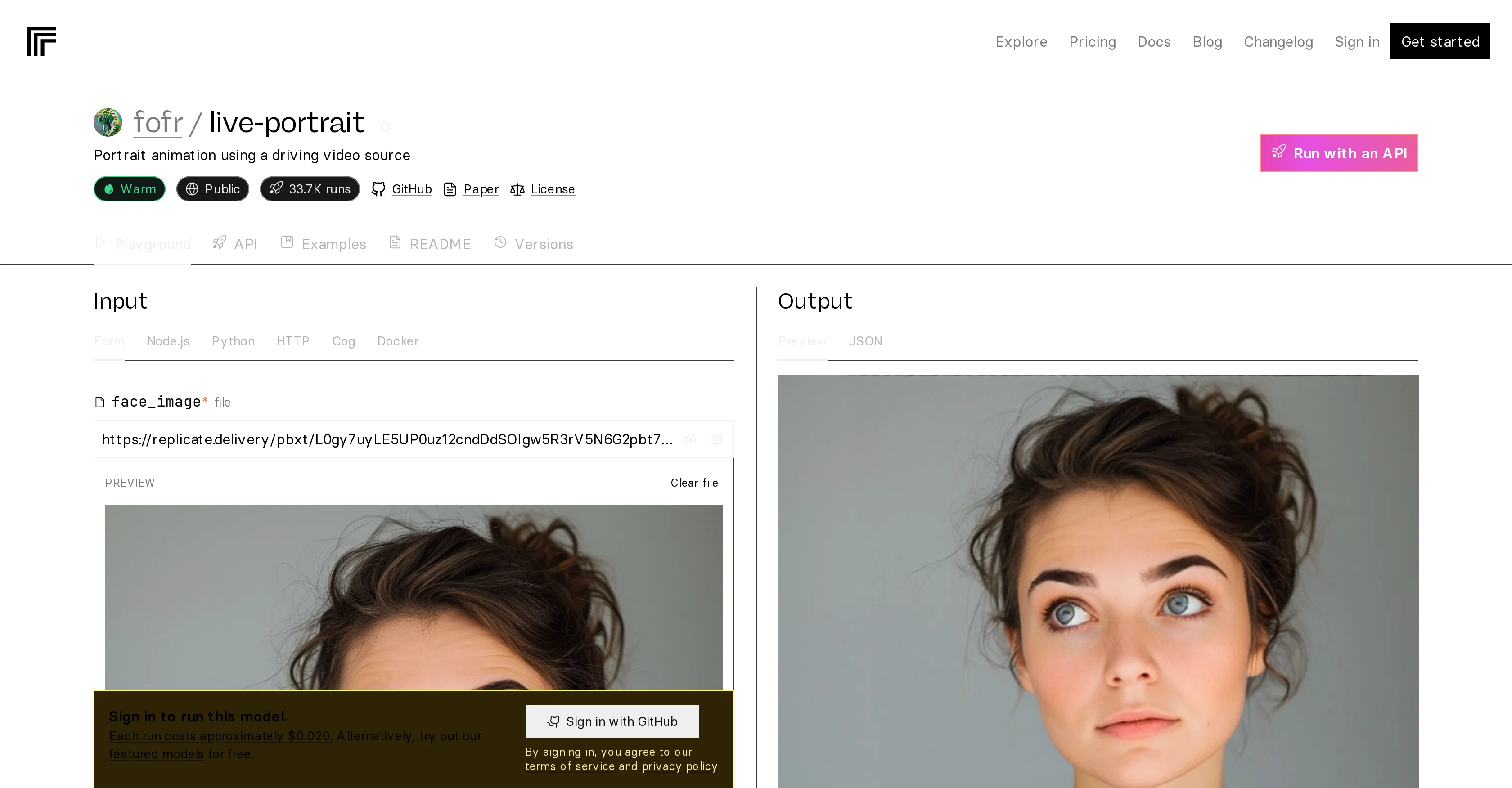
The fofr/live-portrait is an AI model that enables portrait animation by leveraging a driving video source. The main functionality is to generate animated portraits given input images.
This happens on the platform Replicate and the API enables integration with other applications. With an open-source provision, users also have the option of running the model on their local systems with Docker.
The model, which operates on Nvidia A40 (Large) GPU hardware, varies prediction times based on the given inputs. As part of the functionality, LivePortrait uses InsightFace buffalo_l models, thus its usage in commercial applications is restricted.
Additionally, the LivePortrait code and weights are released under the MIT license. The model utilises the ComfyUI custom node that was created by Kijai and the safetensor weights they converted.
There is considerable support with documentation and available examples to assist users in understanding how to use the model. This can be especially helpful while exploring various applications of portrait animation, from digital art creation to virtual avatar design.
Access & connections
Where you can use Live-Portrait, and what it plugs into.
Platforms
Integrations
Capabilities
What this tool accepts, produces, and is strongest at.
Input
- API
- Video
Output
- Video
- API
Pros & cons
Pros
- Animates portraits with video input
- Integration ability with API
- Runs on Replicate platform
- Option for local system execution
- Compatible with Docker
- Operates on Nvidia GPU
- Open-source provision
- MIT license
Show 15 more
- InsightFace buffalo_l model usage
- Custom ComfyUI node
- Assistance with documentation
- Availability of application examples
- Potential for digital art creation
- Avatar design capabilities
- Adaptable prediction times
- Cost transparency
- Option for public runs
- Support for various input/output
- Detailed README
- Retargeting control in animation
- Links to example driving videos
- Links to GitHub and paper
- Restriction for commercial applications
Cons
- Commercial use restricted
- Runs on Nvidia A40 GPU only
- Variable prediction times
- Requires Docker for local execution
- Relies on InsightFace buffalo_l models
- Requires ComfyUI custom node
- Depends on safetensor weights
- Limited to portrait animation
Show 2 more
- MIT License restrictions
- Usage bound to Replicate platform
Compare alternatives
Similar tools in the catalog — with a clear reason to open each one.

Krikey AI ✓
FreemiumCreated animated characters for developers.
Why look Freemium alternative
Full comparison
Janus ✓
Free TrialBecome any character instantly with your webcam.
Free + from $4.99/mo
Full comparison
Nero Face Animation ✓
FreemiumAnimate photos with vivid facial emotions for free
Why look Freemium alternative
Full comparison
Vidnix | AI Text to Video Generator ✓
Free TrialAll-in-one AI video and image generation platform
Why look Stronger for image work
Full comparison

Releases 1
FAQ 12
What is the primary functionality of the LivePortrait AI model?
How does LivePortrait use a driving video source to animate portraits?
What platform does the LivePortrait operate on?
Is there an API for integrating LivePortrait with other applications?
Is it possible to run the LivePortrait model on my local system?
What hardware does LivePortrait operate on?
How do input variations affect the prediction times of the LivePortrait?
Why is the usage of LivePortrait in commercial applications restricted?
Under what license are the LivePortrait code and weights released?
What is the ComfyUI custom node and how does LivePortrait utilize it?
Who converted the safetensor weights the model uses and why?
What is the role of the safetensor weights in the LivePortrait's performance?
Related tools
Recommended

LearningStudioAI ✓
Free TrialAI-powered authoring tool for effortless online course creation.

VideoDubber ✓
FreemiumTranslate and dub videos, audios and subtitles with voice cloning and lipsync

Deepmotion ✓
Freemium3D animations

geni by MemoryLane ✓
FreemiumGeni Make your aging parents' smartphones accessible and fun touse

MimicPC ✓
FreemiumInstantly run AI apps in your browser, no setup required.

Deep NostalgiaAi ✓
PaidBring old family photos to life with AI videos.