

Kestrel AI ✓
AI agents resolve cloud incidents in seconds.
Trial; then from $300/mo
Verdict
A quick read before you dig into the full page.
- Best if
- AI agents resolve cloud incidents in seconds
- Skip if
- Limited to Kubernetes environments
- Pick this when
- Detects cloud incidents
Considering Upwind.io instead? Compare side by side
Overview
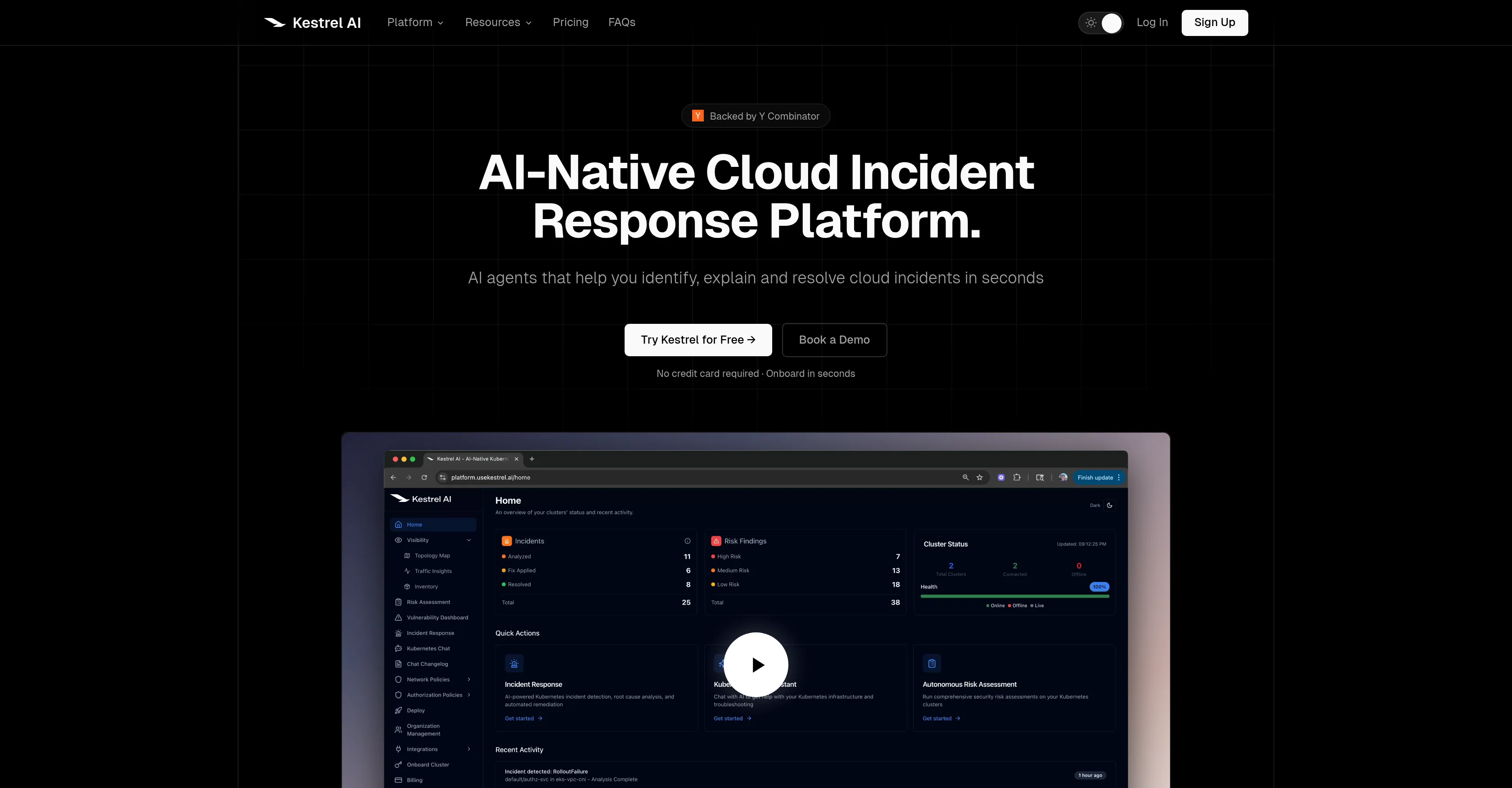
Kestrel AI is an AI-Native Cloud Incident Response Platform designed to detect, investigate, and fix Cloud and Kubernetes incidents swiftly. It connects with your clouds, Kubernetes clusters, observability tools, and code, fixing cloud infrastructure and application issues automatically through cloud APIs, Infrastructures as Code (IaC), and GitOps.Kestrel AI can monitor Cloud round the clock to spot incidents, trace their root causes, and generate immediate fixes either through auto-remediation or single-click approval.
It employs AI Chat Copilot feature, where cloud questions can be asked and complex multi-dependency incidents can be probed in plain English. This chat feature provides instant answers and ready-to-apply fixes.
The platform integrates with your existing CI/CD pipelines, converting every AI-generated fix into a pull request. This keeps your team in full control.
With this, teams are enabled to manage complex infrastructure and application issues such as CoreDNS resolution failures, HTTP 5xx spikes, Kubernetes, VPC routing conflicts, and Kafka broker issues in the cloud.
Kestrel AI system even learns from each incident, improving its performance over time, and offers a complete overview of your entire Cloud infrastructure.
It can detect and compute precise fixes to intricate infrastructure and application failure patterns before they cause a complete production outage. The Risk Assessment function deploys AI agents to identify cross-domain security risks and provides exact remediation steps, helping to avert potential incidents.
Access & connections
Where you can use Kestrel AI, and what it plugs into.
Platforms
Integrations
Capabilities
What this tool accepts, produces, and is strongest at.
Input
- API
- Tabular
Output
- API
- Text
Highlights
- Agents
- API
- MCP
Supported features
- Agents
- API
- Assistant
- Automation
- CLI
- Cybersecurity
- Data Analysis
- Integrations
- MCP
- Memory
Show 1 more
- SOC 2 Compliance
Pros & cons
Pros
- Detects cloud incidents
- Investigates cloud incidents
- Fixes cloud incidents
- Automates through cloud APIs
- Uses Infrastructures as Code
- Employs GitOps
- Constant cloud monitoring
- Root cause analysis
Show 33 more
- Auto-remediation capability
- Single-click approval for fixes
- Plain English interaction
- Seamless CI/CD pipeline integration
- Team retains full control
- Manages complex infrastructure issues
- Handles application issues
- Learns from each incident
- Improves performance over time
- Offers cloud infrastructure overview
- Predicts infrastructure failure patterns
- Prevents production outage
- Identifies cross-domain security risks
- Calculates exact remediation steps
- Resolves incidents swiftly
- Comprehensive Cloud Infrastructure Map
- Visualizes real-time traffic
- Fast Setup
- 24/7 cloud monitoring
- Real-time Incident Response
- IAC and GitOps Integration
- Instant ready-to-apply fixes
- Autonomous Risk Assessment
- Precise config fixes
- Cloud Infrastructure Visualization
- Real-Time Traffic monitoring
- Direct Deployment of changes
- Interactive Config Review
- GitOps Integration
- Multi-cloud Support
- Automated Deployment
- End-to-End Incident Management
- Enterprise-Grade Security
Cons
- No Multi-Language Support
- Limited Cloud Providers Compatibility
- No Standalone Application
- Dependent on GitOps
- No Offline Functionality
- Limited to Kubernetes environments
- Auto-remediation Needs Explicit Approval
- No Cross-Platform Training
Compare alternatives
Similar tools in the catalog.


Wiz.io ✓
UnknownUnified cloud security platform with prevention and response capabilities.
No pricing
Full comparison

Stream Security ✓
UnknownReal-time security against machine-speed attacks.
No pricing
Full comparison

Releases 1
FAQ 12
What is Kestrel AI and how does it work?
What is the AI Chat Copilot feature in Kestrel AI?
How does Kestrel AI integrate with my existing CI/CD pipelines?
How does Kestrel AI detect and remediate cloud and Kubernetes incidents?
What is the Auto-Remediation feature offered by Kestrel AI?
How does Kestrel AI perform root cause analysis?
What type of issues Kestrel AI can handle in my cloud infrastructure?
How does Kestrel AI monitor Cloud round the clock?
What is single-click approval in Kestrel AI?
What are the key features of Kestrel AI in managing infrastructure failure patterns?
How does Kestrel AI's Risk Assessment function work?
How can Kestrel AI prevent a potential production outage?
Related tools
Recommended
ZeroThreat.ai ✓
FreemiumFastest AI-Powered AppSec & Automated Pentesting Platform

GroundPound AI ✓
FreemiumA coordinated team of agents that runs your business.

OpenVox ✓
FreemiumRun AI voices locally on your Mac, iPad and Windows.

Smarsh ✓
UnknownManage risk in electronic communications.

iGPT ✓
FreemiumTurn email into actionable data.

Analytify - A GenBI Platform ✓
Free TrialAI-powered analytics that unlock smarter business insights.