

Honeycomb ✓
Observability for the AI era
Free + from $130/mo
Verdict
A quick read before you dig into the full page.
- Best if
- Observability for the AI era
- Skip if
- Potentially complex setup
- Pick this when
- Swift query speed
Considering Traccia instead? Compare side by side
Overview
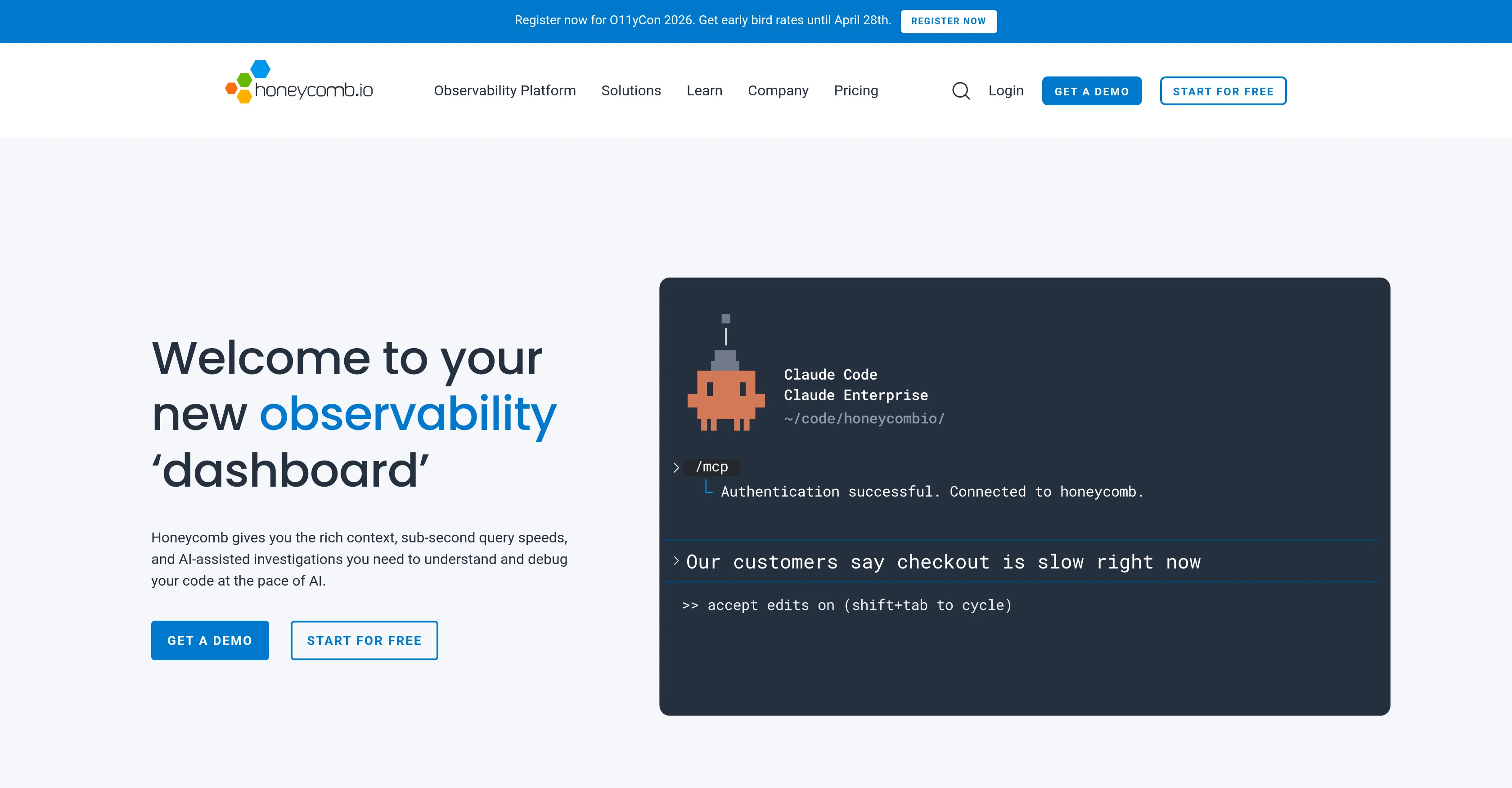
Honeycomb is an observability platform engineered for AI-driven software. Recognised for its swift query speed, unified telemetry, and Low Latency Microservices (LLM) observability, the platform sees use in companies such as Slack, Intercom, and Dropbox.
The purpose-built, columnar data store at the heart of Honeycomb's platform allows for the tracing of distributed systems, debugging of LLM behavior, and swift transition from alert to answer to tackle complex engineering challenges.
It integrates seamlessly into existing tech stacks, accommodating over 60 tools across the software development lifecycle. It offers AI-powered observability through Honeycomb Intelligence enriching every engineer with expert insights for instant investigations.
Honeycomb's platform encourages investigations and insights by providing dynamic, explorable visualizations and incredibly fast results from their query engine.
The Honeycomb platform also boasts AI agent integrations and OpenTelemetry compatibility. This comprehensive platform allows users to define strategies for telemetry data that control costs and yield quicker troubleshooting and deeper insights.
Its scale is engineered to process the complex, voluminous telemetry of contemporary software systems. Observability data can be accessed directly with your AI agent Integrated Development Environment via Honeycomb MCP to maintain a streamlined investigative process.
Furthermore, Honeycomb promotes Service Level Objective (SLO) based monitoring that assists in detecting and investigating anomalies in AI systems.
Access & connections
Where you can use Honeycomb, and what it plugs into.
Platforms
Capabilities
What this tool accepts, produces, and is strongest at.
Input
- API
- Tabular
Output
- Tabular
- API
Pros & cons
Pros
- Swift query speed
- Unified telemetry
- Low Latency Microservices observability
- Columnar data store
- Distributed systems tracing
- Debugging of LLM behavior
- Quick alert to answer transition
- Tech stack integrations
Show 24 more
- Over 60 tool accommodations
- Honeycomb Intelligence for instant investigations
- Dynamic, explorable visualizations
- Fast query results
- OpenTelemetry compatibility
- Telemetry data cost control
- Quick troubleshooting strategies
- Deeper insights generation
- Scale for complex telemetry
- Observability data IDE access
- Streamlined investigative process
- SLO based monitoring
- Anomaly detection
- Sub-second query speeds
- Unlimited data sending
- Telemetry data strategies
- Scalable data store
- No extra charge for context
- No extra cost for investigations
- Unlimited fields with OpenTelemetry
- No vendor lock-in
- LLM reliability with SLO monitoring
- Production insight into LLMs
- Real-time model performance improvement
Cons
- Lack of cost information
- Potentially complex setup
- Long data processing time
- Ambiguous troubleshooting tools
- Over-reliance on OpenTelemetry
- May not fit all stacks
- Requires significant telemetry data
- Unspecified observability metrics
Show 1 more
- Unclear SLO-based monitoring details
Compare alternatives
Similar tools in the catalog — with a clear reason to open each one.

Traccia ✓
FreemiumFinally ! A vendor neutral - AI Agent Control Plane - Observe,Evaluate,Govern&Audit
Why look Typically cheaper
Full comparison
Grafana Assistant ✓
FreemiumMonitor, analyze, and act faster with AI-powered observability.
Why look Typically cheaper
Full comparison
Langfuse ✓
FreemiumTrace, evaluate, and improve AI agents with one open platform.
Why look Typically cheaper
Full comparison
Braintrust ✓
FreemiumAI observability platform for building quality AI products.
Free + from $249/mo
Full comparison
New Relic ✓
Free TrialAI-powered observability platform that predicts and prevents issues.
Why look Typically cheaper
Full comparison
Datadog ✓
FreemiumSee inside any stack, any app, anywhere.
Why look Typically cheaper
Full comparisonReleases 1
FAQ 12
What is Honeycomb?
How does Honeycomb offer AI-driven software observability?
What does Honeycomb's swift query speed entail?
How does Honeycomb provide Low Latency Microservices observability?
Which companies currently use Honeycomb's platform?
What functionality does Honeycomb's columnar data store provide?
Can you explain Honeycomb Intelligence?
How does Honeycomb integrate with other tools in the software development lifecycle?
In what ways does Honeycomb enhance visualizations to encourage investigations?
What does it mean that Honeycomb offers AI agent integrations?
What is OpenTelemetry compatibility and how does Honeycomb support it?
How does Honeycomb assist in telemetry data management?
Related tools
Recommended

Modelence ✓
FreemiumBuild production-ready web apps with AI.

FastRouter ✓
Free TrialLightning Fast LLM Gateway

Support Flow ✓
FreemiumAI assistant that proactively surfaces the best technical content, data, and actions.

Flutch ✓
FreemiumAI sales infrastructure for service businesses

AI Visibility Rank ✓
FreemiumSee how your brand appears in AI answers.

Search-Visibility.AI ✓
FreemiumTrack your brand visibility across AI models.