

AI inference 2026 Rank: #2717
FlexAI ✓
One key. 20+ models. Agent-ready AI infrastructure.
Trial; then from $100/mo
Verdict
A quick read before you dig into the full page.
- Best if
- One key. 20+ models. Agent-ready AI infrastructure
- Skip if
- Limited to governed agents
- Pick this when
- Run multiple models on one key
Considering Nebius Token Factory instead? Compare side by side
Overview
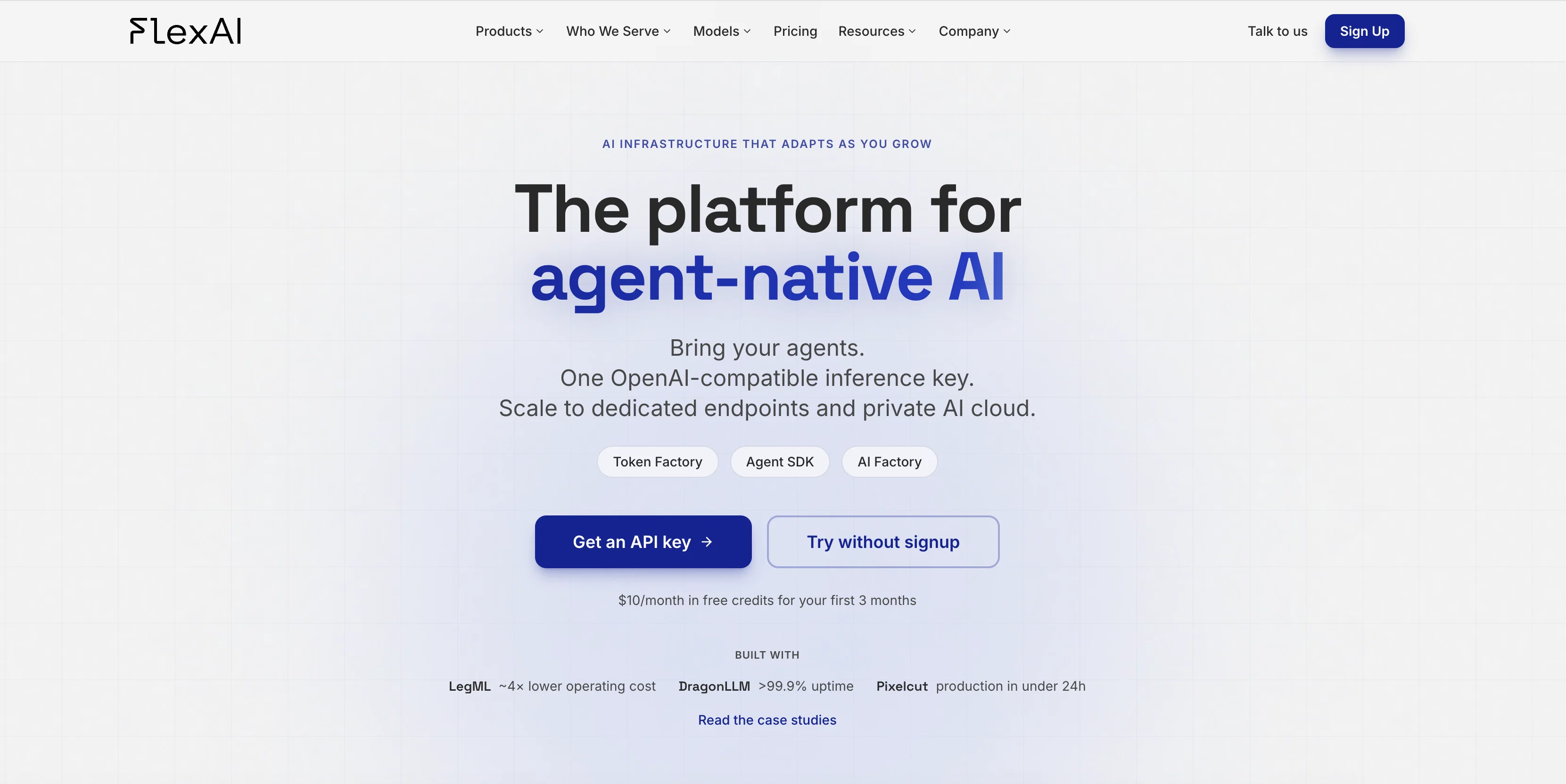
FlexAI is an agent-native AI infrastructure that simplifies the management and execution of open models and agent workloads. The key feature of FlexAI is the ability to run various models using a single OpenAI-compatible key.
This allows developers to switch models freely and scale without having to rebuild their infrastructure. The platform can be deployed in various environments ranging from serverless to dedicated endpoints and private clouds.
A range of models are supported, applicable in tasks such as embeddings, speech-to-text, text-to-speech, image generation, video generation and more. Developers have the convenience to build an agent once and run it anywhere, optimizing it to understand and serve company-specific workflows.
The AI infrastructure from FlexAI is designed to create governed agents, reachable through a GUI, CLI or API. It offers operational scalability, from a single inference key to dedicated capacity or a private cloud, without necessitating a total rebuild.
Additionally, FlexAI facilitates seamless trials of open models, ranging from coding assistants to reasoning models, with zero setup required. With a focus on adaptability, FlexAI provides a robust environment for building, testing, and deploying AI models.
Access & connections
Where you can use FlexAI.
Platforms
Capabilities
What this tool accepts, produces, and is strongest at.
Input
- API
Output
- API
Pros & cons
Pros
- Run multiple models on one key
- Switch models without rebuilding infrastructure
- Deployable on serverless to private cloud
- Supports wide range of models
- Optimized for company specific workflows
- Agent once built can run anywhere
- Governed agents via GUI, CLI or API
- Operational scalability without total rebuild
Show 19 more
- Trials of open models with no setup
- Built for adaptability
- Supports both text and media
- Supports endpoint deployment
- Inference one key for 20+ models
- Run models without account creation
- Up to 99.9% uptime
- Build agents once, run anywhere
- Over 20+ models on managed inference
- Dedicated GPUs when ready
- Effective price tracking according to market rate
- Managed inference for builders
- On-prem or private cloud deployment
- GPU clouds provided
- Low operating cost
- Integrated with NVIDIA and AMD fleets
- GDPR Compliant
- SOC 2 Type II compliant
- Provides Autoscaling capabilities
Cons
- Limited to specific agent models
- Limited to governed agents
- Dependent on their SDK
- No GUI for configuration
- Potential bottleneck through single inference key
- Lack of customization for workflows
- Boundary definitions for serverless/dedicated/private unclear
- Only supports certain types of media models
Show 1 more
- Requires sign up for API key
Compare alternatives
Similar tools in the catalog — with a clear reason to open each one.

Nebius Token Factory ✓
Free TrialEnterprise-grade open-source AI inference at unlimited scale.
Why look Typically cheaper
Full comparison
JustSimpleChat ✓
Free TrialEvery AI model, one platform.
Why look Typically cheaper
Full comparison
AI Playground MCP & CLI by Picsart ✓
FreemiumGenerate images, video, and audio with 150+ AI models.
Why look Typically cheaper
Full comparison
SiliconFlow ✓
FreemiumOne platform for all AI inference needs.
Why look Typically cheaper
Full comparison
General Compute ✓
Free TrialWorld's fastest AI inference with purpose-built hardware.
Why look Typically cheaper
Full comparison
Run BiOS ✓
Free TrialOne API for the best AI models. Zero logs, upto 70% less
Why look Typically cheaper
Full comparisonReleases 1
FAQ 12
What is FlexAI?
How does FlexAI simplify the management and execution of open models and agent workloads?
What does it mean that FlexAI is an agent-native AI infrastructure?
What types of tasks can FlexAI models handle?
Can FlexAI be deployed in multiple environments?
How does FlexAI's single OpenAI-compatible key work?
What types of models are supported in FlexAI?
How does FlexAI facilitate trials of open models?
What do developers need to do to switch models in FlexAI?
How does FlexAI contribute to workflow optimization?
What is meant by governed agents in FlexAI?
What interfaces can I use to interact with FlexAI?
Related tools
Recommended

Berd ✓
UnknownLess chatting, more building.

Tessl ✓
Free TrialSkills are the new code. Treat them that way.

GetLogit ✓
FreemiumArtificial intelligence, available for everyone.

ChatGPT ✓
FreemiumAsk anything, create anything, and move from idea to action.

Notis ✓
Free TrialThe first WhatsApp assistant that runs on your ChatGPT and Claude subscriptions

freebeat AI ✓
FreemiumTurn Music & Ideas into Viral Videos In One Click