

Debugging 2026 Rank: #2350
bugstack ✓
Runtime errors auto-fixed into tested PRs.
Verdict
A quick read before you dig into the full page.
- Best if
- Runtime errors auto-fixed into tested PRs
- Skip if
- Doesn't handle logic errors
- Pick this when
- Transforms errors into tested PRs
Considering HelpMoji instead? Compare side by side
Overview

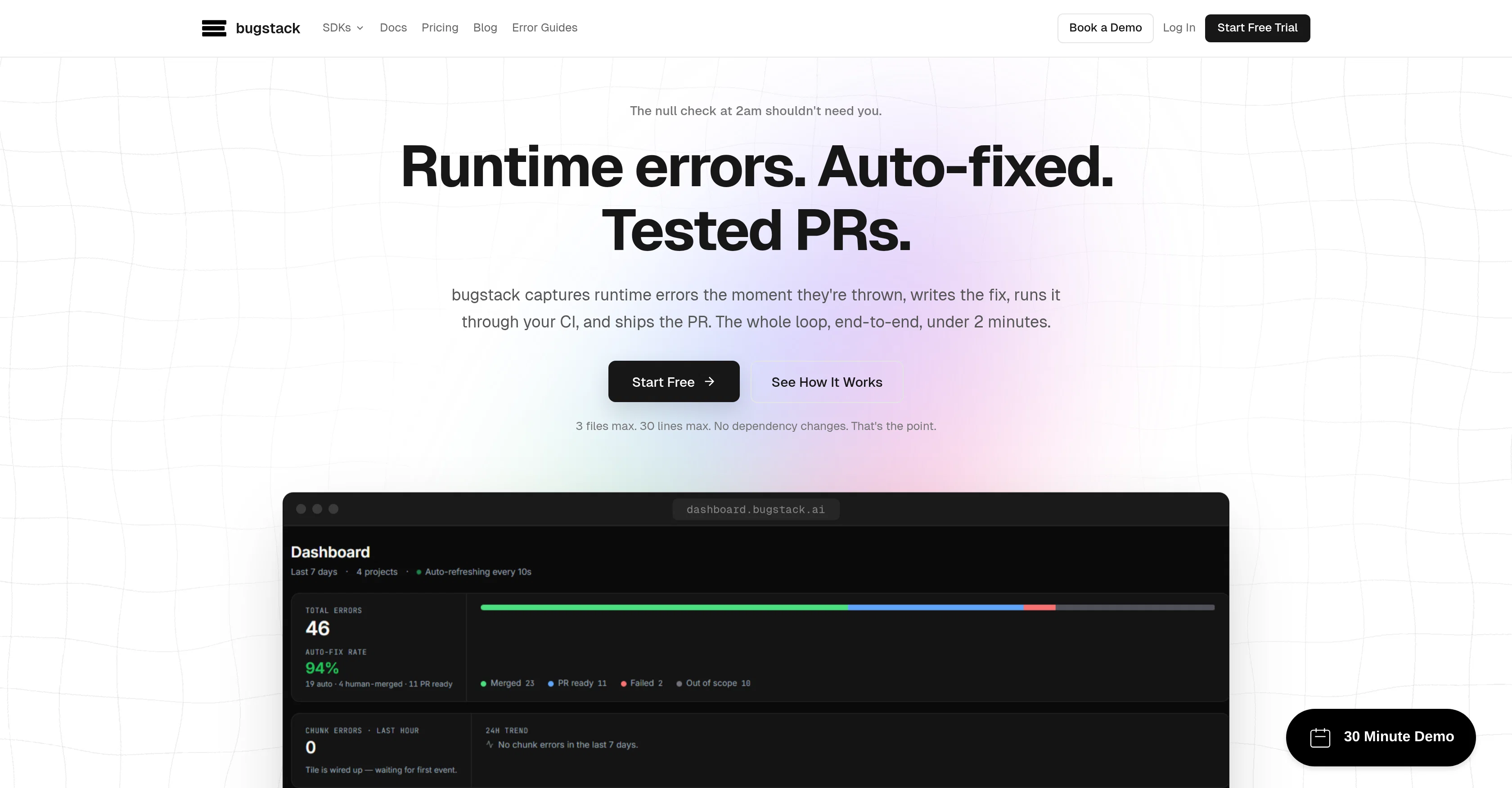
bugstack is a self-healing codebase platform that converts production errors into tested GitHub Pull Requests (PRs) in a short amount of time. Using Software Development Kits (SDKs) for JavaScript, Python, Go, and Ruby, it swiftly captures runtime errors as soon as they're thrown.
Once the error is caught, the tool writes a fix and runs the solution through Continuous Integration (CI) before shipping the PR, providing an end-to-end error resolution process in minutes.
The tool functions without changing dependency, ensuring a secure, simple, and efficient error-fixing process. By implementing bugstack, the platform allows for the automation of otherwise time-consuming debugging processes, without impacting the performance of existing operations.
bugstack's SDK is simple to install and works by providing a fully-contextual flow of production errors that are captured as they occur. It has rate-limiting features to ensure a flood of errors does not overwhelm the system and handles stack-trace-anchored runtime errors, which equate to a considerable portion of production bug volume in typical SaaS codebases.
By utilizing your existing CI pipeline, all fixes pass through robust testing before merging. This platform does not handle logic errors, architectural problems, or business logic bugs, leaving those for your engineers.
Access & connections
Where you can use bugstack, and what it plugs into.
Platforms
Capabilities
What this tool accepts, produces, and is strongest at.
Input
- API
- Text
Output
- Code
- API
Highlights
- Agents
- MCP
- API
Supported features
- Agents
- MCP
- API
- QA Automation
Pros & cons
Pros
- Transforms errors into tested PRs
- Real-time error catching
- SDKs for JavaScript, Python, Go, Ruby
- Automates bug handling
- Doesn't change application's core structure
- Handles stack trace anchored errors
- Runs fixes through existing CI
- Reduces bug handling time
Show 31 more
- Production bug volume reduction
- No dependency changes during fixing
- Fixes submitted as GitHub PRs
- User can review or auto-merge PRs
- Rate limiting feature
- Secure error fixing
- Simple SDK installation
- Full-contextual error flow
- Implements robust testing before merging
- Helps maintain application performance
- Fingerprinting for error management
- Fixes autonomous for 40-60% of bugs
- Checks solution with existing CI pipeline
- Fixes runtime errors in under 2 minutes
- End-to-end error resolution
- No human intervention needed for fixing
- Efficient debugging automation
- Promotes non-blocking error handling
- Duplicate errors increase counter
- Auto-merge based on confidence threshold
- Your CI remains as gatekeeper
- One retry then stop if failed
- Certain fixes always require human review
- Option for manual review of fixes
- Detailed error report generated
- Non-impactful on existing operations
- Fast and concurrent Go SDK
- Fingerprinted automatically
- Swift error capture as they're thrown
- Promotes securer coding practices
- Mitigates impact of broken deploy
Cons
- Doesn't handle logic errors
- Can't address architectural problems
- Doesn't fix dependency/package upgrades
- Not suitable for debugging business logic bugs
- Inefficient for database schema issues
- Not effective for Build-only failures
- Ineffective for errors with bad/missing stack traces
- Useless for third-party/framework-only stack traces
Show 2 more
- Rate-limiting may hamper error resolution
- One retry limitation on failed CI
Compare alternatives
Similar tools in the catalog — with a clear reason to open each one.

HelpMoji ✓
FreeWhen tech support can’t answer your questions, they come to us
Why look Fully free option
Full comparison
DebugPT ✓
PaidYour personal AI debugger for perfect code.
Why look Typically cheaper
Full comparison
Multiplayer.app ✓
Free TrialThe debugging agent for developers.
Why look Typically cheaper
Full comparison
Flo ✓
FreeCatch and solve errors automatically in your code.
Why look Fully free option
Full comparison
Metabob ✓
FreemiumAI-powered code review for improved security
Why look Typically cheaper
Full comparison
Releases 1
FAQ 12
What is bugstack?
How does bugstack transform runtime errors into tested PRs?
Which languages does bugstack support with its SDKs?
How does bugstack handle real-time bug catching?
Does bugstack interfere or make changes to my application's dependencies while fixing bugs?
How does the bugstack auto-fix feature work?
Can bugstack handle architectural issues in my code?
Can bugstack perform package upgrades?
Can I manually review bugstack's generated PRs before merging?
How does bugstack assist in production bugs volume reduction?
How does bugstack maintain the integrity of my codebase?
How does bugstack's automated process enhance development efficiency?
Related tools
Recommended

Bootstrap King ✓
Free TrialAI mentor for bootstrapping your business

MagicSlides.app AI PPT Maker ✓
FreemiumCreate Stunning PPTs in Seconds with the AI PPT Maker

GetLogit ✓
FreemiumArtificial intelligence, available for everyone.

ChatGPT ✓
FreemiumAsk anything, create anything, and move from idea to action.

Automateed ✓
Free TrialCreate eBooks effortlessly with Automateed, the AI-powered writing tool.

Notis ✓
Free TrialThe first WhatsApp assistant that runs on your ChatGPT and Claude subscriptions