

Healthcare 2026 Rank: #3151
Bluenote ✓
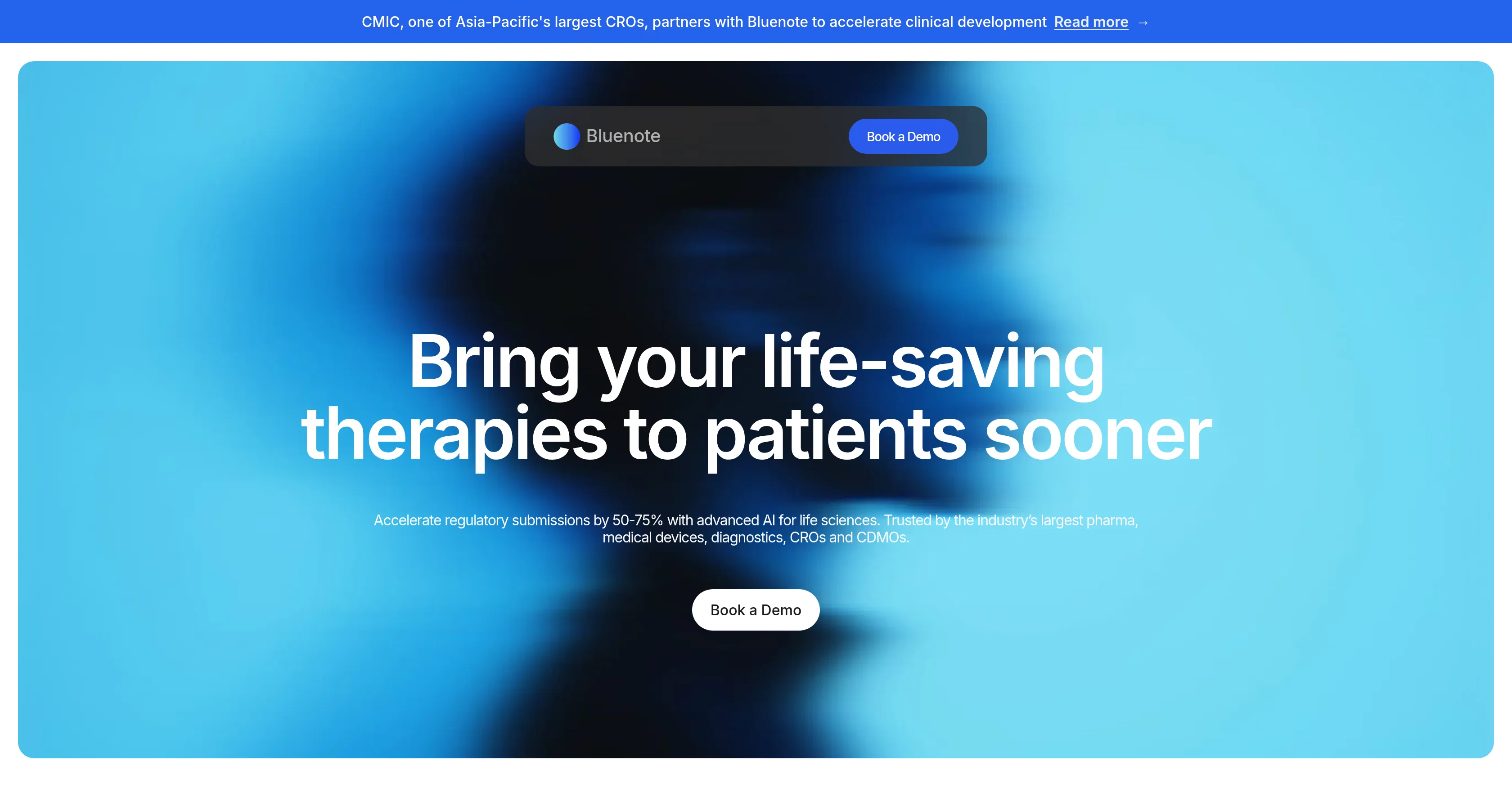
Accelerate regulatory submissions by 5075%.
Verdict
A quick read before you dig into the full page.
- Best if
- Accelerate regulatory submissions by 5075%
- Skip if
- Limited translation functionality
- Pick this when
- Trusted by industry leaders
Considering Hathr AI instead? Compare side by side
Overview
Bluenote is an AI platform designed for life sciences which is trusted by a diverse set of industry leaders from pharmaceuticals, medical devices, diagnostics, to CROs and CDMOs.
It automates crucial documentation with proven accuracy and enterprise-grade security to streamline regulatory submissions. Developed by experts in AI and life sciences, the platform allows companies to focus their resources on science rather than busywork.
It houses several core components: Document Generation, AI Assistant, AI Agents, Workflow Builder, and Datasets. Document Generation enables the instant production of the first drafts of scientific and regulatory documents, while the AI Assistant frees up teams to focus on strategic tasks.
AI Agents and Workflow Builder automate repetitive, multi-step workflows, thus driving innovation. Datasets allow for quick searching across internal data, reducing duplication, and unlocking institutional knowledge.
Translation functions of the platform maintain formatting while converting technical, regulatory, and marketing documents. Bluenote integrates with diverse data sources and ensures every output is connected to source data.
Its scalable design supports high-volume documentation and multi-program needs. Ease of use is another critical feature with a seamless adoption process due to an intuitive design.
It assists with automation across various life science stages including Pre-Clinical, Clinical, CMC, Regulatory, Quality, and Commercial.
Access & connections
Where you can use Bluenote.
Platforms
Capabilities
What this tool accepts, produces, and is strongest at.
Input
- Text
Output
- Text
Highlights
- Agents
- Local
Supported features
- Docs
- Assistant
- Agents
- Automation
- Search
- Translation
- Integrations
- SOC 2 Compliance
- Runs Locally
Pros & cons
Pros
- Trusted by industry leaders
- Automates crucial documentation
- Streamlines regulatory submissions
- Developed by life sciences experts
- Document Generation component
- Workflow Builder for innovation
- Datasets for quick searching
- Reduces data duplication
Show 37 more
- Unlocks institutional knowledge
- Translates documents maintaining formatting
- Integrates with diverse data sources
- Output linked to source data
- Scalable design for high-volume documentation
- User-friendly, intuitive design
- Supports entire life science stages
- Accelerate regulatory submissions by 50-75%
- Works with pharmaceuticals, medical devices, diagnostics
- Suitable for CROs and CDMOs
- Handles Pre-Clinical to Commercial processes
- Supports enterprise-grade security
- Simplifies busywork in life sciences
- Automates multi-step workflows
- Ease of adoption
- Built-in verification and traceability
- Refines data presentations, formats datasets
- Creates figure captions, runs gap analyses
- Translation maintains glossary, preserves styling
- Decision-supporting insights
- Enterprise-wide scalability
- Proven accuracy in document creation
- Seamless adoption, value from day one
- Extends automation across development stages
- Documentation for clinical study reports
- Assists with responses to health queries
- Generates validation reports
- Accelerates safety, CMC documentation
- Helps in protocol generation
- Can assist with informed consent forms
- Aids in deviation and CAPA reports
- Helps reduce document creation time
- Integrates with ELN, QMS/DMS, data warehouses
- Can deploy on-premise for increased control
- Built for regulatory compliance
- Adheres to SOC 2 Type II, HIPAA
- Supports IP allowlisting and SAML SSO
Cons
- Limited to life sciences
- Reliant on data quality
- Requires standardization of data
- No mobile interface mentioned
- Limited translation functionality
- Dependent on external data sources
- Not disclosed out-of-the-box integrations
- No real-time collaboration noted
Show 2 more
- No open source for customization
- On-premise option may increase costs
Compare alternatives
Similar tools in the catalog — with a clear reason to open each one.

Hathr AI ✓
Free TrialHIPAA-compliant AI that secures, summarizes, and streamlines healthcare workflows.
Why look Higher community rating
Full comparison

Glass.health ✓
UnknownAI-powered knowledge management for doctors
Why look Higher community rating
Full comparison
Suki ✓
UnknownAI voice assistant lifts administrative burden from clinicians
No pricing
Full comparison
Athelas ✓
UnknownThe next-gen healthcare operating system
Why look Higher community rating
Full comparisonReleases 1
FAQ 12
What is Bluenote?
What industries does Bluenote cater to?
How does Bluenote assist in the documentation process?
What are the core components of the Bluenote platform?
What is the role of the AI Assistant in Bluenote?
What kind of tasks are automated by the AI Agents and Workflow Builder in Bluenote?
How does the Document Generation feature of Bluenote work?
What is the purpose of the Datasets component in Bluenote?
Does Bluenote have any translation capabilities?
How does Bluenote integrate with different data sources?
Can Bluenote handle high-volume documentation and multi-program needs?
What makes Bluenote user-friendly?
Related tools
Recommended

Fina Money ✓
FreemiumModular Finance Tracker For Personal And Business

Genie by Lumalabs ✓
FreeGenerate 3D models with AI

Fabricate ✓
FreemiumFabricate builds entire web apps from a single prompt - free!

GoFaceless ✓
Free TrialTurn any idea into a finished faceless video.

Atoms ✓
FreemiumTurn ideas into products that sell with AI.

Mixboard ✓
FreeAI-powered concepting board for exploring ideas.