

Glass.health ✓
AI-powered knowledge management for doctors
Verdict
A quick read before you dig into the full page.
- Best if
- You are clinicians and need: Assisting clinicians in making informed decisions
- Skip if
- Limited to clinicians and trainees
- Pick this when
- Tailored for doctors
Considering Hathr AI instead? Compare side by side
Overview
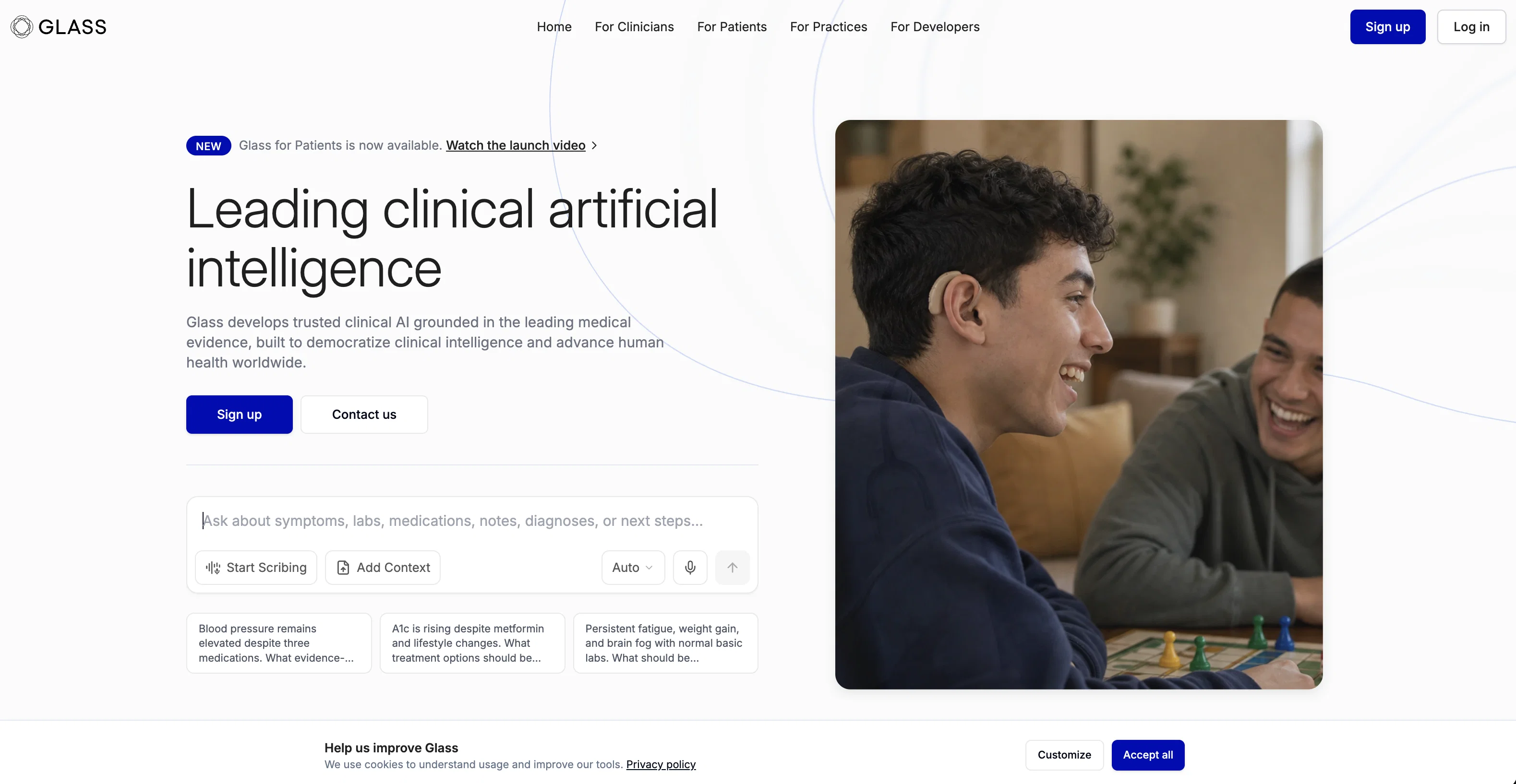
Glass AI is a powerful AI-driven knowledge management system developed by Glass Health, specifically tailored to the way in which doctors learn, organize, and curate medical knowledge.
It enables doctors to draft a differential diagnosis or clinical plan based on a diagnostic problem representation. This feature is only intended for use by clinicians and clinicians in training, and should not be used by the general public.
Glass AI uses an artificial intelligence (AI) model to generate the differential diagnosis or clinical plan and is constantly undergoing research and testing to improve accuracy.
The quality and usefulness of the output is highly dependent on the quality of the diagnostic one-liner submitted, and all output must be carefully interpreted and never replace professional judgement.
Glass AI is a secure and frictionless software for learning and practicing medicine and is easily shareable with the public.
Best for
Short scenarios where Glass.health tends to shine.
-
Assisting clinicians in making informed decisions
Best for Clinicians
-
Generating drafts of medical documents to save time
Best for Doctors
-
Providing quick answers to clinical questions
Best for Medical professionals
Example outputs 1
Sample generations and before/after results for Glass.health.
Access & connections
Where you can use Glass.health.
Platforms
Capabilities
What this tool accepts, produces, and is strongest at.
Input
- Text
Output
- Text
Pros & cons
Pros
- Tailored for doctors
- Enhances medical knowledge organization
- Differential diagnosis feature
- Clinical plan generation
- Continual improvement via research/testing
- Output dependent on quality input
- Secure software
- Frictionless user experience
Show 8 more
- Easily shareable tool
- Useful for clinician training
- Helps with effective problem representation
- Not intended for general public
- Output cannot replace professional judgement
- Designed for learning and practicing medicine
- Presence of precautions against bad output
- Importance tied to interpretative skills
Cons
- Not for general public use
- Dependent on quality of one-liners
- Output may be incomplete
- Output may be incorrect
- Output may be biased
- Strictly for medical professionals
- Requires careful interpretation
- BETA stage, not fully developed
Show 2 more
- Limited to clinicians and trainees
- Doesn't generate medical advice
Compare alternatives
Similar tools in the catalog — with a clear reason to open each one.

Hathr AI ✓
Free TrialHIPAA-compliant AI that secures, summarizes, and streamlines healthcare workflows.
Why look Higher community rating
Full comparison
Suki ✓
UnknownAI voice assistant lifts administrative burden from clinicians
No pricing
Full comparison
Athelas ✓
UnknownThe next-gen healthcare operating system
Why look Higher community rating
Full comparison
Tempus ✓
UnknownAI-powered precision medicine for cancer care
Why look Higher community rating
Full comparisonPeople also view
Tools that often show up alongside Glass.health in collections and comparisons.

Valerie Health ✓
UnknownAI front office for healthcare providers.
Tempus ✓
UnknownAI-powered precision medicine for cancer care
Suki ✓
UnknownAI voice assistant lifts administrative burden from clinicians
Hathr AI ✓
Free TrialHIPAA-compliant AI that secures, summarizes, and streamlines healthcare workflows.
Athelas ✓
UnknownThe next-gen healthcare operating system

Symplicured ✓
FreeYour AI health assistant, delivering answers in under 5 minutes

SOPMaker ✓
Free TrialSOPs your team will actually follow.

Pendra ✓
FreemiumAI infrastructure regulated industries can trust.
Releases 1
Imported reviews 1
Really promising.
FAQ 12
What is Glass AI?
What are some features of Glass AI?
Who is the intended audience for using Glass AI?
How does Glass AI generate its diagnoses?
What is the role of the AI model in Glass AI?
How dependable is the output of Glass AI?
In what ways does Glass AI assist clinicians?
Is Glass AI applicable for general public use?
How can Glass AI be shared with the public?
What are differential diagnoses and clinical plans in context to Glass AI?
Can Glass AI tool replace professional judgement?
What are the precautions taken by Glass AI to mitigate potential inaccuracies?
Related tools
Recommended

Scisummary ✓
Free TrialCutting-edge scientific articles summarization.

Medical Chat ✓
FreemiumMedical chatbot for professionals and patients.

LearningStudioAI ✓
Free TrialAI-powered authoring tool for effortless online course creation.

Scholarcy ✓
FreemiumConvert long articles into summary flashcards.

Agentgpt ✓
FreemiumDeploy autonomous AI Agents effortlessly in your browser.

OpenRead ✓
FreemiumAI-powered interactive papers for faster, intuitive research