

from $10
Verdict
A quick read before you dig into the full page.
- Best if
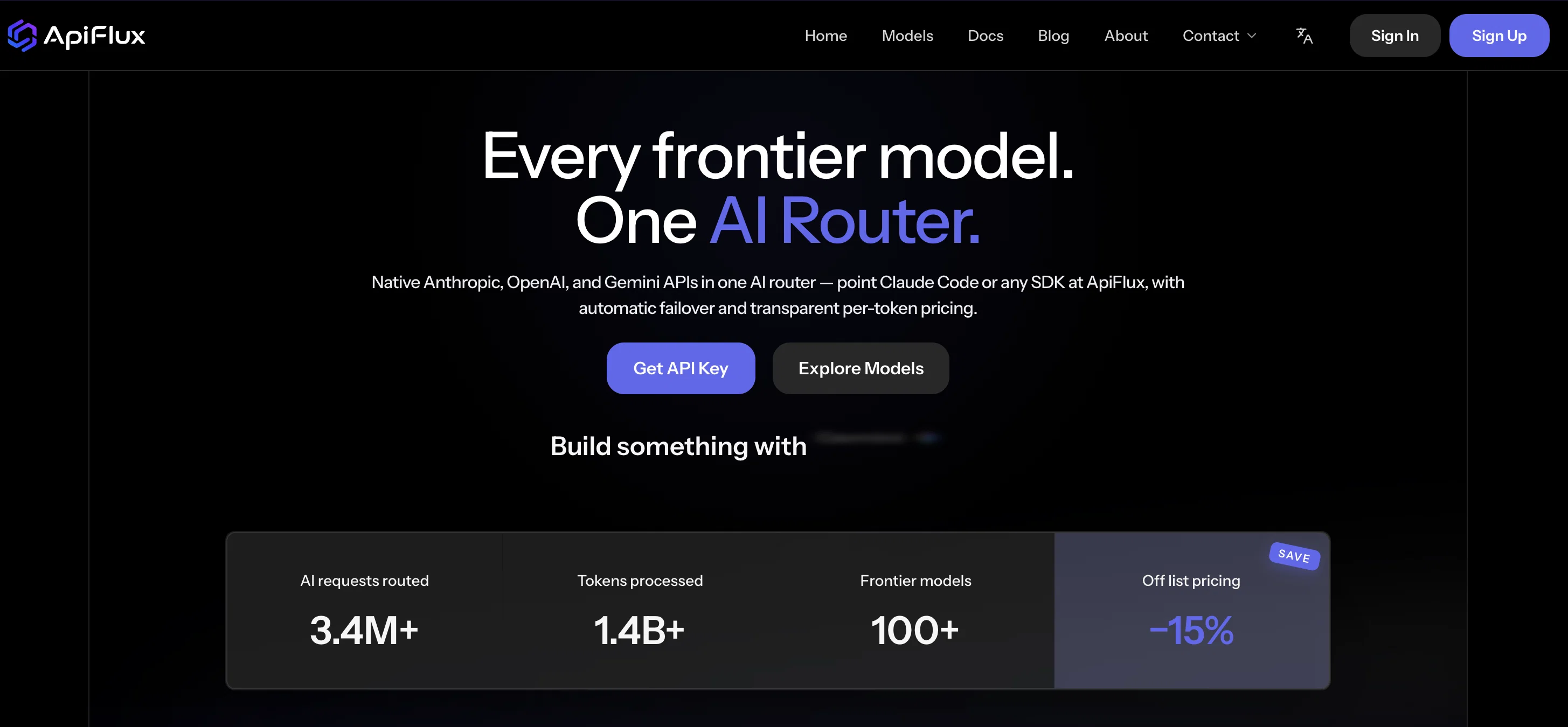
- Every frontier model. One AI router
- Skip if
- Per-token pricing can be expensive
- Pick this when
- Native integration to APIs
Considering Featherless - Serverless LLM Hosting instead? Compare side by side
Overview
ApiFluxAI is a multi-protocol Artificial Intelligence (AI) router with native integration to APIs from Anthropic, OpenAI, and Gemini, capable of routing AI requests to over 100 different models.
The platform offers transparent per-token pricing and automatic failover in case of any issues with one of the APIs, making it a highly reliable tool for AI development and deployment.
It is specifically designed with compatibility in mind, accepting input from varied tools like Claude Code, Codex CLI, OpenCode, Pi, Hermes, OpenClaw, and other OpenAI SDKs.
Users simply need to change their base URL to ApiFluxAI to take advantage of these features.ApiFluxAI offers a live dashboard for monitoring token usage, latency, model health, and the cost of AI requests.
It also provides automatic failover support to reroute requests to healthy paths during upstream provider degradation, ensuring uninterrupted service.
The pricing model is per-token-based, offering transparent and flexible pricing for the users.Notably, ApiFluxAI is ecosystem-friendly. It allows users to compare and use models from different providers without having to juggle multiple accounts.
It also helps in sharing credits across teammates with per-key limits and per-key usage logs. The built-in feature for automatic failover prevents users from becoming overly dependent on a single provider.
The platform is geared towards aiding diverse applications, ranging from coding agents to production apps, prototypes, and side projects.
Access & connections
Where you can use ApiFlux.
Platforms
Capabilities
What this tool accepts, produces, and is strongest at.
Input
- API
Output
- API
Pros & cons
Pros
- Native integration to APIs
- Routs requests to 100+ models
- Transparent per-token pricing
- Automatic failover support
- Compatible with various tools
- Live token usage monitoring
- Latency monitoring
- Model health tracking
Show 36 more
- Per-key limits
- Per-key usage logs
- Prevents provider dependence
- Supports diverse applications
- Allows model comparison
- Supports credits sharing
- 15% off model pricing
- One key for all models
- Upstream provider degradation handling
- Flexible pricing
- Works with Claude Code
- Works with Codex CLI
- Works with OpenCode
- Works with Pi
- Works with Hermes
- Works with OpenClaw
- Ecosystem-friendly
- One API key for all
- No subscription
- No code rewrite
- API key compatibility across models
- Connected with major model makers
- Transparent pricing
- Native tool integration
- Live usage insight
- Supports production apps & agents
- Help in prototypes & side projects
- Facilitates model evaluation
- Allows small team collaboration
- Avoids single-vendor lock-in
- Routs requests to healthy paths
- No extra instrumentation needed
- Cheaper tokens
- Allows model swap per request
- Avoids provider account juggling
- Reduces token bill by 15%
Cons
- Per-token pricing can be expensive
- Limited to specified API integrations
- Dependent on external API providers
- No direct provider contact
- No subscription option
- Limited to listed coding tools
- Doesn't mention offline capabilities
- Dependence on healthy paths
Show 1 more
- Single point of failure
Compare alternatives
Similar tools in the catalog — with a clear reason to open each one.

Featherless - Serverless LLM Hosting ✓
Free TrialDeploy any open AI model effortlessly.
Why look Offers a public API
Full comparison
ZEGOCLOUD ✓
FreemiumAPIs for real-time voice, video and chat.
Why look Freemium alternative
Full comparison
CometAPI ✓
FreemiumOne API, 500+ AI models at your fingertips.
Why look Freemium alternative
Full comparison
APIMart ✓
UnknownOne API for 500+ AI models at 70% less cost.
Why look Offers a public API
Full comparison
Roya ✓
FreemiumPlan APIs and frontend integrations in days, not weeks
Why look Freemium alternative
Full comparison
Token Harbor ✓
Free TrialThe easiest way to access frontier AI models.
Why look Offers a public API
Full comparisonReleases 1
Related tools
Recommended

GetLogit ✓
FreemiumArtificial intelligence, available for everyone.

ChatGPT ✓
FreemiumAsk anything, create anything, and move from idea to action.

Notis ✓
Free TrialThe first WhatsApp assistant that runs on your ChatGPT and Claude subscriptions

freebeat AI ✓
FreemiumTurn Music & Ideas into Viral Videos In One Click

Jason AI ✓
PaidAI-powered assistant for B2B sales outreach

DeepSeek ✓
FreeUnravel the mystery of AGI with curiosity