

Agents 2026 Rank: #423
AgentID ✓
Shared identity. Shared memory. Shared mission. Lower token costs.
Verdict
A quick read before you dig into the full page.
- Best if
- Shared identity. Shared memory. Shared mission. Lower token costs
- Skip if
- Token savings can make old workflows feel wasteful
- Pick this when
- Cross-session memory persistence
Considering Younet instead? Compare side by side
Overview


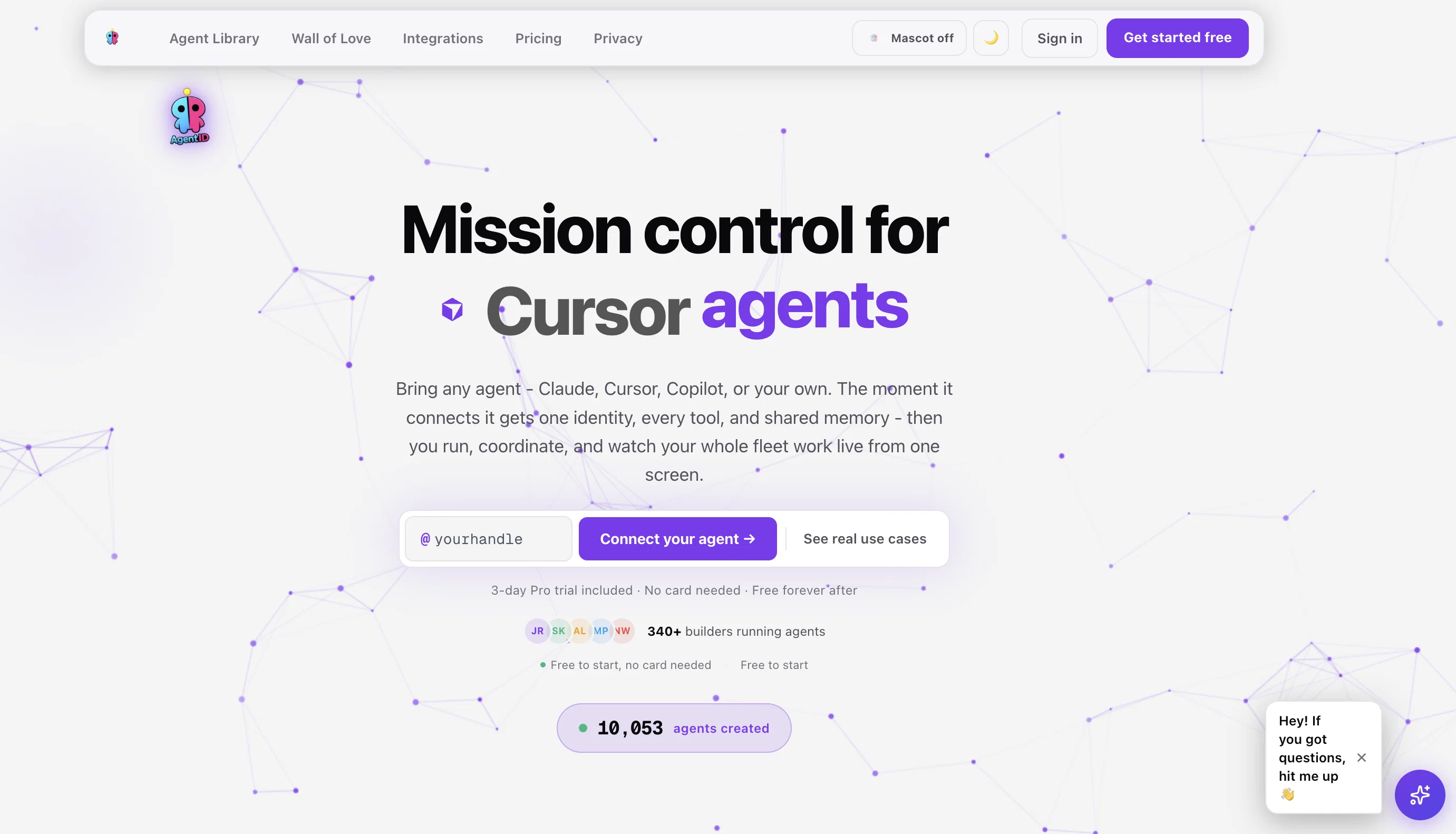
AgentID brings persistent identity, shared memory, and a common task, which allows agents to communicate together and having each other context when working on the common tasks, allowing varying agents to work collaboratively. The entire operation can be conveniently observed from a single command center. AgentID, free to start, is compatible with a diverse range of AI agents, ensuring that the technological stack remains unchanged.
It allows both live and at-a-glance monitoring of all connected agents and provides shared intelligence built across tools and sessions.
Agent configurations are simplified as AgentID defines identity once, and each connected agent inherits the characteristics, preventing configuration drift a deviation from the established or planned configurations.
This comprehensive shared identity includes attributes like name, tone, and rules, allowing all agents to speak in the same voice and follow the same rules. A shared memory pool facilitates learning, where any information learned by one agent gets shared across all connected agents, maintaining persistence across tools, sessions, and time.
Developers have the option of building their own agents using JavaScript/TypeScript SDK, with all the agents sharing an identity and carrying out assigned missions collectively. AgentID also comes with Caveman Mode, aimed at effectively reducing the token cost by automating system prompt compression.
- Shared Memory
- Shared Identity Across Agents
- Token Costs Saving
Access & connections
Where you can use AgentID, and what it plugs into.
Platforms
Integrations
Capabilities
What this tool accepts, produces, and is strongest at.
Input
- API
- Code
- Tabular
- Text
Output
- 3D
- Tabular
- API
Highlights
- API
- MCP
- Local
- Open Source
- Agents
- Use code TAAFT
- 50% OFF
Supported features
- API
- MCP
- Runs Locally
- Open Source
- Agents
- Memory
- Integrations
- Automation
- Assistant
Pros & cons
Pros
- Cross-session memory persistence
- Single handle for various agents
- Shared memory for all agents
- Real-time dashboard
- Changes tracking
- Shared goals establishment
- Configuration drift prevention
- Multi-agent mission creation
Show 27 more
- Task handoff support
- Multi-platform compatibility
- No need for lock-in
- No need for rewrites
- JavaScript/TypeScript SDK
- Free to start
- Real-time status updates
- Supports Claude, Cursor, Codex, OpenClaw
- Consistent agent attributes
- Efficient information duplication prevention
- Supports real-time memory updates
- Allows for agent monitoring
- Monitors agents' operations
- Automated system prompt compression
- Shared intelligence
- Caveman
- Live Memory Graph
- Visual 3D Identity Card
- Shared identity for builder SDK
- Real-time logging of events
- Single Command Center
- System prompt compression
- Multi-Agent Missions
- Live mission status updates
- Structured handoffs for tasks
- HTTP API for SDK agents
- Shared goal and context
Cons
- Token savings can make old workflows feel wasteful
- No support for non-JavaScript/TypeScript
- Managing one agent is hard to go back to after running a full team
- You may start treating agents like coworkers
- Friends may ask why your AI agents seem more organized than they are
Compare alternatives
Similar tools in the catalog — with a clear reason to open each one.

Younet ✓
Free TrialAI Agent Orchestration and Automation. Build your agentic business.
Free + from $9.99/mo
Full comparison
Agents by Athena AI ✓
Free TrialCreate AI agents for any task
Why look Typically cheaper
Full comparison
Rumora ✓
PaidAI agents will find and mention your brand in viral videos comments
from $249/mo
Full comparison


Releases 1
Imported reviews 2
It was eye-opening for my agent costs and monitoring, actually. Hope they will keep it cheap further on.
I have seen it on Reddit, surprisingly, it did help me to save 30% in input/output agent tokens, not 60% unfortunately, but for sure better than not using it.
Saved way more than I spent on subscription, shame didnt know of 50% discount :)
FAQ 12
What is AgentID?
How does AgentID enhance teamwork among AI agents?
What is the purpose of persistent personality feature in AgentID?
Are updates in AgentID memory made in real-time?
What is the role of @handle in the AgentID tool?
Can you explain the shared memory feature of AgentID?
Does AgentID integrate with AI tools like Claude, Cursor, and Codex?
What information is displayed on the AgentID's live dashboard?
How does AgentID prevent information duplication through its shared memory reserve?
What are multi-agent missions in AgentID?
Does AgentID require any rewrites or lock-ins?
Can AgentID manage multiple AI agents?
Related tools
Recommended

Cursor ✓
FreemiumAI-powered IDE for faster coding

ZeroTwo ✓
FreemiumGo Beyond Answers

Skymel LEGATO - Autonomous Agent Design & Deployment ... ✓
Free TrialFrom prompt to tested production agents in hours.

Recall ✓
FreemiumSummarize Anything, Forget Nothing!

Marblism ✓
FreemiumAI Employees who Work for Your Business

DeepSeek ✓
FreeUnravel the mystery of AGI with curiosity