

Supermemory ✓
The memory layer for AI agents.
Verdict
A quick read before you dig into the full page.
- Best if
- The memory layer for AI agents
- Skip if
- Limited user understanding model
- Pick this when
- Boosts commercial APIs
Considering Constella instead? Compare side by side
Overview
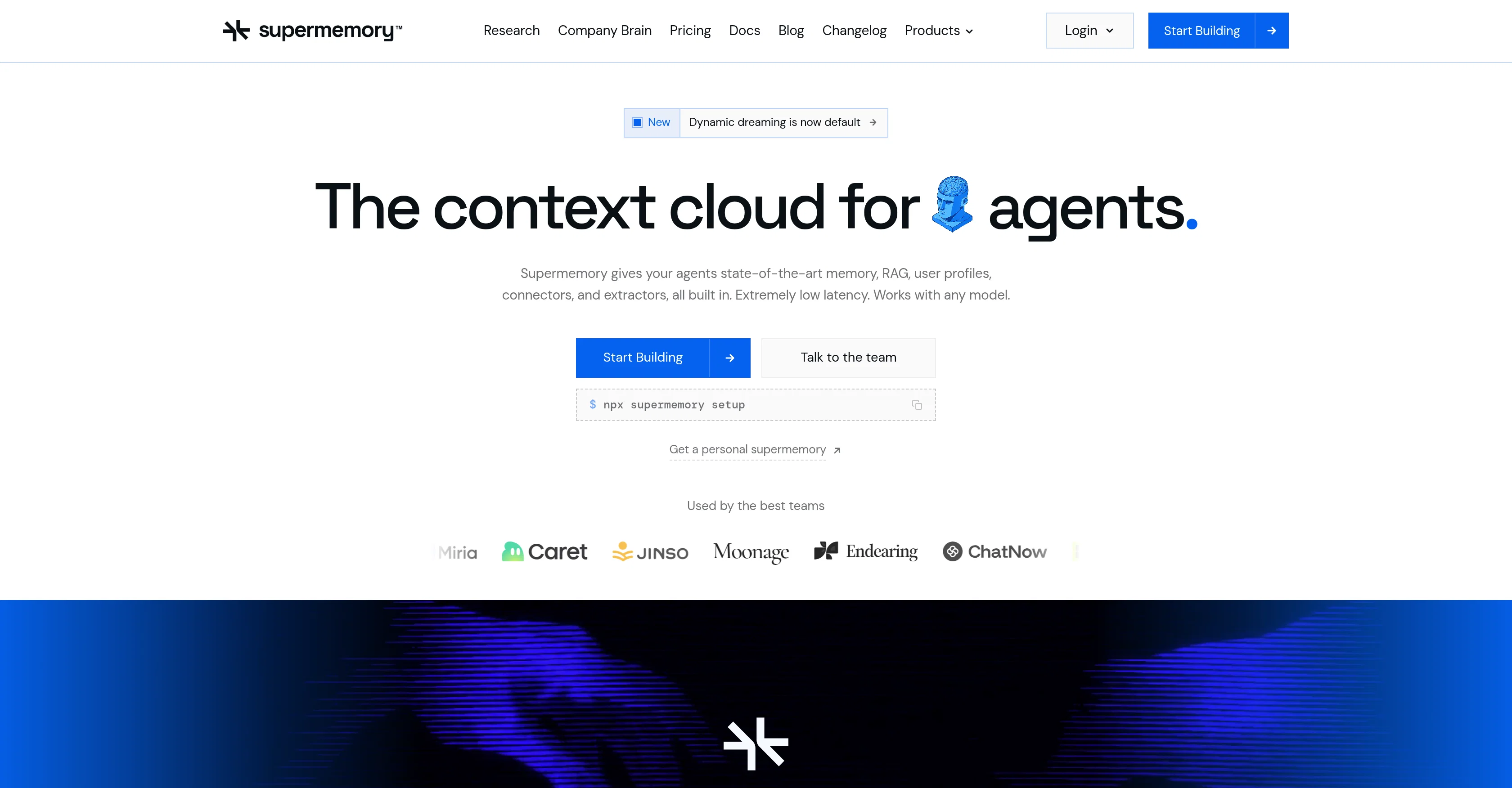
Supermemory is an advanced artificial intelligence (AI) memory layer that boosts commercial APIs, techies' plugins, and an individual-designed application that boasts a remarkable recall function.
As an AI memory management tool, Supermemory offers progressive features such as state-of-the-art memory, SuperRAG (Retrieval), Profiles, Extractors and Connectors, which create an ideal context for AI agents.
Supermemory's core functionality comprises Memory and Continual Learning, using a cutting-edge memory that boasts of being persistent, structured, built as a knowledge graph using a custom user understanding model.
The tool provides a SuperRAG retrieval function, offering hybrid search, reranking, and structured context for documents with incredibly low latency. Connectors allow integration of various platforms such as Slack, Notion, Drive, Gmail, GitHub, S3, among others, with real-time synchronization.
Supermemory facilitates the extraction of files types including PDFs, web pages, images, and audio into memory objects that are ready for use by AI agents.
Profiles provide preference, behavior, and identity context that remains consistent across sessions. This solution also offers a personal Supermemory app, providing one memory across everything the user utilizes.
The tool is self-hostable and facilitates TypeScript & Python SDKs. Its benefits include latency under 300ms and an easy start-up process, requiring only five minutes to begin realizing the benefits of this advanced memory management tool.
Access & connections
Where you can use Supermemory, and what it plugs into.
Platforms
Capabilities
What this tool accepts, produces, and is strongest at.
Supported features
- Memory
- Instant file search
Pros & cons
Pros
- Boosts commercial APIs
- Supports techies' plugins
- Advanced recall function
- State-of-the-art memory
- Features SuperRAG Retrieval
- Provides profiles
- Includes Extractors
- Integrates with Connectors
Show 43 more
- Enables platform integration
- Offers real-time synchronization
- Extracts file types
- Supports user identity context
- Integrated Personal App
- Self-hostable software
- Supports TypeScript SDKs
- Supports Python SDKs
- Latency under 300ms
- Fast startup process
- Generates Knowledge Graph
- Allows hybrid search
- Enables reranking
- Structured document context
- Integrates with various platforms
- Extracts web pages
- Extracts images
- Extracts audio files
- Profile consistency across sessions
- Persistent memory
- Ingests data quickly
- Compatible with major languages
- Optimized content extraction
- Includes entity model
- Performs unified query
- Handles qualitative analysis
- Custom user understanding model
- Converts raw files
- Clusters user signals
- Explains user signals
- Summarizes user signals
- Requires only five minutes setup
- Automatic content synchronization
- Provides preference context
- Performs behavior context
- Memory, RAG, profiles in one graph
- In-built connectors and extractors
- Parallel context coherency
- Works with Mount Filesystem
- Offers enterprise solutions
- Multiple hosting options
- Compliant with SOC 2
- Compliant with GDPR
Cons
- Requires constant internet access
- Latency issues potential
- Supported languages limited
- Limited file type extraction
- Limited platform integration
- Highly dependent on plugins
- Potential data privacy concerns
- Limited user understanding model
Show 2 more
- No mobile application
- Requires technical knowledge
Compare alternatives
Similar tools in the catalog — with a clear reason to open each one.

Constella ✓
Free TrialForget files and folders, not your thoughts.
Why look Higher community rating
Full comparison
Cerebro ✓
Free TrialAmplify your ideas with AI-powered knowledge management.
Free + from $4.99/mo
Full comparison
Keymate.AI ✓
FreemiumOrganize digital resources and research with AI
Why look Offers a public API
Full comparison
ArcaNotes ✓
FreeFree your mind with AI-powered micro-notes.
Why look Fully free option
Full comparison
everfind | AI workspace ✓
FreemiumFind and ask all your documents and emails in one AI workspace.
Why look Higher community rating
Full comparison
MyMemo ✓
FreemiumTransform personal data into actionable wisdom.
Free + from $5.9/mo
Full comparisonReleases 1
FAQ 12
What is Supermemory and how does it function?
How does Supermemory enhance commercial APIs and tech plugins?
What's a Recall Function and how does it perform within Supermemory?
What are the key features of Supermemory and why are they beneficial?
What is SuperRAG in Supermemory and what is its purpose?
How does Supermemory integrate with platforms like Slack, Notion, Drive, and Gmail?
What file types can Supermemory extract into memory objects?
How does Supermemory manage user profiles and maintain consistency across sessions?
What does it mean that Supermemory is self-hostable?
How does the Supermemory personal app work and what can it do?
How long does it take to start up Supermemory and begin seeing benefits?
What programming languages does Supermemory support?
Related tools
Recommended

Kin - Personal AI Advisors ✓
FreePrivacy-first & designed your for mind, and life at work

COACH ✓
FreeAI-powered career development platform built by career experts.

AI Mind Mapper ✓
FreeTransform PDFs into easy-to-digest mind maps.

Hyperis ✓
FreemiumOrganized task prioritization.

Beeyond AI ✓
Free TrialBeeyond AI: Unlock 50+ AI tools under one subscription

Nouswise ✓
FreemiumYour personal search engine for trusted information.