

Technical specifications 2026 Rank: #2585
Spec ✓
Turn any idea into engineering-ready product specs.
Verdict
A quick read before you dig into the full page.
- Best if
- Turn any idea into engineering-ready product specs
- Skip if
- Limited to 20+ product categories
- Pick this when
- Automated 10-step discovery pipeline
Considering CoreStory instead? Compare side by side
Overview
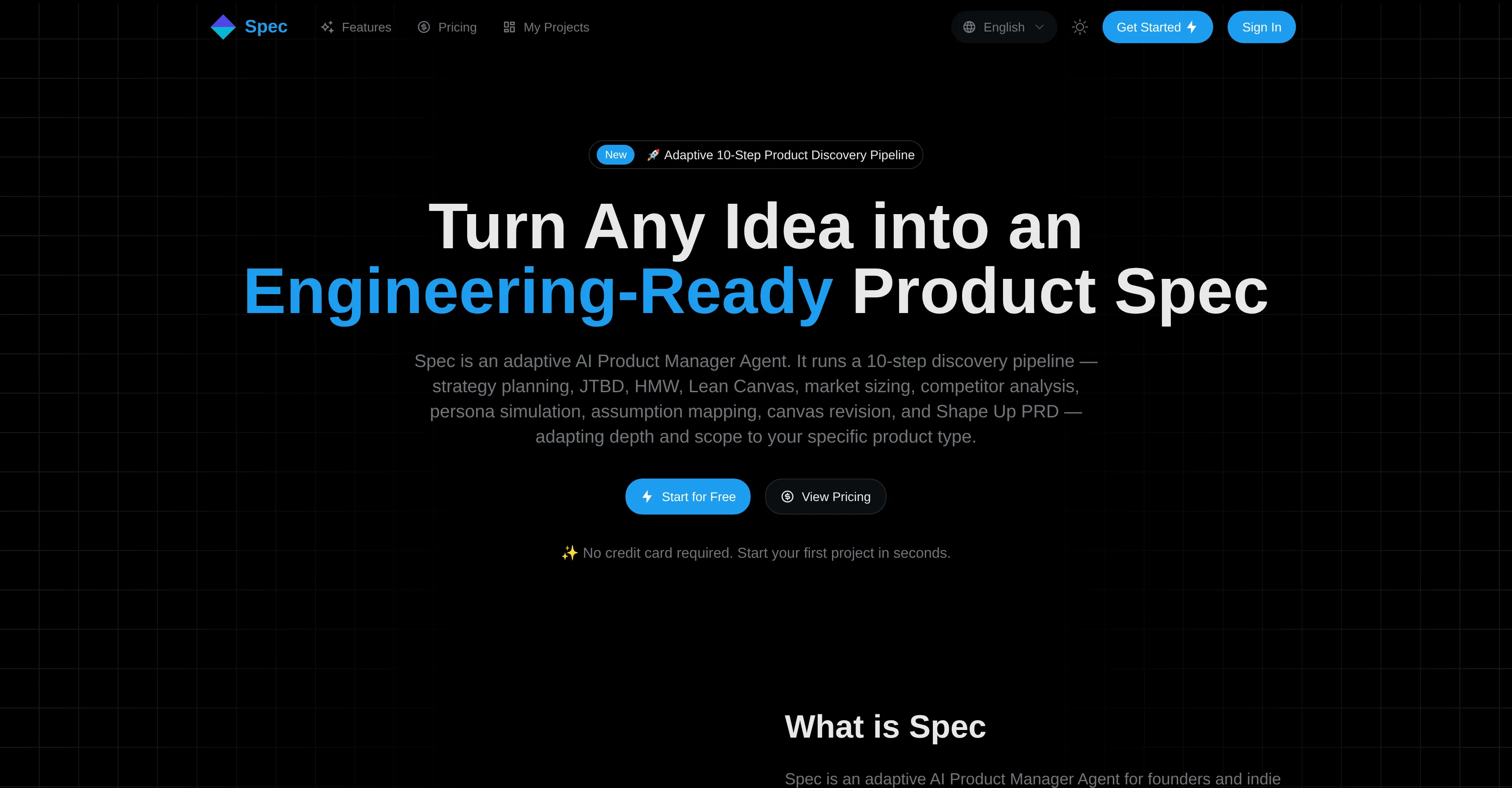
Spec is an adaptive AI Product Manager Agent designed to streamline and automate product discovery processes. This tool is targeted towards founders and indie hackers and has the capability to adapt its functionality based on the specific type of product, be it SaaS, hardware, fintech, healthtech or any from the 20+ categories.
The tool operates on a 10-step discovery pipeline which includes strategy planning, Jobs To Be Done (JTBD) framing, How Might We (HMW), Lean Canvas creation, market sizing, competitor analysis, persona simulation, assumption mapping, canvas revision, and a Shape Up Product Requirements Document (PRD).
Specs unique approach allows it to devise its own research strategy, thereby setting research depth, classifying the product and even activating domain-specific modules automatically.
The outcome of the Spec AI agent is a structured Markdown file that serves as a complete and comprehensive PRD, formatted and ready for AI coding tools; this file houses data models, API specifications, user stories, and explicit scope boundaries.
Spec's functionality also encompasses a key human-in-the-loop feature, giving users control over direction at crucial steps. This AI tool uses Firecrawl for deep scraping of competitor websites, and Tavily for market data search.
An additional functionality offered by Spec is its capability to simulate distinct user personas via Van Westendorp Price Sensitivity Meter analysis, thereby surfacing willingness-to-pay ranges and pain points without needing to conduct real user interviews.
Access & connections
Where you can use Spec.
Platforms
Capabilities
What this tool accepts, produces, and is strongest at.
Input
- Text
Output
- Code
- Tabular
- Text
Highlights
- Agents
Supported features
- Agents
- Automation
- Deep Research
- Docs
- Text Generation
Pros & cons
Pros
- Automated 10-step discovery pipeline
- Adaptation to product type
- Full-structured markdown export
- User approvals at critical steps
- Deep competitor website scraping
- Lean Canvas revision loop
- Market sizing with citations
- Digital focus group simulation
Show 41 more
- Van Westendorp Price Sensitivity Meter
- Finished PRD exportable
- Comprehensive competitor analysis
- Persona simulation feature
- JTBD framing implemented
- Market and competitor intelligence
- Automated product discovery
- Product-orientated output
- Domain-specific modules activation
- Streamlined strategy planning
- Final product requirements document
- Strategy planning tool
- Lean canvas creation
- SaaS, hardware, fintech orientation
- Simulates user personas
- Product categorization feature
- Firecrawl and Tavily integration
- Automated assumption mapping
- Real-time streaming results
- Regulatory research activation
- Supply chain analysis feature
- Capabilities for 20+ categories
- Scope set by user control
- User story creation
- API specification included
- Explicit scope boundaries
- Product strategy planning
- Healthtech and game orientation
- HMW Process implementation
- Automated PRD creation process
- User pain points identification
- Automated user interviews
- Markdown file generation
- Distinct user persona simulation
- Differentiation from other tools
- Willingness-to-pay analysis
- Automated research execution
- Consolidated product specification
- Adaptive strategy planner
- Focus on product ideas
- Streamlines product discovery
Cons
- No multi-language support
- No mobile application
- Dependent on Firecrawl and Tavily
- Limited to 20+ product categories
- Markdown only export format
- Requires user approvals
- No real-time customer support
- No offline functionality
Show 2 more
- Lean Canvas only framework
- Long full analysis time
Compare alternatives
Similar tools in the catalog — with a clear reason to open each one.


MySpec ✓
UnknownTurn vague ideas into robust technical specifications.
Why look Higher community rating
Full comparison
GreenPRD ✓
FreemiumTurn your idea into a spec that stays in sync
Why look Typically cheaper
Full comparison
WriteMeSpecs ✓
FreemiumCreate technical specs 10x faster with AI
Why look Typically cheaper
Full comparisonReleases 1
FAQ 12
How does Spec simplify product discovery with its 10-step discovery pipeline?
What is the purpose of Spec's Jobs-To-Be-Done (JTBD)?
How does Spec utilize 'How Might We' (HMW) during ideation?
How does Spec adapt its research for different types of products?
What types of products does Spec cater to?
Can Spec's PRD structure and output depth be tailored according to product type?
What does Lean Canvas creation involve?
How does Spec's competitor analysis work?
How is persona simulation incorporated in Spec's process?
How does Spec utilize assumption mapping?
What distinguishes Spec's Lean Canvas revision feature?
How does Spec's digital focus group simulation work?
Related tools
Recommended

Notis ✓
Free TrialThe first WhatsApp assistant that runs on your ChatGPT and Claude subscriptions

Denovo ✓
FreemiumTurn your idea into a real business in minutes.

MagicSlides.app AI PPT Maker ✓
FreemiumCreate Stunning PPTs in Seconds with the AI PPT Maker

GetLogit ✓
FreemiumArtificial intelligence, available for everyone.

ChatGPT ✓
FreemiumAsk anything, create anything, and move from idea to action.

Automateed ✓
Free TrialCreate eBooks effortlessly with Automateed, the AI-powered writing tool.