

Multimedia APIs 2026 Rank: #2798
SJolt ✓
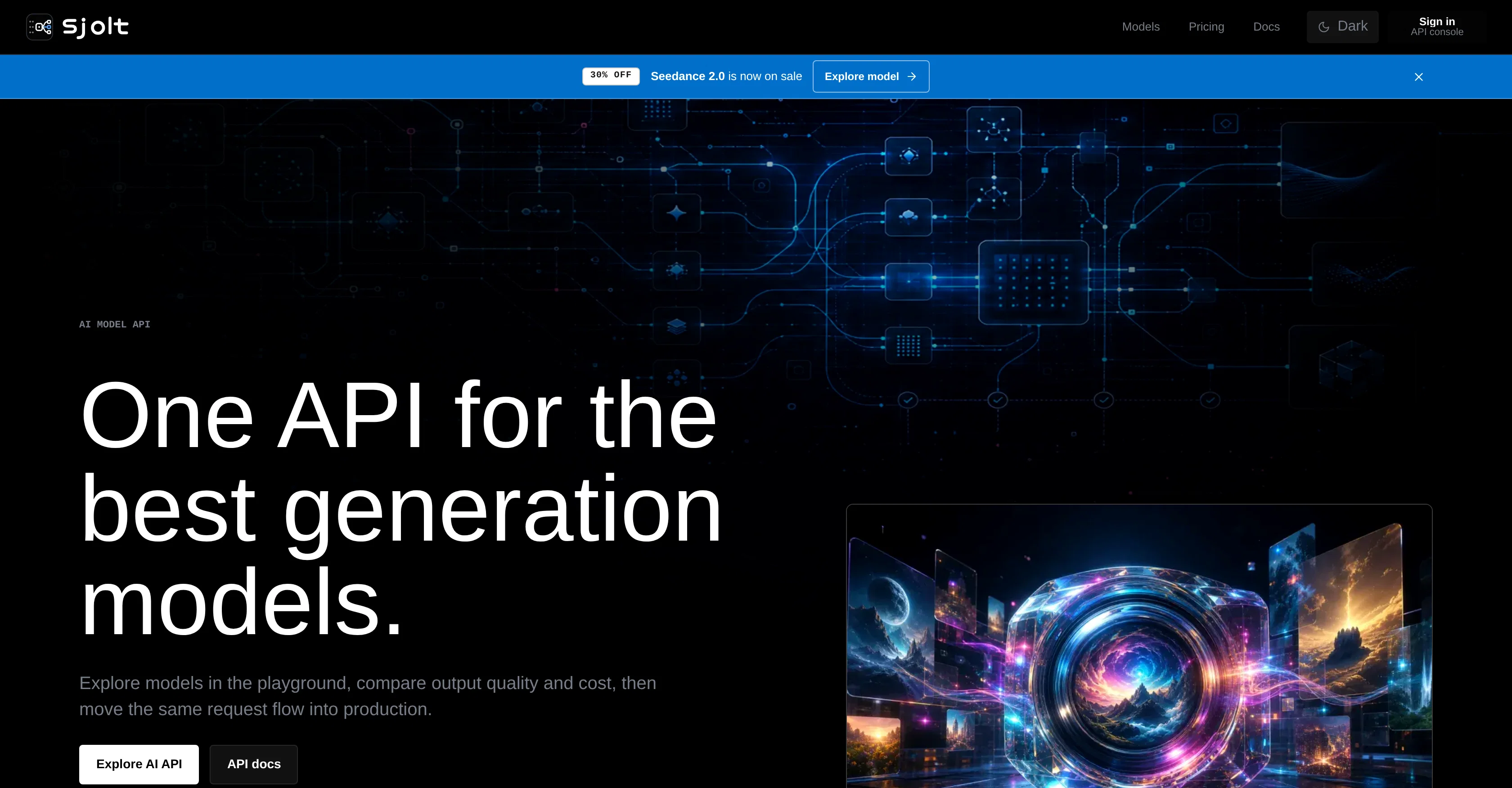
One API for all the best AI generation models.
Verdict
A quick read before you dig into the full page.
- Best if
- One API for all the best AI generation models
- Skip if
- Inspection limited to model samples
- Pick this when
- Array of generation models
Considering Muapi instead? Compare side by side
Overview
Sjolt is an AI model API platform that provides access to an array of generation models mainly for images and videos. It simplifies the exploration process by offering a playground environment where users can compare the output quality and cost of different models, then effectively implement the selected model into their production environment.
The intuitive platform allows for model choice to transition seamlessly to production calls without the need to switch tools. A selection of generation, editing, and multimodal workflows are available to choose based on specific tasks.
Integration with the sjolt API is user-friendly, with API-ready inputs including prompt, ratio, duration, and source assets. Billing is usage-based across the selected models.
Users can inspect model output samples before committing to a model, ensuring proper fit for the intended purpose. Some of the models mentioned include 'Seedance 2.0', a multimodal video generation model by ByteDance, 'GPT Image 2', an image generation model by OpenAI, and the 'Kling 3.0', a video generation model by Kuaishou.
The sjolt platform facilitates async status tracking and one-request pattern across supported models. Additionally, Sjolt provides clear operational notes and API examples for a smooth integration process.
The API platform is designed to support product teams, developers, and creators in their AI modeling needs.
Access & connections
Where you can use SJolt.
Platforms
Capabilities
What this tool accepts, produces, and is strongest at.
Input
- API
Output
- API
Highlights
- API
Supported features
- API
Pros & cons
Pros
- Array of generation models
- Playground environment
- Compare output quality
- Compare cost of models
- Seamless transition to production
- User-friendly API integration
- Usage-based billing
- Inspect output before commitment
Show 34 more
- Async status tracking
- Operational notes provided
- Clear API examples
- Supports product teams, developers, creators
- One API for multiple models
- Ready-to-use API inputs
- Supports Seedance 2.0, GPT Image 2, Kling 3.0
- Image and video generation
- Editing and multimodal workflows
- One-request pattern support
- Model-specific pricing visible
- Browser model catalog
- Test models with API-ready inputs
- Track usage and cost
- Supports long-running async jobs
- Quality, cost, status tracking comparison
- Prompt, ratio, duration, source assets inputs
- Model output inspection
- One balance covers model usage
- Billing views for finance review
- Model coverage visible before integration
- Task, inputs, outputs, status tracking catalog
- Same request flow across models
- Operational notes for integration
- Test model on playground
- API examples cover multiple languages
- Async job status updates
- Supports Image-to-video workflows
- Supports image editing workflows
- No tool switching for production
- Ability to reuse API example
- Explore model in playground
- Same object from playground to production
- Supports cinematic visuals generation
Cons
- Limited to image/video generation
- Usage-based billing fluctuations
- Dependent on model availability
- Difficult to estimate costs
- Async requests could delay
- Requires constant status tracking
- Limited predefined workflows
- Model selection could be challenging
Show 1 more
- Inspection limited to model samples
Compare alternatives
Similar tools in the catalog — with a clear reason to open each one.

Muapi ✓
PaidAI-powered image and video generation API platform.
Why look Stronger for image work
Full comparison



API Direct ✓
Free TrialThe social data layer for AI agents.
Why look Typically cheaper
Full comparison
Releases 1
FAQ 12
What is sjolt?
What does the sjolt API offer?
Is sjolt user-friendly for developers?
How does the API-ready inputs work on sjolt?
Can you explain the 'playground environment' provided by sjolt?
How can users compare the output quality and cost of different models on sjolt?
How does the model selection process work on sjolt?
What are some AI models sjolt supports?
How does the billing process work on Sjolt?
What is the 'Seedance 2.0' model on sjolt?
What is the 'GPT Image 2' model on sjolt?
What is the 'Kling 3.0' model on sjolt?
Related tools
Recommended

Mediaweb ✓
PaidCreate stunning portfolios in minutes with AI.
APIPASS ✓
PaidConnect to Any API, Instantly.

MMAudio Pro ✓
FreemiumTransform videos with AI-powered audio synthesis.

Medeo ✓
Free TrialMake great videos by chatting with AI.

Creative APIs by Picsart ✓
FreemiumTransforming creativity and automation with AI-powered image, video, and content editing tools

Unify AI ✓
FreemiumOne AI platform for all your creative needs.