
Sam3D
Meta's single-image 3D reconstruction model with SAM 3 segmentation.
Source rating 5.0
(70)
0 views
0 saves
Unknown
Verdict
A quick read before you dig into the full page.
- Best if
- Meta's single-image 3D reconstruction model with SAM 3 segmentation
- Pick this when
- Meta's single-image 3D reconstruction model with SAM 3 segmentation
Overview
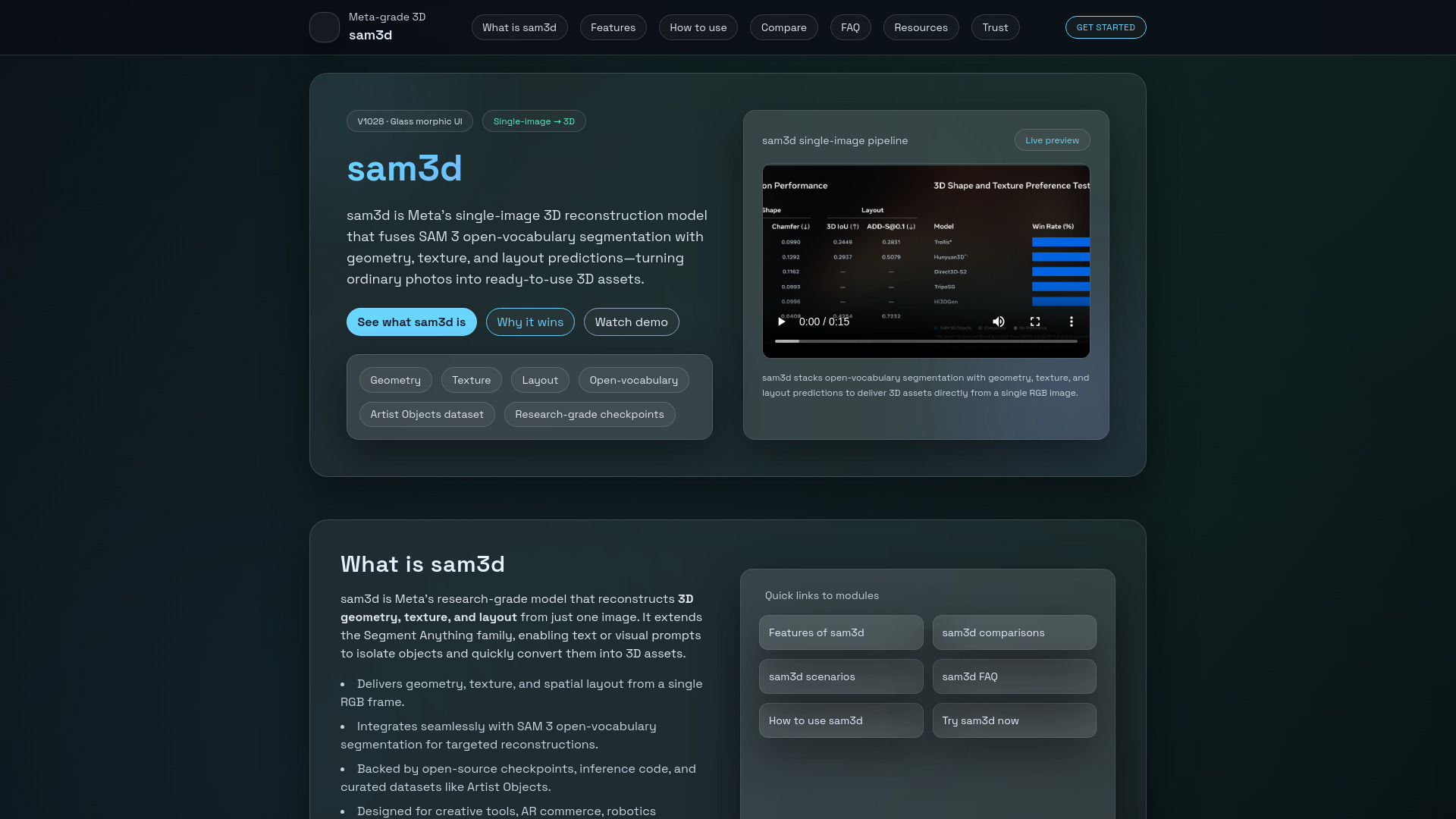
sam3d is Meta’s single-image 3D reconstruction model that fuses SAM 3 open-vocabulary segmentation with geometry, texture, and layout predictions. It turns ordinary photos into ready-to-use 3D assets. As a research-grade model, it reconstructs 3D geometry, texture, and layout from just one image, extending the Segment Anything family to enable text or visual prompts to isolate objects and quickly convert them into 3D assets.
Access & connections
Where you can use Sam3D.
Platforms
Capabilities
What this tool accepts, produces, and is strongest at.
Highlights
- Single-image 3D reconstruction (geometry, texture, layout)
- Open-vocabulary segmentation using SAM 3 prompts (text, points, boxes)
- Open ecosystem with checkpoints, inference code, and benchmarks
- XR (AR/VR) ready for immersive applications
- Efficient inputs, compatible with legacy photos and user-generated content
FAQ 12
What is Sam3D?
sam3d is Meta’s single-image 3D reconstruction model that fuses SAM 3 open-vocabulary segmentation with geometry, texture, and layout predictions. It turns ordinary photos into ready-to-use 3D assets. As a research-grade model, it reconstructs 3D geometry, texture, and layout from just one image, extending the Segment Anything family to enable text or visual prompts to isolate objects and quickly convert them into 3D assets.
How to use Sam3D?
To use sam3d, first capture a single, well-lit RGB image. Optionally, apply SAM 3 with a text or box prompt to isolate the target object. Next, run inference using the released checkpoints and code; sam3d will predict geometry, texture, and layout directly. Finally, export the mesh/texture for deployment into AR viewers, 3D engines, robotics simulators, or marketing experiences.
What makes sam3d different from photogrammetry?
sam3d reconstructs from a single image with SAM 3 prompts, while photogrammetry needs many calibrated views and controlled capture.
Does sam3d need depth sensors?
No. sam3d predicts geometry, texture, and layout from RGB alone, reducing reliance on LiDAR or depth cameras.
Can sam3d isolate specific objects?
Yes. Use SAM 3 open-vocabulary prompts (text, points, boxes) to mask the object, then pass it to sam3d for clean reconstruction.
Where does sam3d struggle?
Low-res, noisy, or heavily occluded images; rare categories; deformable humans; and scenes with motion blur.
Is sam3d open-source?
Meta provides checkpoints, inference code, and benchmarks, enabling reproducible research and production pilots.
Which datasets ship with sam3d?
Benchmarks include the artist-curated Artist Objects set and SAM 3D Body data for human mesh recovery.
How does sam3d help AR commerce?
Convert single product shots into AR-ready 3D assets, powering “view in room” with minimal capture overhead.
Can sam3d run in real time?
Latency depends on hardware and optimization (batching, quantization, distillation). Profile for your target devices.
How do I improve sam3d output?
Capture sharp images, simplify backgrounds, and fine-tune on domain-specific data to reduce artifacts.
What about safety and privacy?
Establish consent and policies for reconstructing private spaces; consider watermarking or usage controls for sensitive deployments.
Related tools
Recommended



Sam3D