PaperBanana: AI Academic Illustration Generator
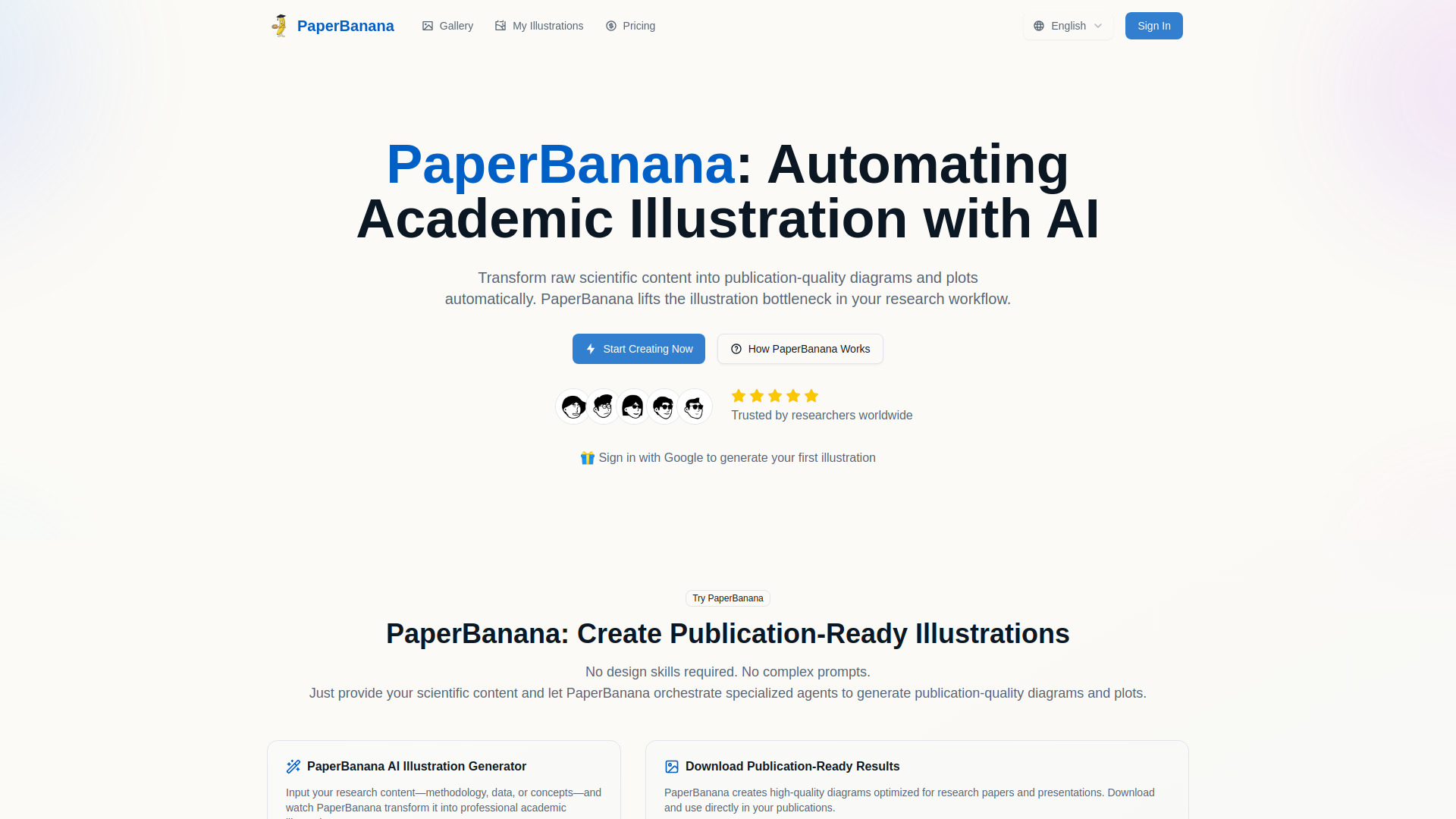
Transform raw scientific content into publication-quality diagrams and plots automatically. PaperBanana lifts the illustration bottleneck in your research workflow.
Verdict
A quick read before you dig into the full page.
- Best if
- Transform raw scientific content into publication-quality diagrams and plots automatically. PaperBanana lifts the illustration bottleneck in your research…
- Pick this when
- Transform raw scientific content into publication-quality diagrams and plots automatically. PaperBanana lifts the illustration bottleneck in your research…
Overview
PaperBanana(https://paper-banana.ai) is a cutting-edge AI academic illustration generator designed to revolutionize the research workflow by transforming raw scientific content into publication-quality diagrams and plots automatically. Addressing the common "illustration bottleneck" faced by scientists and researchers, PaperBanana eliminates the need for complex graphic design skills or tedious manual drafting.
At its core, PaperBanana is not just a standard image tool; it is a sophisticated agentic framework. Unlike generic AI art generators, PaperBanana orchestrates a collaborative team of five specialized AI agents—Retriever, Planner, Stylist, Visualizer, and Critic—to ensure every output meets rigorous academic standards.
Key capabilities of PaperBanana include:
Multi-Agent Collaboration: The workflow begins with the Retriever finding relevant references, followed by the Planner structuring the content. The Stylist applies professional aesthetics, the Visualizer renders the image, and finally, the Critic inspects the result against the source text to ensure accuracy through iterative self-correction.
Diverse Illustration Types: Whether you need complex Methodology Diagrams (such as Transformer architectures or GAN pipelines), Educational Infographics, or Aesthetic Enhancement for rough sketches, PaperBanana handles it all.
Accurate Statistical Plots: For data visualization, PaperBanana avoids AI hallucinations by generating executable Python Matplotlib code. This ensures that every bar height, axis tick, and data point in your AI academic illustration reflects your actual data with 100% precision.
Publication-Ready Output: The platform is engineered to produce high-resolution visuals optimized for top-tier venues like NeurIPS, ICML, and ICLR. Users can download images or code that are ready to be inserted directly into LaTeX or Word documents.
By combining reference-driven generation with iterative refinement, PaperBanana stands out as the premier solution for researchers seeking to create professional, accurate, and aesthetically pleasing AI academic illustrations in seconds.
Transform your research today at: https://paper-banana.ai
Access & connections
Where you can use PaperBanana: AI Academic Illustration Generator.
Platforms
Capabilities
What this tool accepts, produces, and is strongest at.
Highlights
- Specialized Multi-Agent Workflow: Unlike standard tools that rely on a single model, PaperBanana orchestrates a team of five specialized AI agents to handle different aspects of the illustration process: Retriever: Scans for relevant academic references to ground the visual style. Planner: Translates complex technical text into a structured visual blueprint. Stylist: Applies rigorous academic aesthetic standards (fonts, colors, layout). Visualizer: Renders the high-resolution image based on precise specifications. Critic: Inspects the output against the source content for quality control.
- Zero-Hallucination Statistical Plots: Data accuracy is non-negotiable in research. PaperBanana solves the "AI hallucination" problem by generating executable Python Matplotlib code for statistical plots. Accuracy: Every bar height, axis tick, and data point reflects your actual numbers, not an approximation. Customization: Users can download the underlying Python code to fine-tune the visualization in their preferred environment.
- Reference-Driven Style Generation: To ensure your diagrams fit seamlessly into top-tier journals (e.g., NeurIPS, ICML), PaperBanana uses a Reference-Driven approach. The system retrieves and analyzes relevant academic examples to guide the visual style, ensuring that the generated AI academic illustration matches established publication standards in your specific field.
- Iterative Self-Critique & Refinement: Perfection rarely happens in one shot. PaperBanana features a built-in Iterative Refinement loop driven by the "Critic" agent. Automatic Feedback: The Critic reviews the generated image against your original description. Self-Correction: If discrepancies are found, the system automatically regenerates and refines the image until it meets quality benchmarks, saving you from manual editing.
- Diverse Illustration Capabilities: PaperBanana is a versatile platform capable of handling the full spectrum of academic visuals: Methodology Diagrams: Flowcharts for Transformer architectures, GAN pipelines, and multi-agent systems. Aesthetic Enhancement: Upload rough hand-drawn sketches, and the AI will "polish" them into professional graphics without changing the structure. Educational Infographics: Simplify dense concepts into intuitive visuals for teaching and presentations.
- Publication-Ready Output: The ultimate goal of PaperBanana is to streamline the submission process. All outputs are optimized for: High Resolution: Crisp visuals suitable for print and digital archives. Format Compatibility: Images are ready to be inserted directly into LaTeX or Word documents without further format conversion.
FAQ 8
What is PaperBanana: AI Academic Illustration Generator?
At its core, PaperBanana is not just a standard image tool; it is a sophisticated agentic framework. Unlike generic AI art generators, PaperBanana orchestrates a collaborative team of five specialized AI agents—Retriever, Planner, Stylist, Visualizer, and Critic—to ensure every output meets rigorous academic standards.
Key capabilities of PaperBanana include:
Multi-Agent Collaboration: The workflow begins with the Retriever finding relevant references, followed by the Planner structuring the content. The Stylist applies professional aesthetics, the Visualizer renders the image, and finally, the Critic inspects the result against the source text to ensure accuracy through iterative self-correction.
Diverse Illustration Types: Whether you need complex Methodology Diagrams (such as Transformer architectures or GAN pipelines), Educational Infographics, or Aesthetic Enhancement for rough sketches, PaperBanana handles it all.
Accurate Statistical Plots: For data visualization, PaperBanana avoids AI hallucinations by generating executable Python Matplotlib code. This ensures that every bar height, axis tick, and data point in your AI academic illustration reflects your actual data with 100% precision.
Publication-Ready Output: The platform is engineered to produce high-resolution visuals optimized for top-tier venues like NeurIPS, ICML, and ICLR. Users can download images or code that are ready to be inserted directly into LaTeX or Word documents.
By combining reference-driven generation with iterative refinement, PaperBanana stands out as the premier solution for researchers seeking to create professional, accurate, and aesthetically pleasing AI academic illustrations in seconds.
Transform your research today at: https://paper-banana.ai
How to use PaperBanana: AI Academic Illustration Generator?
PaperBanana is an advanced AI academic illustration tool that uses a multi-agent workflow to automate the entire design process. Whether you are visualizing a complex neural network or plotting statistical data, here is your comprehensive guide on how to master PaperBanana.
Step 1: Access the PaperBanana Platform
Navigate to https://paper-banana.ai to access the dashboard. The interface is designed for researchers, meaning no design skills are required. You don't need to master complex prompt engineering; the system understands scientific context natively.
Step 2: Input Your Scientific Content
To generate a high-quality AI academic illustration, simply provide a text description of your research.
For Methodology Diagrams: Paste your methodology section, algorithm description, or system architecture details (e.g., "Transformer architecture with multi-head attention").
For Statistical Plots: Input your dataset and specific chart requirements (e.g., "Bar chart comparing model accuracy across three datasets").
For Educational Infographics: Describe the concept you want to simplify for students or a general audience.
Pro Tip: You can also upload reference images to guide the "Retriever" agent, ensuring the style matches specific academic conventions.
Step 3: Let the Multi-Agent System Work
Once you click 'Generate Images', PaperBanana's unique Agentic Framework takes over. Unlike standard image generators, five specialized agents collaborate on your request:
Retriever: Finds relevant academic style references.
Planner: Structures the layout based on your text.
Stylist: Applies publication-standard aesthetics (fonts, colors, line weights).
Visualizer: Renders the diagram.
Critic: Inspects the result against your prompt and triggers automatic refinement if necessary.
Step 4: Iterative Refinement & Editing
If the initial output isn't perfect, PaperBanana allows for easy updates.
Regenerate: Adjust your text prompt to clarify details.
Aesthetic Refinement: Upload an existing rough sketch or a generated diagram and ask PaperBanana to "polish" it. The AI will upgrade colors, typography, and spacing without altering the logical structure of your data.
Step 5: Download Publication-Ready Assets
PaperBanana ensures your files are ready for immediate submission to top-tier venues like NeurIPS or ICML.
Images: Download high-resolution visuals optimized for LaTeX and Word.
Python Code (Exclusive): For statistical plots, you can download the underlying Python Matplotlib code. This guarantees that your AI academic illustration is numerically accurate and free from "hallucinations," giving you full control over the data representation.