x402

P402.io

Routing control plane for reliable x402 crypto micropayments on Base, enabling paid APIs for agents.

Source rating 5.0 (59) 0 views 0 saves Unknown
More categories (11)

Verdict

A quick read before you dig into the full page.

Best if
Routing control plane for reliable x402 crypto micropayments on Base, enabling paid APIs for agents
Pick this when
Routing control plane for reliable x402 crypto micropayments on Base, enabling paid APIs for agents

Overview

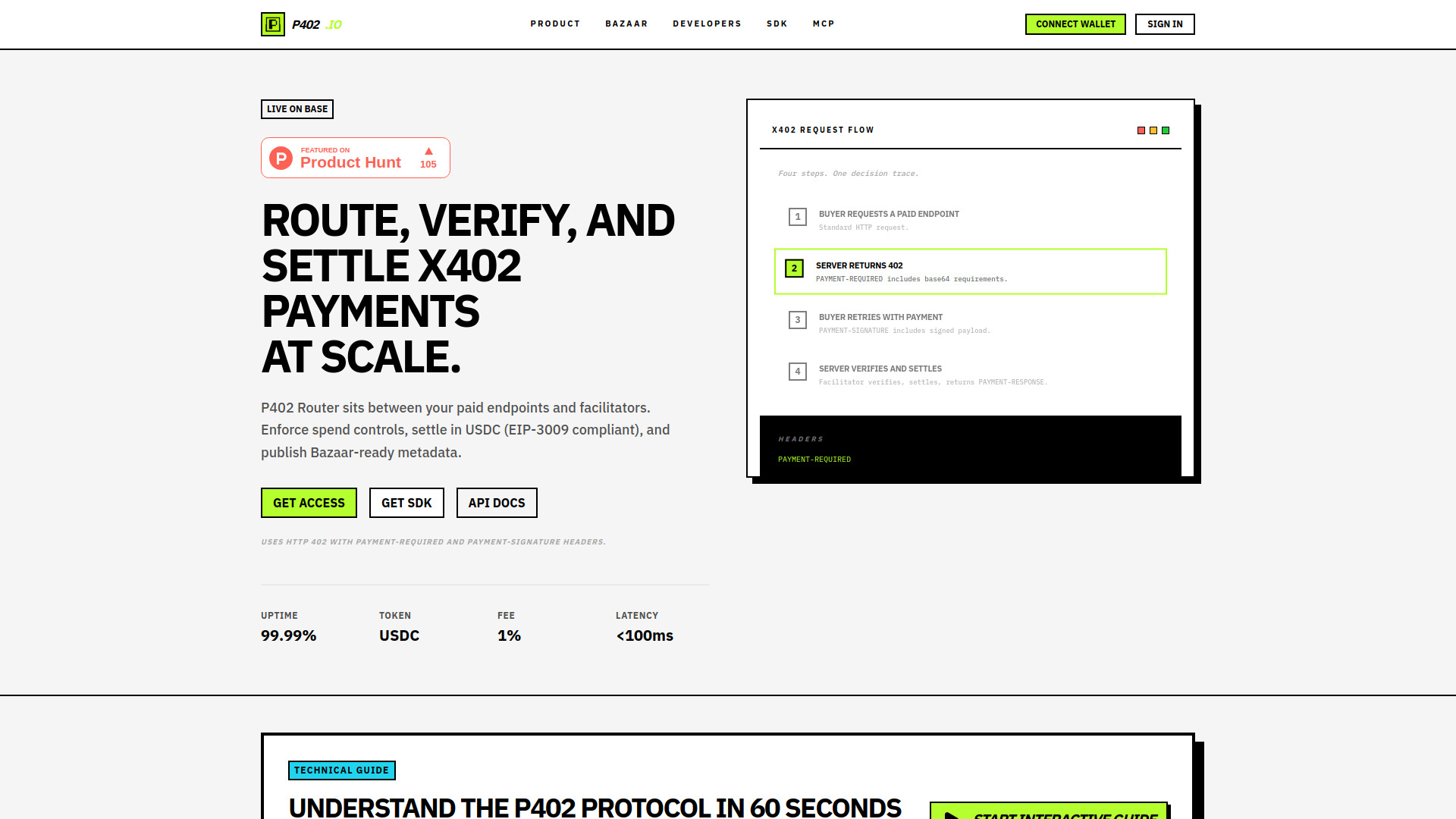
P402 Router is a sophisticated routing control plane designed to operationalize and scale x402 (HTTP 402 Payment Required) payments for paid endpoints and agent stacks. It addresses fragmentation and instability in the x402 ecosystem by sitting between paid endpoints and payment facilitators. The Router evaluates requests, selects optimal acceptance options, routes verification and settlement, and enforces critical policies like spend controls and rate limits. It facilitates trustless micropayment settlement using USDC and USDT on the Base blockchain with a low 1% flat fee, making it ideal for high-volume pay-per-call APIs and agent-to-agent transactions.

P402.io screenshot

Access & connections

Where you can use P402.io.

Platforms

Web

Capabilities

What this tool accepts, produces, and is strongest at.

Highlights

  • Smart Routing: Selects the best facilitator based on health, cost, and policy, with failover capability.
  • Spend Controls: Enforces per-buyer budgets, rate limits (RPM), route caps, and denial rules.
  • x402 Payment Settlement: Route, verify, and settle USDC/USDT payments on the Base blockchain with a 1% flat fee.
  • Observability & Tracing: Provides a DecisionTrace timeline for every payment attempt, tracking conversion and failure causes.
  • Bazaar Overlays: Exposes machine-readable metadata tied to runtime health for endpoint discovery.


FAQ 5

What is P402 Router | x402 Payment Infrastructure?
P402 Router is a sophisticated routing control plane designed to operationalize and scale x402 (HTTP 402 Payment Required) payments for paid endpoints and agent stacks. It addresses fragmentation and instability in the x402 ecosystem by sitting between paid endpoints and payment facilitators. The Router evaluates requests, selects optimal acceptance options, routes verification and settlement, and enforces critical policies like spend controls and rate limits. It facilitates trustless micropayment settlement using USDC and USDT on the Base blockchain with a low 1% flat fee, making it ideal for high-volume pay-per-call APIs and agent-to-agent transactions.
How to use P402 Router | x402 Payment Infrastructure?
To use the P402 Router, integrate it between your paid endpoints and payment facilitators. The process follows the standard x402 flow, enhanced by the Router's controls: 1. Server returns HTTP 402 with the PAYMENT-REQUIRED header (specifying payment requirements). 2. Buyer (typically an agent) retries with the PAYMENT-SIGNATURE header (including the signed payment payload). 3. The Router routes the verification and settlement through the optimal facilitator, records a detailed DecisionTrace, enforces policies (budgets, caps), and settles the payment in USDC/USDT on Base. Access requires submitting a 'Request Access' form to join the router validation network.
I still get 402 after attaching the payment header. Why?
Possible reasons include: 1) Using legacy X-PAYMENT instead of PAYMENT-SIGNATURE. 2) Invalid signature. 3) Amount requested is too low. 4) The buyer address lacks sufficient USDC or is KYT flagged.
What does Bazaar do?
Bazaar serves as the discovery layer, listing payable endpoints using machine-readable metadata so developers and agents can discover accurate pricing and routing information.
Do different facilitators exist in the x402 ecosystem?
Yes. The ecosystem includes multiple facilitators, which vary by network, supported tokens, fees, and feature profiles.
P402.io