
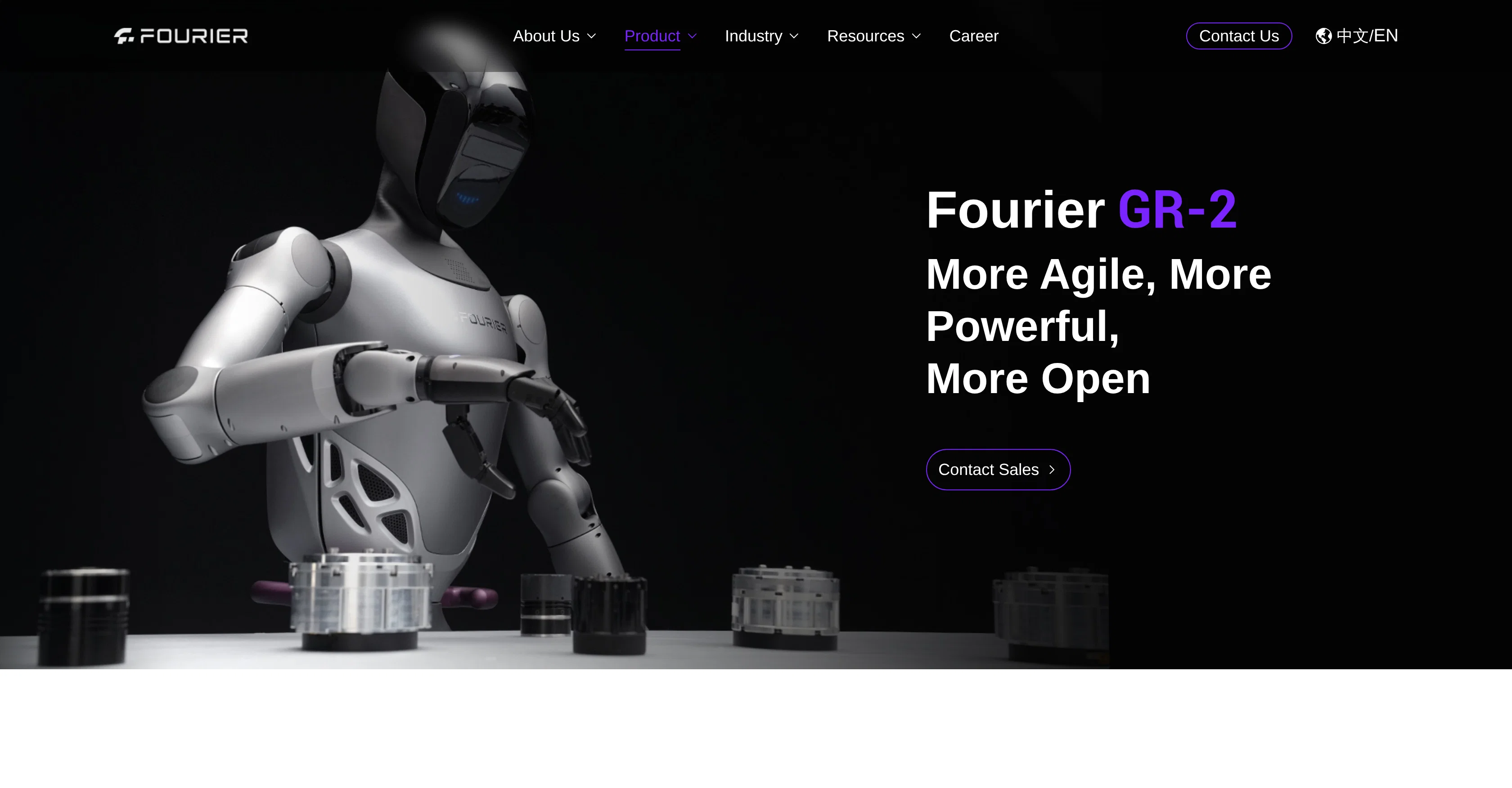
FOURIER-Robotics GR-2
More Agile, More Powerful, More Open
Verdict
A quick read before you dig into the full page.
- Best if
- More Agile, More Powerful, More Open
- Skip if
- Complex assembly required
- Pick this when
- State-of-the-art design
Considering Figure instead? Compare side by side
Overview
FOURIER-Robotics GR-2 is a state-of-the-art humanoid robot that introduces remarkable upgrades across hardware, design, and software. Designed based on first-hand data and customer feedback, GR-2 is crafted with optimal function and industry use in mind.
The hardware design includes an integrated cabling design for seamless power and communication transmission, leading to fewer visible wires and more compact packaging.
Its joint configuration has been refined to improve debugging, lower manufacturing costs, and enhance the transition from AI simulation to real-world applications.
GR-2 introduces 12 Degrees of Freedom (DoF) dexterous hands, engineered to emulate the flexibility of human physiology, thus improving the robots ability to carry out complex tasks with great precision.
It also utilizes seven different types of Field-oriented Control (FoC) Stepper Actuators (FSA), specifically designed to meet unique torque requirements of each joint.
The GR-2's dexterity is further enhanced with six array-type tactile sensors that enable the robot to sense force, identify object shapes and materials, and adjust its grip in real time.
As a part of the developer experience, the GR-2 comes with an upgraded Software Development Kit (SDK) that provides easy access to a suite of pre-optimized modules via intuitive APIs.
Moreover, this platform is compatible with various software frameworks including NVIDIA Isaac Lab, ROS, and Mujoco.
Access & connections
Where you can use FOURIER-Robotics GR-2.
Platforms
Capabilities
What this tool accepts, produces, and is strongest at.
Input
- API
Output
- API
Pros & cons
Pros
- State-of-the-art design
- Upgrades across hardware, software
- Integrated cabling
- Joint debugging capability
- Lower manufacturing costs
- 12 Degrees of Freedom hands
- Seven types of FSA
- Identify object shapes
Show 32 more
- Greip adjustment in real-time
- Compatible with NVIDIA Isaac Lab
- Compatible with ROS
- Compatible with Mujoco
- Enhanced dexterity
- Six tactile sensors
- Real-world application transitioning
- Object shape recognition
- Real-time grip adjustment
- Force sensing
- Autonomous humanoid features
- Reduced visible wires
- Improved developer SDK
- Intuitive APIs
- Compact packaging
- Real-time object identification
- Customizable torque requirements
- Array-type tactile sensors
- Unique joint configuration
- Upgraded software modules
- Agility and precision
- Distinguished robotics physiology
- Size and weight balance
- Ease of use
- Supports various software frameworks
- Increased mobility
- Greater flexibility
- Precise movements
- High-pressure environment performance
- Enhanced customer feedback incorporation
- Double control accuracy
- Robust pre-optimized modules
Cons
- Limited battery life
- Does not support Python
- No waterproof capabilities
- No collision detection
- Sensitive to light conditions
- Complex assembly required
- Lack of safety measures
- Locked Source Code
Show 2 more
- Difficult debugging process
- Proprietary repair parts
Compare alternatives
Similar tools in the catalog — with a clear reason to open each one.

Figure
UnknownBringing general purpose humanoid robots to life.
Why look Higher community rating
Full comparison

1X TECH NEO Home Robot
UnknownTransform your home with an autonomous helper robot.
Autonomous humanoids
Full comparison
UBTECH Walker S2
UnknownNavigate the world with comprehensive country data.
Autonomous humanoids
Full comparison
UBTECH Cruzr S2
UnknownGlobal connectivity meets intelligent automation.
Autonomous humanoids
Full comparison
Releases 1
FAQ 12
What are the hardware improvements in FOURIER-Robotics GR-2?
What does the integrated cabling design do in the FOURIER-Robotics GR-2?
How does joint configuration in FOURIER-Robotics GR-2 enhance real-world applications?
How does the 12 Degrees of Freedom functionality of FOURIER-Robotics GR-2 work?
What are the different types of Field-oriented Control Stepper Actuators in FOURIER-Robotics GR-2?
What type of tasks can the tactile sensors in FOURIER-Robotics GR-2 handle?
In what ways does the upgraded Software Development Kit improve the developer experience for FOURIER-Robotics GR-2?
Which software frameworks is FOURIER-Robotics GR-2 compatible with?
How does FOURIER-Robotics GR-2 emulate human physiology?
What does the real-time grip adjustment do for FOURIER-Robotics GR-2?
What are the unique torque requirements met by the actuators in FOURIER-Robotics GR-2?
What is the role of NVIDIA Isaac Lab in the functionality of FOURIER-Robotics GR-2?
Related tools
Recommended

Autonoma ✓
FreemiumAgentic testing with real browsers and devices.

Autopilots by Athena AI ✓
Free TrialAutonomous AI agents that execute tasks for you.

ownAI ✓
FreemiumThe AI that belongs to you – open source, local, self-evolving.