

FlowTestAI ✓
Craft API workflows with GenAI-powered IDE
Verdict
A quick read before you dig into the full page.
- Best if
- Craft API workflows with GenAI-powered IDE
- Skip if
- Complex setup with CI/CD pipelines
- Pick this when
- Open-source tool
Considering Featherless - Serverless LLM Hosting instead? Compare side by side
Overview
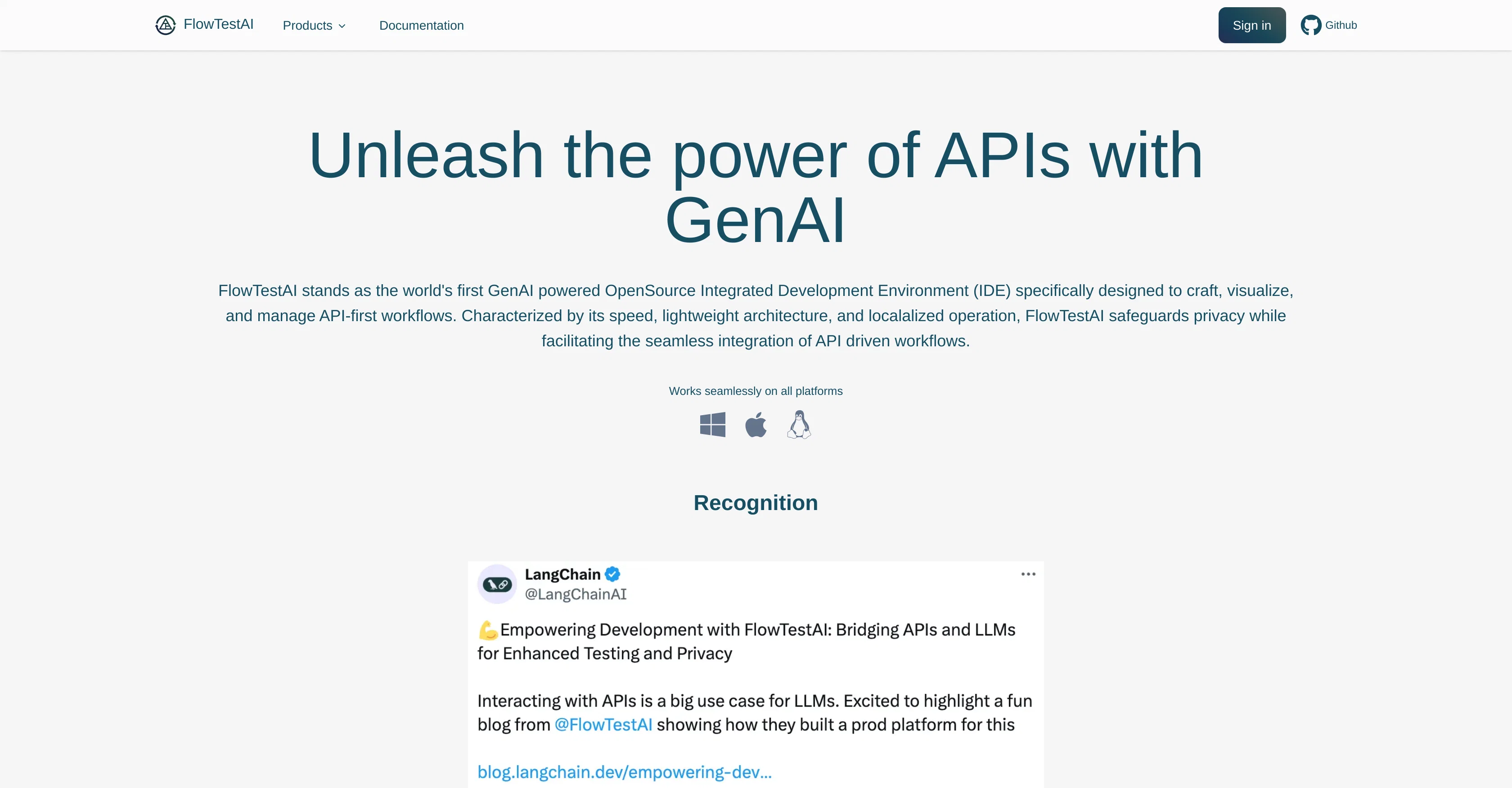
FlowTestAI is an open-source, GenAI-powered integrated development environment (IDE) innovatively built for crafting, visualizing, and managing API-first workflows.
Its lightweight architecture offers speed and localized operation, promoting the effortless integration of API-driven workflows across all platforms. One of its salient features is its innovative approach to testing, focusing on the context of APIs within the whole system to ensure smooth user journeys.
With a user-centric testing approach, APIs are tested in real-world scenarios, elevating the practicality of its user application. FlowTestAI also redefines end-to-end tests as visual graphical flows, serving as a living documentation of the system's expected behaviors.
Visual graphical flows simplify the understanding of complex API interactions, aiding users in swiftly understanding interoperability among different components.
The tool also upholds privacy and security by keeping operations local and securely handling credentials. An addition to its portfolio includes a CLI with seamless integration for existing CI/CD pipelines and an analytics tool for identifying slow tests, pinpointing failure points, optimizing API performance and enhancing the overall API testing process.
The platform embraces community-driven innovation by being an open-source tool and is actively working on integrating with locally run LLMs for increased privacy.
Access & connections
Where you can use FlowTestAI.
Platforms
Capabilities
What this tool accepts, produces, and is strongest at.
Input
- API
- Text
Output
- API
Supported features
- QA Automation
Pros & cons
Pros
- Open-source tool
- Exclusively built for API
- Lightweight architecture
- Speedy performance
- Localized operation
- Innovative testing approach
- Real-world scenario API testing
- Visual graphical flows
Show 21 more
- User-centric testing
- Ensures smooth user journey
- Living documentation
- Enhances interoperability understanding
- Privacy and security prioritized
- Seamless CLI integration
- Analytics for test optimization
- Promotes community-driven innovation
- Integration with local LLMs
- Performance and efficiency focus
- Clear traceability of operations
- Secure credential handling
- Compatible on all platforms
- Natural language translation
- Contextual testing
- Revolutionizing API testing
- Generates tests from descriptions
- Synchronization with version control
- Drag-and-drop interface
- Detailed performance charts
- Pinpoints test failures
Cons
- No mobile app
- Operates only locally
- No integrated collaboration tools
- Graphical flow understanding required
- Open-source may mean less stable
- Not integrated with most LLMs
- Dependent on internet connectivity
- Limited analytics tools
Show 2 more
- Lack of user-reviews
- Complex setup with CI/CD pipelines
Compare alternatives
Similar tools in the catalog — with a clear reason to open each one.

Featherless - Serverless LLM Hosting ✓
Free TrialDeploy any open AI model effortlessly.
Why look Higher community rating
Full comparison

CometAPI ✓
FreemiumOne API, 500+ AI models at your fingertips.
Why look Higher community rating
Full comparison
APIMart ✓
UnknownOne API for 500+ AI models at 70% less cost.
Why look Higher community rating
Full comparison

Token Harbor ✓
Free TrialThe easiest way to access frontier AI models.
Why look Higher community rating
Full comparisonReleases 1
FAQ 12
What is FlowTestAI?
What is the purpose of GenAI in FlowTestAI?
How does FlowTestAI prioritize speed and lightweight architecture?
What is unique about FlowTestAI's approach to testing?
How does FlowTestAI implement real-world testing scenarios?
What are visual graphical flows in FlowTestAI?
How does FlowTestAI uphold privacy and security?
What is the role of CLI in FlowTestAI?
How does FlowTestAI integrate with existing CI/CD pipelines?
How does the analytics tool in FlowTestAI identify slow tests?
How does FlowTestAI facilitate understanding of complex API interactions?
What are the advantages of FlowTestAI being an open-source tool?
Related tools
Recommended

TutorAI ✓
FreemiumInstant knowledge on any topic

Mindsmith ✓
FreemiumPlatform for building and sharing eLearning content

OpenRead ✓
FreemiumAI-powered interactive papers for faster, intuitive research

Programming Helper ✓
UnknownGenerate code from text descriptions instantly.

LearnGPT ✓
FreeLearn any topic with AI-powered guidance

DeepSeek ✓
FreeUnravel the mystery of AGI with curiosity