Low-Code/NoCode

Digma.ai

Digma AI provides continuous feedback to developers, identifying code issues early in the SDLC.

Source rating 5.0 (74) 1k views 1k/mo traffic 0 saves Unknown
More categories (14)

Verdict

A quick read before you dig into the full page.

Best if
You are engineering Managers and need: Resolve performance issues in pre-production
Pick this when
Digma AI provides continuous feedback to developers, identifying code issues early in the SDLC

Overview

Digma Continuous Feedback (CF) enables developers to uncover code runtime regressions, anomalies and code smells, right from their IDE. Digma resolves performance issues earlier in the SDLC, preventing incidents in production and engineering disruptions. Digma’s MCP Server makes AI Coding smarter. Digma highlights the affected areas and impacted components for each code change and Pull Request, eliminating the risk of breaking changes and consequent loss of engineering time. Digma goes beyond traditional monitoring and alerting, focusing on preempting issues.

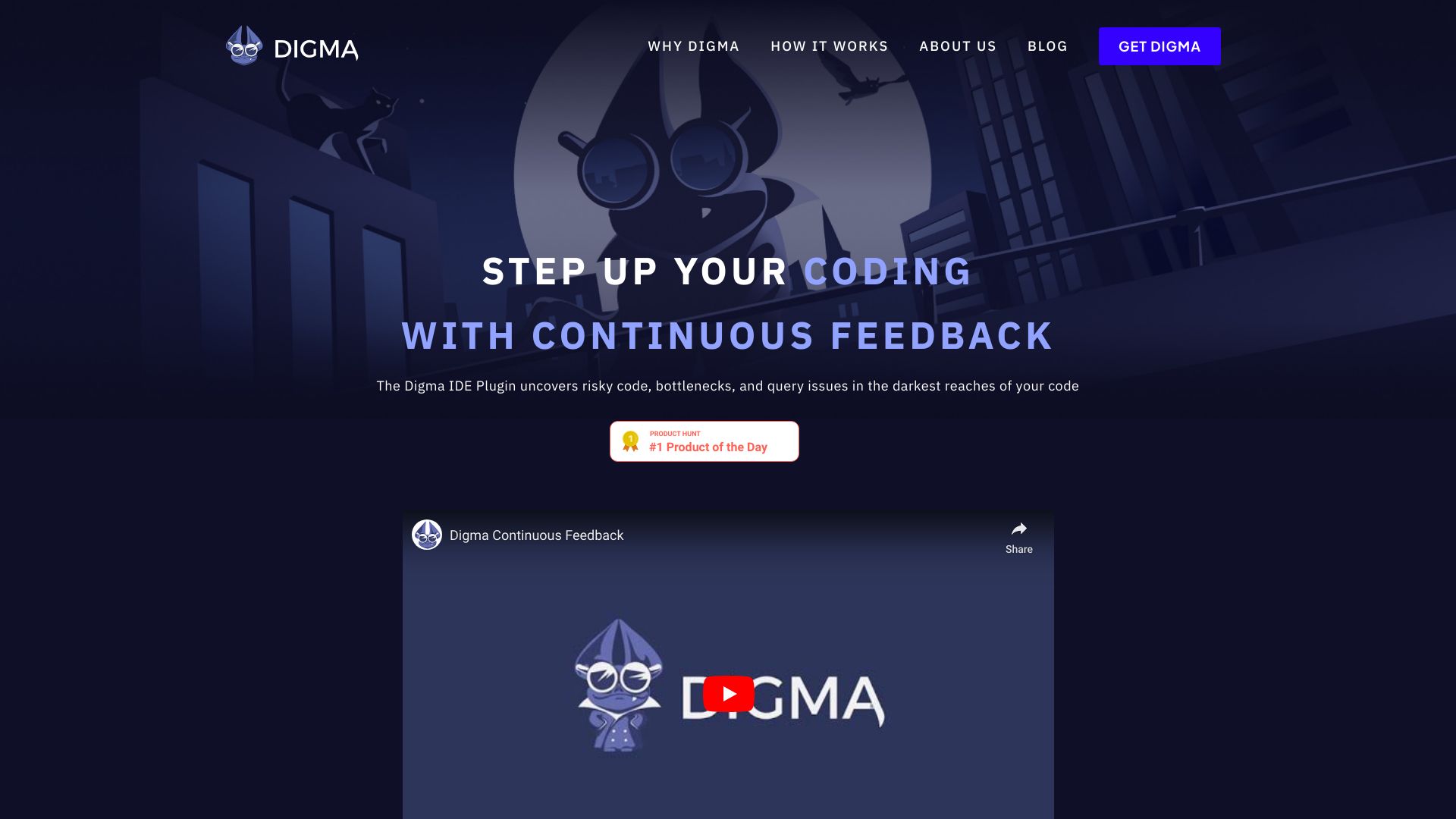
Digma.ai screenshot

Best for

Short scenarios where Digma.ai tends to shine.

  • Resolve performance issues in pre-production.

    Best for Engineering Managers

  • Prepare codebase for scale by identifying bottlenecks.

    Best for Architects and Team Leads

  • Stop breaking the code by highlighting affected areas for each code change.

    Best for Software Developers

Example outputs 1

Sample generations and before/after results for Digma.ai.

Access & connections

Where you can use Digma.ai, and what it plugs into.

Platforms

Web

Integrations

MCP

Capabilities

What this tool accepts, produces, and is strongest at.

Highlights

  • Dynamic Code Analysis
  • Performance Issue Identification
  • Scalability Insights
  • Prevention of Breaking Changes
  • AI Coding Assistance

People also view

Tools that often show up alongside Digma.ai in collections and comparisons.
FAQ 9

What is Digma AI?
Digma Continuous Feedback (CF) enables developers to uncover code runtime regressions, anomalies and code smells, right from their IDE. Digma resolves performance issues earlier in the SDLC, preventing incidents in production and engineering disruptions. Digma’s MCP Server makes AI Coding smarter. Digma highlights the affected areas and impacted components for each code change and Pull Request, eliminating the risk of breaking changes and consequent loss of engineering time. Digma goes beyond traditional monitoring and alerting, focusing on preempting issues.
How to use Digma AI?
Install the Digma plugin in your IDE. Digma analyzes code changes and highlights affected areas before merging a Pull Request. It works without requiring code changes and integrates with OpenTelemetry.
How is Digma different from traditional monitoring tools like APMs?
Digma identifies problems earlier in the development cycle using Dynamic Code Analysis, preventing disruptions before they impact production. It is a complementary solution to APMs.
Can Digma help with breaking changes across the team’s codebase?
Yes! Digma analyzes every code change and highlights affected areas before you even merge a Pull Request.
Does Digma require any code changes? Or setting up a complicated observability system?
Nope! Digma works without requiring any code changes. It’s also OpenTelemetry (OTEL) compliant.
How does Digma help reduce infrastructure costs?
Digma identifies inefficient code patterns that increase resource consumption, helping engineering teams write cost-efficient code.
Does Digma use AI, and what happens to our data?
Digma doesn’t use public AI models that could share your data outside your organization. Everything stays local.
What kind of performance issues can Digma detect?
Digma detects a variety of performance-related issues, including: Code changes that introduce unexpected performance regressions, Slow execution paths in the code, Scalability bottlenecks that may cause failures under load, Inefficient database queries or API calls
Is Digma a replacement for profilers or static analysis tools?
Not really—profilers and static analysis tools have their place, but they usually come into play after something goes wrong. Digma goes further by analyzing real runtime data.
Digma.ai