

DataRobot Generative AI ✓
Enterprise generative AI models, rapidly evaluated and benchmarked.
Verdict
A quick read before you dig into the full page.
- Best if
- Enterprise generative AI models, rapidly evaluated and benchmarked
- Skip if
- Complex to set up
- Pick this when
- Rapid evaluation capability
Considering Mistral AI Studio instead? Compare side by side
Overview
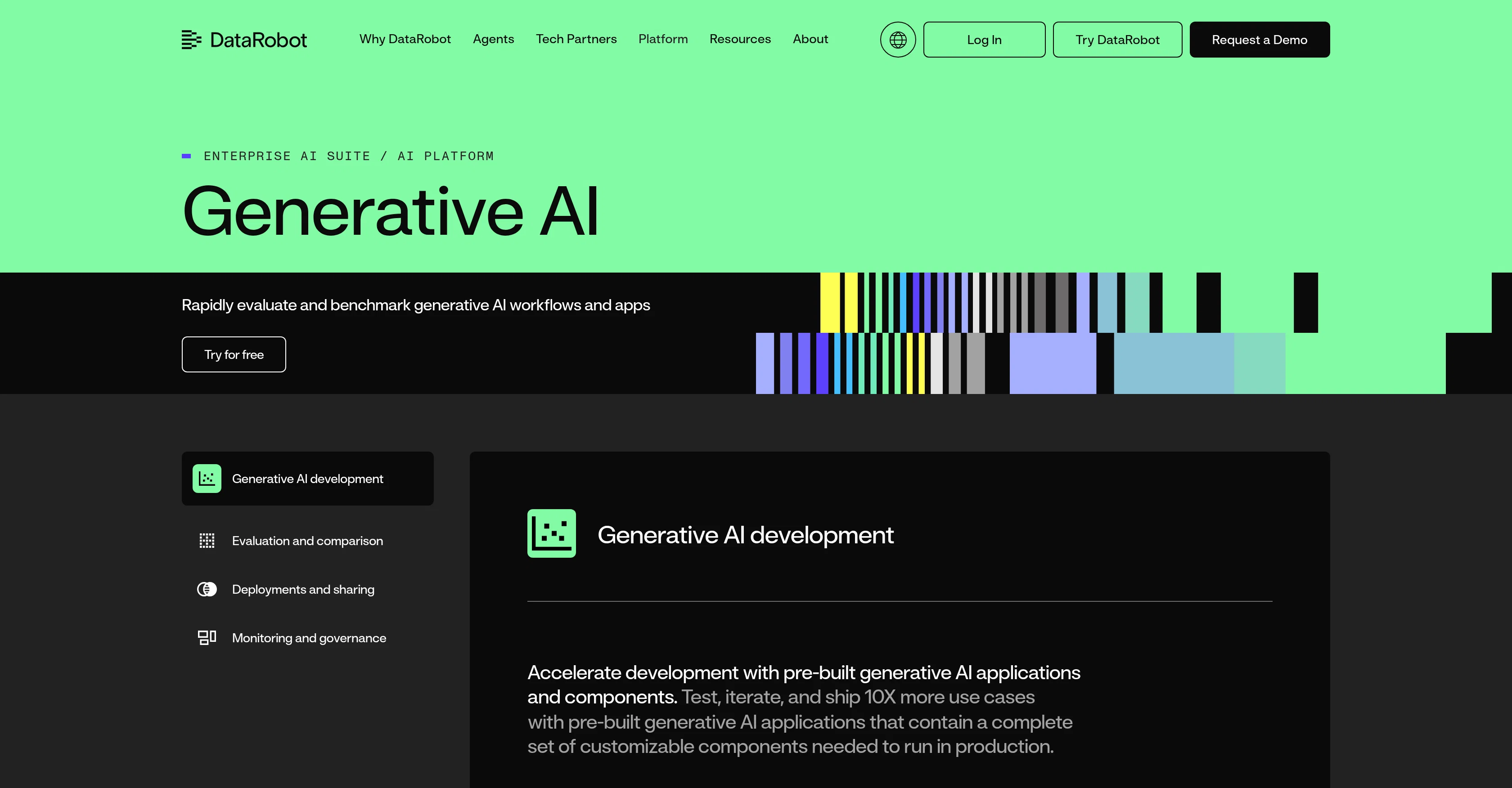
DataRobot's Generative AI is a versatile tool that enables rapid evaluation, benchmarking, and development of generative AI workflows and applications.
It is designed with pre-built generative AI applications and customizable components to streamline development and deployment, thereby enabling more use cases to be explored and deployed more quickly.
It empowers data decision makers to gather deep insights from tabular data and documents securely. This tool also has a special emphasis on scaling up business operations through generating personalized content based on customer data and predictions.
It provides an understanding of predictive analytics by supplementing time series forecasts with generative AI-driven summaries and predictive explanations.
Users can develop across ecosystems using the tool's user-friendly GUI and code-based generative AI tooling. It simplifies credential handling and allows for rapid experimentation and deployment of various models such as LLM, SLM, vector database, or embedding model.
DataRobot Generative AI supports the combination of over 70 generative AI models and embedding models, effectively managing API keys and accounts. It also accesses GPUs from any cloud, optimizing workflow latency, cost, and availability for large workloads across multiple cloud resources.
The tool facilitates efficient testing of prompts, tweaking settings, and comparing outputs to identify optimal configurations. Its capabilities extend to enabling the construction of advanced RAG systems, incorporating RAG into generative AI workflows, and improving retrieval speeds and overall accuracy by indexing vectors with metadata.
A unique feature is its ability to synthetically generate thousands of question-answer pairs in seconds.
Access & connections
Where you can use DataRobot Generative AI.
Platforms
Capabilities
What this tool accepts, produces, and is strongest at.
Input
- Code
- Tabular
- Text
Output
- Code
- Tabular
- Text
Supported features
- Data Analysis
Pros & cons
Pros
- Rapid evaluation capability
- Pre-built generative applications
- Deployment streamlining
- Tabular data insight gathering
- Secure document analysis
- Predictive analytics understanding
- Time series forecast supplementing
- Predictive explanations provided
Show 39 more
- User-friendly GUI
- Credential handling simplification
- Rapid model deployment
- Multi-model support (over 70)
- Effective API key/account management
- Cloud GPU access
- Workflow optimization
- Large workload handling
- Prompt testing efficiency
- Setting optimization
- Output comparisons
- Advanced RAG systems construction
- RAG integration into workflows
- Vector metadata indexing
- Synthetic Q&A pair generation
- Versatile development across ecosystems
- LLM, SLM, vector database support
- Embedding model support
- Personalized content generation
- Optimal configuration identification
- Retrieval speed and accuracy improvements
- Advanced RAG systems
- Rapid experimentation support
- Large generative model arsenal
- Multi-cloud resource utilization
- Latency, cost, availability optimization
- Ecosystem-wide Model benchmarking
- Real-time stakeholder feedback
- Customizable evaluation criteria
- Quick model adoption
- Deployment ease
- Auto-managed Infrastructure as Code workflow
- Seamless model swapping
- Chatbot integration
- Custom application UIs
- Workflow debugging
- Automated issue intervention
- Guard library for monitoring
- Automated compliance checks
Cons
- Dependent on cloud access
- Complex to set up
- Increased workload optimization latency
- GPU dependent
- Difficulties managing API keys
- Customizable components may confuse
- May require external vector database
- Requires continuous input optimization
Show 2 more
- Multi-model support complexity
- Difficult to index vectors
Compare alternatives
Similar tools in the catalog — with a clear reason to open each one.

Mistral AI Studio ✓
FreeAI builders' preferred toolkit for enterprise deployment.
Free
Full comparison

Elham.ai ✓
FreemiumEmpowering You with the Future of Automated Machine Learning
Why look Offers a public API
Full comparison
MagicShot.ai ✓
PaidEvery photo, video & voice clip you need, made in seconds
Why look Stronger for image work
Full comparison
BotX ✓
FreemiumRapid AI development with low-code solutions
Why look Better fit for coding
Full comparison
Releases 1
Imported reviews 1
Played around with this a bit — the benchmarking and evaluation side feels especially useful for teams testing multiple models at scale.
Related tools
Recommended

ChatGPT ✓
FreemiumAsk anything, create anything, and move from idea to action.

Automateed ✓
Free TrialCreate eBooks effortlessly with Automateed, the AI-powered writing tool.

Notis ✓
Free TrialThe first WhatsApp assistant that runs on your ChatGPT and Claude subscriptions

ElevenLabs ✓
FreemiumCreate lifelike AI voices for compelling storytelling.

Ideogram ✓
FreemiumAI-powered creativity booster

Synthesia ✓
FreemiumCreate AI videos from text in minutes.