

Data processing 2026 Rank: #712
DataFlow ✓
Easy data preparation with AI-powered operators.
Verdict
A quick read before you dig into the full page.
- Best if
- Easy data preparation with AI-powered operators
- Skip if
- Domain adaptation can be complex
- Pick this when
- Generates high-quality data
Considering Managed Hermes Agent | Hostinger instead? Compare side by side
Overview
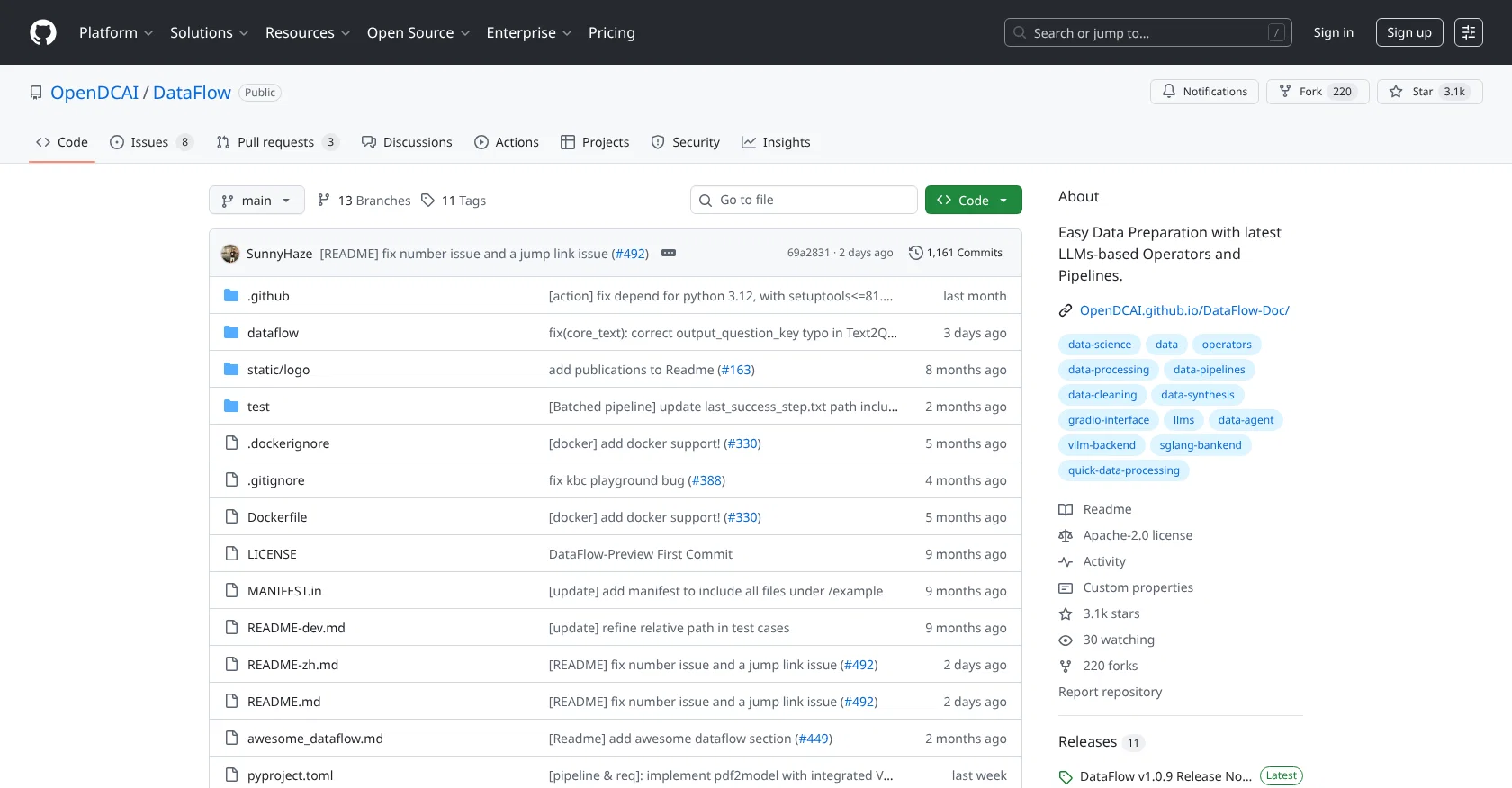
OpenDCAI/DataFlow is a tool developed for data preparation and training. It's intended to generate, refine, evaluate and filter high-quality data for AI from noisy sources such as PDFs, plain text, and low-quality QA.
This tool aims to improve the performance of large language models (LLMs) through targeted training in specific domains like healthcare, finance, legal, and academic research.
The system incorporates operator-based design to transform the entire data cleaning workflow into a reproducible, reusable, and shareable pipeline. This serves as the core infrastructure for the Data-Centric AI community.
Additionally, OpenDCAI/DataFlow has an intelligent agent capability that can dynamically assemble new pipelines by either recombining existing operators or creating new ones based on demand.
This tool assists in generating high-quality LLM training datasets from raw data using visual, low-code pipelines with flexible orchestration across domains and use cases.
The tool also includes text, math, and code data generation, as well as tools like AgenticRAG and Text2SQL for data creation. Other features include large-scale PDF to QA conversion and structured data extraction.
Access & connections
Where you can use DataFlow.
Platforms
Capabilities
What this tool accepts, produces, and is strongest at.
Input
- API
- Tabular
- Text
Output
- Tabular
- API
- Text
Highlights
- Open Source
- API
Supported features
- SQL
- Integrations
- Open Source
- Spreadsheets
- API
Pros & cons
Pros
- Generates high-quality data
- Refines noisy sources
- Evaluates data quality
- Filters low-quality QA
- Boosts large language models
- Focused training Landforms
- Flexible domain functionality
- Operator-based design
Show 40 more
- Reproducible data cleaning
- Reusable data cleaning
- Shareable data cleaning
- Establishes Data-Centric infrastructure
- Includes a DataFlow-agent
- Dynamically assembles pipelines
- Recombining existing operators
- Creating operators on-demand
- Includes data synthesis
- Supports text generation
- Supports math generation
- Supports code data generation
- Easy data preparation
- Text2SQL creation
- PDF to QA conversion
- Structured data extraction
- Adept at healthcare domain
- Adept at finance domain
- Adept at legal domain
- Adept at academic research domain
- LLM training dataset generation
- Visual low-code pipelines
- Flexible orchestration across domains
- Cross-domain use-case application
- High-quality LLM datasets
- Reproducible data workflows
- Reusable data workflows
- Shareable data workflows
- Dynamic pipeline assembly
- In-built intelligent agent
- Domain-specific training
- Low-Code Pipelines
- Noisy Data Refinement
- Intelligent Agent Capability
- Flexible Orchestration
- Ready-to-use data cleaning pipelines
- Math data workflows
- Large-scale data conversion
- Scientific Data Workflow Management
- Flexible custom pipeline orchestration
Cons
- Noisy data refinement unclear
- Limited languages support
- Lacks multi-platform support
- Requires high computational resources
- Lacks robust error handling
- Limited operator customization
- Unclear operator classification system
- Domain adaptation can be complex
Show 2 more
- No detailed instructions for use
- Relies heavily on manual tuning
Compare alternatives
Similar tools in the catalog.

Managed Hermes Agent | Hostinger ✓
PaidHermes Agent with zero setup, maintenance, or infrastructure management.
from $6.49/mo
Full comparison
Macky ✓
FreemiumAI-executed, consultant-certified engagements for SMEs.
Free + from $29/mo
Full comparison
GoAI: Personal AI Investment Assistant ✓
FreemiumYour Personal AI Investment Analyst — See the opportunities others don't.
Free + from $24.99/mo
Full comparison
Quaestor Ledger ✓
Free TrialAn AI-powered financial command center that untangles your complex financial life
Free + from $12.99/mo
Full comparison

Releases 1
FAQ 12
How does DataFlow handle low-quality QA data?
How does the OpenDCAI/DataFlow tool help in pre-training, supervised fine-tuning, and RL training of large language models?
Can OpenDCAI/DataFlow be adjusted to function in specific domains such as healthcare, finance, legal, and academic research?
What does it mean that OpenDCAI/DataFlow has an operator-based design?
What is the use of the built-in DataFlow-agent inside OpenDCAI/DataFlow?
How does Dynamic Pipeline Assembly work in OpenDCAI/DataFlow?
What kind of data can OpenDCAI/DataFlow's ready-to-use data synthesis and cleaning pipelines generate?
What role does AI play in Data Preparation with OpenDCAI/DataFlow?
How does OpenDCAI/DataFlow handle noise reduction in data?
How does the source filtering feature in OpenDCAI/DataFlow work?
How does the OpenDCAI/DataFlow tool aid in Data Refining?
How does OpenDCAI/DataFlow create reproducible, reusable, and shareable pipelines?
Related tools
Recommended

Manus ✓
FreemiumTurn your thoughts into actions with AI

Grok ✓
FreemiumConversational AI for understanding the universe.

GenTube ✓
FreeCreate stunning AI art in 2 seconds

Kling ✓
FreemiumCreate high-fidelity videos from text with lifelike motion and real-world physics

AppDeploy ✓
FreeDeploy real apps directly from ChatGPT or Claude

Promtist AI ✓
FreeGenerate optimized prompts for better AI results.