
Databricks ✓
Infuse AI into every facet of your business
Trial; then from $0.15
Verdict
A quick read before you dig into the full page.
- Best if
- Infuse AI into every facet of your business
- Skip if
- Expensive licensing
- Pick this when
- Unified approach for data management
Considering BlazorData instead? Compare side by side
Overview
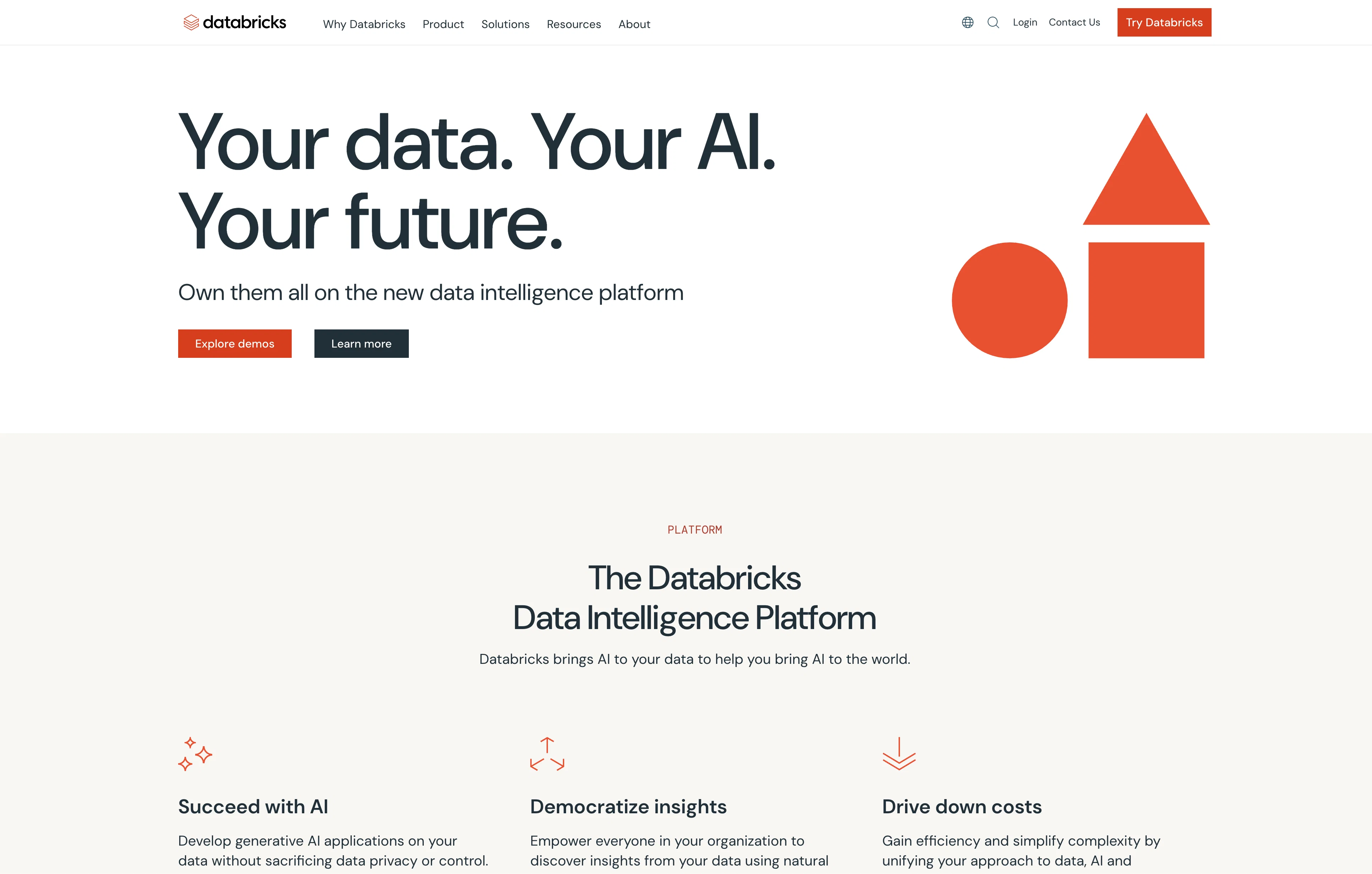
The Databricks Platform is an expansive data intelligence platform infused with generative artificial intelligence capabilities. It is designed to streamline data management and operations for businesses, allowing for efficient unification of many aspects related to data, AI and governance.
This platform provides a unified approach towards dealing with data, analytics, and AI. Users have access to a range of features, such as a serverless data warehouse for SQL analytics, ETL and orchestration for batch and streaming data, data reliability and security, and real-time analytics.
It facilitates building, selling, and growing businesses by connecting your existing tools to your shared data space known as Lakehouse. It also supports the construction and deployment of machine learning and generative AI applications.
Moreover, the platform enables collaborative data science at scale. It fosters the development of generative AI applications without compromising on issues of data privacy or control.
Additionally, the platform provides the ability to empower all users in an organization to uncover insights from data through natural language. Functions beyond data, including training, certification, events, blogs, podcasts, and customer support, are also offered.
Access & connections
Where you can use Databricks.
Platforms
Capabilities
What this tool accepts, produces, and is strongest at.
Input
- Tabular
Output
- API
Highlights
- Agents
- Local
Supported features
- Integrations
- Agents
- Spreadsheets
- Runs Locally
- Fine-tuning
- Data Analysis
- SQL
Pros & cons
Pros
- Unified approach for data management
- Serverless data warehouse
- ETL and orchestration support
- Batch and streaming data handling
- Promotes data reliability and security
- Real-time analytics
- Facilitates business growth
- Data science collaboration at scale
Show 24 more
- Prioritizes data privacy and control
- Natural language data insights
- Provided training and certification
- Efficient data unification
- Hosts events and podcasts
- Includes comprehensive customer support
- Serves startups
- Lakehouse data architecture
- Connects existing tools
- Partner integration options
- Cost calculator
- Teaching platform connections
- Open source technologies support
- Offers resources for data migration
- Professional services available
- Ease of integration with existing tools
- Industry-specific solutions
- Data sharing capabilities
- Data warehousing for SQL analytics
- Governance for all data and assets
- Data lineage and quality control
- Experiment tracking automation
- Monitoring models at scale
- Industry leader collaborations
Cons
- Lacking third-party integrations
- No mobile application
- Potential over-reliance on Lakehouse
- Interface not user-friendly
- Lack of customizability
- Expensive licensing
- Steep learning curve
- Limited ETL functions
Show 1 more
- No offline operation
Compare alternatives
Similar tools in the catalog — with a clear reason to open each one.

BlazorData ✓
FreeBuild your personal data warehouse with Blazor
Why look Fully free option
Full comparison


Aboard ✓
FreemiumAI-powered data management to simplify your digital life.
Free + from $10/mo
Full comparison

Gentables ✓
FreemiumTransform unstructured data into organized tables.
Free + from $9.99/mo
Full comparisonReleases 1
FAQ 12
What is Databricks?
What are the primary features of Databricks?
How does the serverless data warehouse in Databricks work?
Can Databricks handle both batch and streaming data?
How does Databricks ensure data reliability and security?
What are the real-time analytics capabilities of Databricks?
Can I integrate my existing tools with Databricks via the Lakehouse feature?
What kind of AI applications can I build and deploy using Databricks?
How does Databricks support collaborative data science at scale?
How does Databricks respect data privacy and control in the development of generative AI applications?
Can every user in an organization uncover insights from data using Databricks?
What kind of training and support does Databricks provide?
Related tools
Recommended
D-ID ✓
FreemiumCreate AI-generated videos with ease

Recall ✓
FreemiumSummarize Anything, Forget Nothing!

PrometAI ✓
FreemiumTurn ideas into viable reality with AI business plan generator.

AI-Flow ✓
PaidConnect multiple AI models easily.

Breadcrumb ✓
FreemiumAutomate data work and reporting with AI Agents. No data|coding skills required.

Vizologi ✓
Free TrialAI to boost your business strategy.