

Cyanite ✓
AI music tagging and similarity search for industry pioneers.
Free + from $19/mo
Verdict
A quick read before you dig into the full page.
- Best if
- You are music licensing agencies and need: Music licensing agencies using AI for music discovery
- Skip if
- Language limited for description
- Pick this when
- 60x faster tagging speed
Considering Find Genre instead? Compare side by side
Overview


Cyanite.ai is a tool designed to leverage artificial intelligence in order to enhance the way we search and discover music. It provides music recommendation services with the ability to generate comprehensive metadata for songs or music catalogs in a matter of seconds.
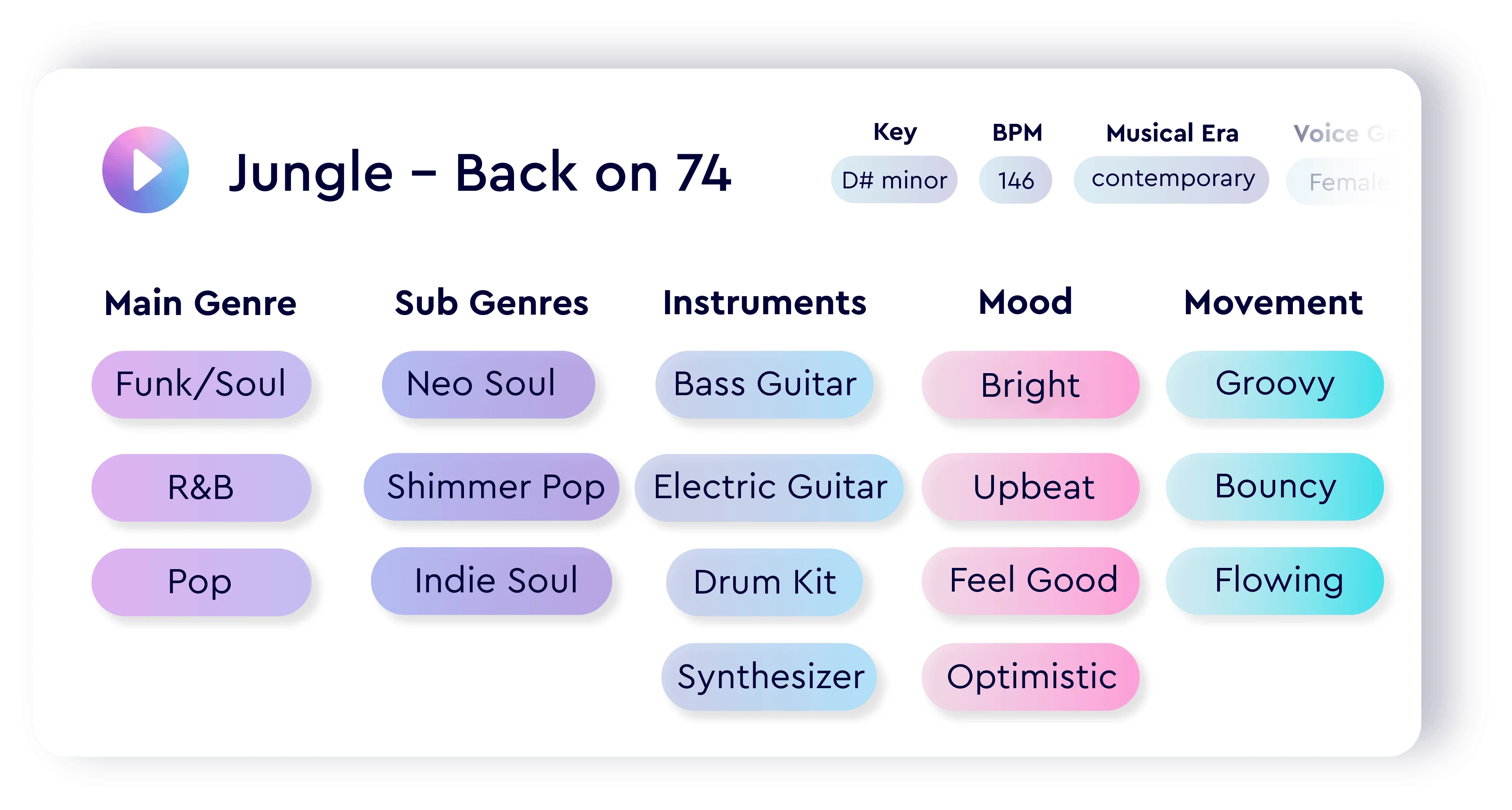
The system can automatically tag various aspects of a song, such as its genre, mood, instruments, and tempo, freeing users from manual tagging. Metadata generated by Cyanite not only enriches the information about the music but also significantly simplifies management and search activities.
With one of its features, users can input a reference song and discover similar music, thus providing valuable insights for music supervision, content creation, curation and more.
The tool also offers a flexible keyword search, allowing the combination and weighting of different keyword to fine-tune the search process. A holistic Free Text Search enables the users to search for music using their own choice of words and descriptions.
It also includes powerful visualization tools to identify patterns and show music data graphically, supporting various strategic applications like pitching and marketing.
The AI framework and search technology can be integrated into current systems via an API, and is already compatible with various Catalog Management Systems.
Best for
Short scenarios where Cyanite tends to shine.
-
Music licensing agencies using AI for music discovery.
Best for Music licensing agencies
-
Music CMS solutions integrating AI for content management.
Best for Music supervisors
-
AI-powered music marketing for artist development.
Best for Music content managers
Example outputs 1
Sample generations and before/after results for Cyanite.
Access & connections
Where you can use Cyanite.
Platforms
Capabilities
What this tool accepts, produces, and is strongest at.
Input
- API
- Tabular
- Audio
Output
- API
- Text
Pros & cons
Pros
- 60x faster tagging speed
- 99.4% cost reduction
- Large variety of applications
- Similarity Search feature
- Acoustic feature comparison
- Revolutionary Keyword Search
- Personalized song recommendations
- Visual song comparisons
Show 26 more
- Odd keyword detection
- Customizable for many scenarios
- Music recommendation services
- Comprehensive music metadata generation
- Automatic genre tagging
- Automatic mood tagging
- Automatic instrument tagging
- Automatic tempo tagging
- Reference song similar music discovery
- Flexible keyword search
- Detailed visualization tools
- Integration capabilities via API
- Catalog Management Systems compatibility
- Saves time and effort
- Auto-Description feature
- 1,500 keywords available
- Groundbreaking Free Text Search
- Effective music data graphing
- Browser-based Web App
- CMS integration
- Generation of full-text descriptions
- Intuitive search interface
- API for easy integration
- Professional customer service
- Highly accurate tagging
- Robust and reliable API
Cons
- Lacks musical diversity recognition
- Cannot fine-tune auto-tagging
- Limited keyword dictionary
- Non-intuitive search for newbies
- No separate audio quality analysis
- Limited catalog management systems compatibility
- No natural language processing
- Visualizations not downloading
Show 2 more
- Language limited for description
- No dedicated mobile application
Compare alternatives
Similar tools in the catalog — with a clear reason to open each one.

Find Genre ✓
Free TrialInstantly detect any song's genre, BPM, and key.
Why look Typically cheaper
Full comparisonPeople also view
Tools that often show up alongside Cyanite in collections and comparisons.
Find Genre ✓
Free TrialInstantly detect any song's genre, BPM, and key.

Scholarcy ✓
FreemiumConvert long articles into summary flashcards.

Musicfy ✓
PaidCreate AI covers of your favorite songs instantly.

Moodplaylist ✓
FreeAI-powered playlists for every mood, ad-free.

Hyperis ✓
FreemiumOrganized task prioritization.

Eightify
UnknownAI-powered YouTube video summarizer extracting key ideas for quick content assessment.

AI Course Creator ✓
FreemiumAI-powered course creation in minutes.
Releases 1
Imported reviews 2
Similarity search works okay, but UX could be improved — it's hard to tell when a search was completed. Also there are some minor mistakes in BPM assignation. But overall works as expected and helps finding similar tracks.
this idea is so cool, music producers are going to love all the information this gives them and i can't wait to throw all my playlists into it and see what more i can find <3
FAQ 12
What is Cyanite.ai?
How does Cyanite.ai's auto-tagging feature work?
What is the Similarity Search feature of Cyanite.ai?
How does the Keyword Search function in Cyanite.ai?
What makes Cyanite.ai's Keyword Cleaning feature unique?
Can Cyanite.ai be customized for different use cases?
What does the personalized song recommendations feature of Cyanite.ai do?
How effective is Cyanite.ai in music categorization?
Does Cyanite.ai offer a free trial?
How does Cyanite.ai enhance music search and discovery?
What does Cyanite.ai's data visualization feature do?
How can I integrate Cyanite.ai into my current system?
Related tools
Recommended
Scholarcy ✓
FreemiumConvert long articles into summary flashcards.
Musicfy ✓
PaidCreate AI covers of your favorite songs instantly.

Songmastr ✓
PaidAI-powered song mastering to match reference tracks

VenturusAI ✓
FreemiumBusiness idea analysis and reporting.
Hyperis ✓
FreemiumOrganized task prioritization.

Stockimg AI ✓
PaidGenerated images and text for design ease.