

Coder ✓
Secure, governed AI development infrastructure for enterprises.
Verdict
A quick read before you dig into the full page.
- Best if
- Secure, governed AI development infrastructure for enterprises
- Skip if
- Limited to specific industries
- Pick this when
- Strong governance solutions
Considering Zeabur instead? Compare side by side
Overview
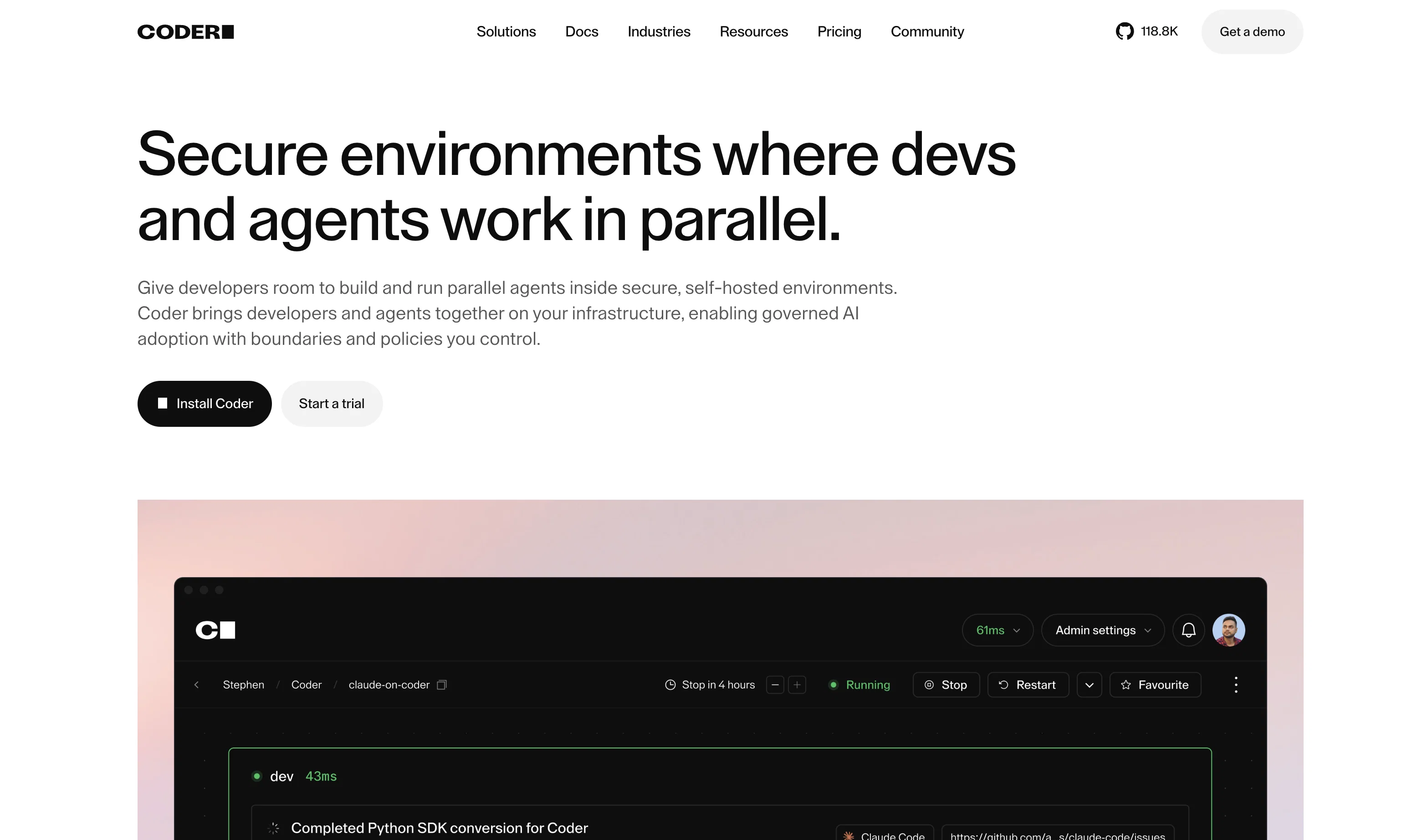
Coder offers AI development infrastructure and governance solutions. It provides developers with a secure, governed environment that allows AI coding agents to be run at scale.
The main features of Coder focus on creating self-hosted development environments, allowing developers and their AI coding agents to work together on an organization's infrastructure following established boundaries and policies.
With Coder, AI governance becomes simpler through a centralized gateway for the observation and control of language model (LLM) tool usage across environments.
Coder's services are geared towards a range of industries, including automotive, finance, government, and technology. It specializes in creating secure environments where both developers and AI coding agents can operate in parallel, each within their own secure, consistent workspaces, provisioned through Terraform.
Moreover, Coder has the ability to integrate with a variety of tools and platforms, like AWS, Google Cloud, Azure, Kubernetes, Docker, Openshift, Terraform, Github, Gitlab, Jupyter and VSCode.
Coder is heavily oriented towards maintaining security as it powers development across these industries, enforcing tight compliance and supporting seamless AI adoption.
Access & connections
Where you can use Coder, and what it plugs into.
Platforms
Integrations
Capabilities
What this tool accepts, produces, and is strongest at.
Input
- Code
- Tabular
Output
- Code
- Tabular
Pros & cons
Pros
- Strong governance solutions
- Self-hosted development environments
- Controlled language model tool usage
- Customizable boundaries and policies
- Platform integrations: AWS, Azure...
- Supports Terraform provisioning
- Audit logging feature
- Agent permissions control
Show 28 more
- Dedicated workspaces for developers
- Tight compliance enforcement
- VSCode and Jupyter support
- Applicable in automotive, finance, government...
- Designed for key industries
- Integration with GitHub, GitLab
- Self-hostable on various infrastructures
- Containerization with Docker, Kubernetes
- OpenShift integration
- On-premise or cloud deployment
- Defined environments as code
- GDPR, DORA compliant
- Low latency at scale
- Offloads compute-heavy tasks
- Air-gapped infrastructure compatibility
- Operates on all classification levels
- Supports all IDEs, tools, languages
- Complete control over compute, access
- Context control for security
- Fast, consistent developer onboarding
- Reduce Developer VDI Costs
- Centralized ATO compliance
- Increased developer productivity
- Collaboration-friendly environment
- Streamlined developer onboarding
- Adaption without losing control
- Supports globally-distributed teams
- SOC 2 Type II Certified
Cons
- Requires self-hosted environment
- Focused on established policies
- Potential Terraform dependence
- Heavy integrations could overwhelm
- No lightweight version mentioned
- Not optimized for beginners
- Might overly secure environments
- No stated support for lesser-known tools
Show 2 more
- Limited to specific industries
- Needs infrastructure setup knowledge
Compare alternatives
Similar tools in the catalog — with a clear reason to open each one.


AWS DevOps Agent ✓
Free TrialYour always-available AI operations teammate.
Why look Offers a public API
Full comparison

Releases 1
FAQ 12
What industries does Coder serve?
How does Coder ensure security in AI development?
What integration platforms are supported by Coder?
What is the role of Terraform in Coder's operation?
How does Coder facilitate compliance in AI development?
Can Coder's work environment be self-hosted?
What are the main features of Coder?
How does Coder control language model tool usage across environments?
Is Coder suitable for large-scale AI coding?
What mechanisms does Coder use for AI governance?
What's the process of AI adoption facilitated by Coder?
How does Coder help in establishing boundaries and policies in an organization's infrastructure?
Related tools
Recommended

Reqops ✓
Free TrialAccelerate software delivery with AI-powered communication.

Decopy ✓
FreemiumSpot AI-generated text with precision.

KiloClaw ✓
PaidHosted OpenClaw AI agent with zero DevOps required.

ClawOneClick ✓
PaidDeploy your AI assistant in one click.

ThinkRoot - The AI Compiler ✓
FreemiumFrom idea to app in minutes.

OneRouter ✓
PaidEnterprise AI model router with unified API.