

Agent identity verification 2026 Rank: #2538
AxioRank ✓
Zero-trust security for every AI agent action.
Verdict
A quick read before you dig into the full page.
- Best if
- Zero-trust security for every AI agent action
- Skip if
- Short-lived identities limit
- Pick this when
- Real-time audit trail
Considering RNWY.com | Soulbound AI Identity instead? Compare side by side
Overview


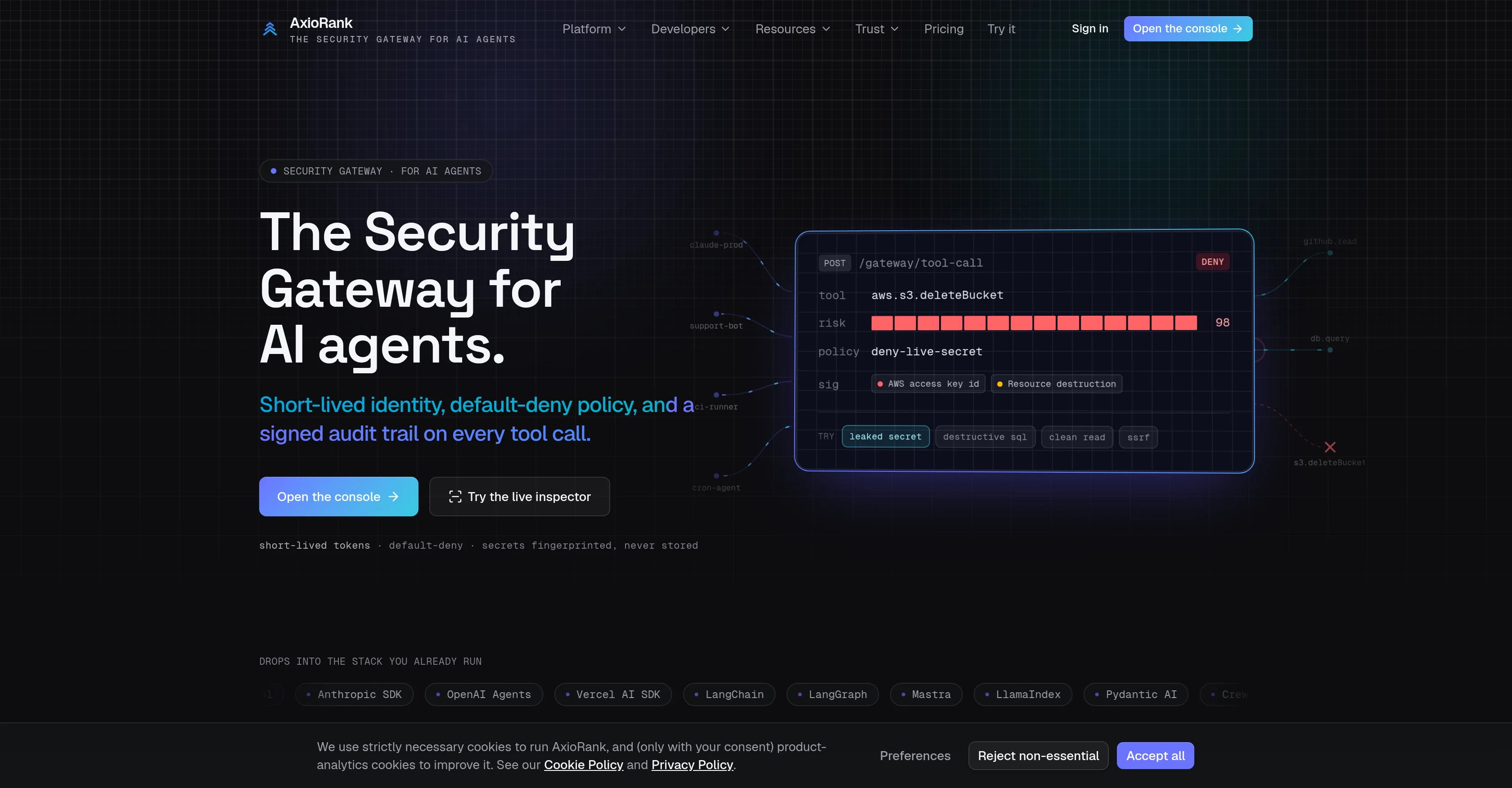
AxioRank serves as a security gateway for AI agents. This tool is designed to strengthen security for AI agents interacting with MCP servers, APIs, and databases.
It acts as a checkpoint for every interaction an agent makes with your infrastructure and provides an audit trail for those actions. AxioRank gives agents a temporary identity, evaluates your policies, scores the risk, and writes a redacted audit trail in real-time.
It plays an important role in managing access for autonomous AI applications, which can include credentials to interact with databases, code repositories, and cloud environments.
To mitigate risks associated with such autonomous interactions, AxioRank provides a 'short-lived' identity for agents. This limits the potential for misuse of these identities as they are valid for a limited duration.
Every tool call directed at the gateway triggers several security checks in one hop: local identity verification, risk scoring, policy evaluation, checking the allow-list, and writing a redacted record.
Subsequently, the gateway provides rapid verdicts whether to allow, deny, or hold on the operation. The AxioRank policy engine adopts a 'deny-overrides' design, ensuring secure, regulated interactions.
It features a range of detectors to scan payloads for potential issues such as embedding live credentials or performing destructive commands. Detected issues are masked and logged within a redacted audit record.
This system offers control and security for agents' operations, making it a robust choice for managing AI agent interactions within a secure framework.
Access & connections
Where you can use AxioRank, and what it plugs into.
Platforms
Integrations
Capabilities
What this tool accepts, produces, and is strongest at.
Input
- API
- Code
- Tabular
- Text
- Audio
Output
- Audio
- Tabular
- API
- Text
Highlights
- Agents
- API
- MCP
- No Signup
- Open Source
- Local
Supported features
- Agents
- API
- MCP
- No Signup
- Open Source
- Runs Locally
Pros & cons
Pros
- Real-time audit trail
- Temporary identity issuing
- Risk scoring feature
- Real-time redacted audit recording
- Identity verification
- Multiple security checks
- Rapid operation verdicts
- Deny-overrides policy design
Show 11 more
- Payload scanning
- Mask and log issues
- Short-lived identity provision
- Controls agent misuses
- Infrastructure interaction checkpoint
- Temporary identities limit misuse
- Managed access to clouds, databases, and repositories
- Machine credential provision
- Content detectors
- Agent integrity monitoring
- Zero-trust security for agent actions
Cons
- Uses 'Deny overrides' design
- Short-lived identities limit
- Only writes redacted records
- Potential latency from multiple checks
- Limited detectors range
- Conduction of security checks in one hop
- Lack advanced Content inspection
- No obvious scalability options
Show 2 more
- Agent rewrite not supported
- No dynamic identities support
Compare alternatives
Similar tools in the catalog — with a clear reason to open each one.

RNWY.com | Soulbound AI Identity ✓
UnknownSoulbound Passports for Humans and AI.
No pricing
Full comparison
Okta for AI Agents ✓
UnknownSecure the entire AI agent lifecycle with identity-first governance.
No pricing
Full comparison

Exogram ✓
Free TrialThe Infrastructure Substrate for Safe, Stateful, and Autonomous AI Agents
Free + from $99.00/mo
Full comparison
AuthentaLink ✓
FreemiumYour career, running on intelligence.
Why look Typically cheaper
Full comparisonReleases 1
FAQ 12
What is the purpose of AxioRank?
How does AxioRank secure AI agents?
What's the role of AxioRank in managing access for autonomous AI applications?
Can you explain the process of providing a 'short-lived' identity for agents in AxioRank?
What are the security checks performed by AxioRank?
What does the 'deny-overrides' design in AxioRank policy engine mean?
How does AxioRank scan payloads for potential issues?
What happens when AxioRank detects issues in the payloads?
What does AxioRank mean by 'agent integrity monitoring'?
How does AxioRank manage access to cloud environments?
Can AxioRank interact with code repositories?
What kind of audit trail does AxioRank provide?
Related tools
Recommended

MagicSlides.app AI PPT Maker ✓
FreemiumCreate Stunning PPTs in Seconds with the AI PPT Maker

GetLogit ✓
FreemiumArtificial intelligence, available for everyone.

ChatGPT ✓
FreemiumAsk anything, create anything, and move from idea to action.

Automateed ✓
Free TrialCreate eBooks effortlessly with Automateed, the AI-powered writing tool.

Kin - Personal AI Advisors ✓
FreePrivacy-first & designed your for mind, and life at work

Aiter.io | Paste a URL. Ship a Campaign That Sounds L... ✓
FreemiumAI marketing that sounds like you, not everyone else.