

Model training 2026 Rank: #3247
Applied Compute Training ✓
Turn your data into models you own.
Verdict
A quick read before you dig into the full page.
- Best if
- Turn your data into models you own
- Skip if
- Possible overfitting from continual learning
- Pick this when
- Fine-tunes existing models
Considering Commissioned instead? Compare side by side
Overview
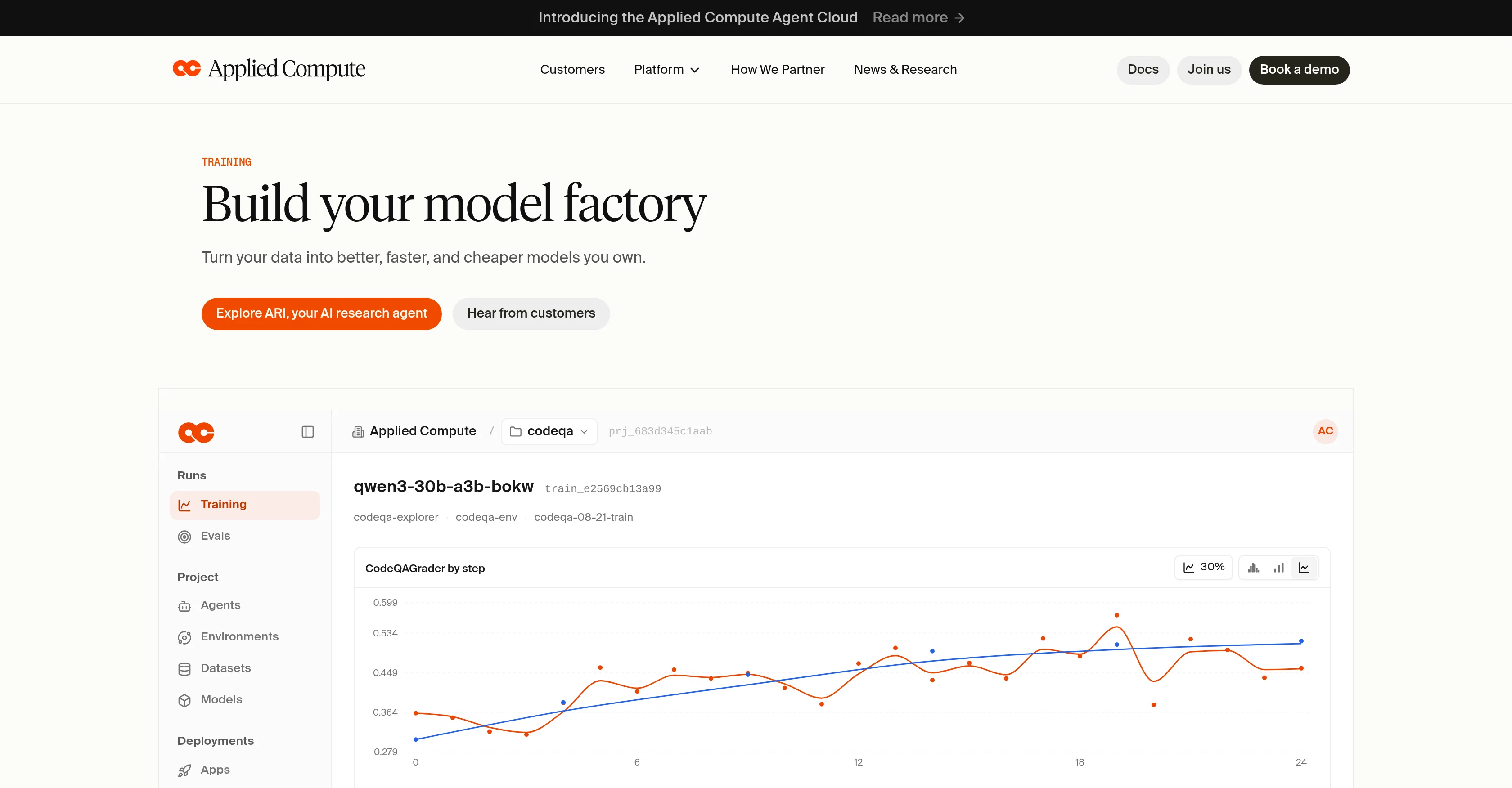
Applied Compute Training is a robust tool designed to fine-tune machine learning models optimally. It grants users the ability to start with an existing model and gradually enhance its performance by running iterative experiments.
Through its fully asynchronous Reinforcement Learning (RL) system, the tool offers high-throughput inference and lower-precision training, optimizing model efficiency and stability.
The platform also promotes full parameter tuning at a large scale, allowing the training of multi-trillion parameter models effortlessly, without necessitating the user to manage a cluster.
Utilizing the client's computational resources, Applied Compute Training makes it possible to train complex models with little to no setup, arguably boosting the speed of achieving enhanced results.
Applied Compute Training also incorporates Continual Learning with self-distillation, enabling models to learn directly from non-replayable production traces.
This strategy ensures that model usage automatically doubles as training signal, fostering continual model improvement. The platform introduces 'Ari', an Applied Research Intelligence agent that automates the research loop.
Ari monitors each run, proactively alerts of potential drifts, fixes config issues, relaunches runs, and even generates reports, reducing operational time.
Applied Compute Training allows clients to bring their own harness and train within the framework they currently operate, thereby ensuring the learning environment closely matches real-time production context.
This tool also creates the potential for models to improve the more they are used, turning data into better, faster, and cheaper models owned by the client.
Access & connections
Where you can use Applied Compute Training.
Platforms
Capabilities
What this tool accepts, produces, and is strongest at.
Input
- Text
- Structured data
Output
- Text
- Structured data
Pros & cons
Pros
- Fine-tunes existing models
- Performs iterative experiments
- Fully asynchronous Reinforcement Learning
- High-throughput inference
- Lower-precision training
- Optimizes model efficiency
- Promotes model stability
- Full parameter tuning capability
Show 31 more
- Large scale model training
- Can train multi-trillion parameter models
- No cluster management required
- Utilizes client's computational resources
- Minimal setup complexity
- Continual learning via self-distillation
- Learns from non-replayable traces
- 'Ari' research automation agent
- Automatic drift alerts
- Automated config issue resolution
- Auto-relaunches runs
- Generates operational reports
- Allows custom training harness
- Learning environment mirrors production context
- Models improve with usage
- Data to models transformation
- Matching real-time production context
- Live model run monitoring
- Spot regressions automatically
- Product-specific KPI optimization
- Optimization on less compute
- Models get better with usage
- Frontier post-training
- Faithful training-to-production similarity
- Trains with real production traffic
- Scalable to thousands of GPUs
- Runs efficient, stable experiments
- Efficient share of computational resources
- Automated iterative experiments
- Metric monitoring and alerting
- Analysis of traces at scale
Cons
- Limited precision in training
- Requires substantial computational resources
- Potential bias from self-distillation
- Dependent on 'Ari' agent
- Potential compatibility issues with harness
- Possible overfitting from continual learning
- Setup required for own harness
- Potential data handling concerns
Show 2 more
- Depends on iterative learning
- Relies on clients' datasets
Compare alternatives
Similar tools in the catalog — with a clear reason to open each one.

Commissioned ✓
FreemiumFine-tuning in minutes not weeks
Why look Higher community rating
Full comparison


Entry Point AI ✓
PaidTrain custom LLMs with no code required.
Why look Better fit for coding
Full comparison
Releases 1
FAQ 12
What is Applied Compute Training?
What is the main function of the 'Ari' feature on Applied Compute Training?
How does Applied Compute Training optimize the efficiency and stability of models?
Can Applied Compute Training handle large scale parameter tuning?
What is the purpose of the fully asynchronous Reinforcement Learning system in Applied Compute Training?
How does Applied Compute Training implement Continual Learning with self-distillation?
What does it mean when it says that Applied Compute Training allows clients to bring their own harness?
How does Applied Compute Training make use of the client's computational resources?
Does Applied Compute Training need any setup to train complex models?
How does the model improve the more it is used in Applied Compute Training?
What efficiency benefits does Applied Compute Training provide?
Can Applied Compute Training manage and train multi-trillion parameter models?
Related tools
Recommended

MagicSlides.app AI PPT Maker ✓
FreemiumCreate Stunning PPTs in Seconds with the AI PPT Maker

GetLogit ✓
FreemiumArtificial intelligence, available for everyone.

ChatGPT ✓
FreemiumAsk anything, create anything, and move from idea to action.

Automateed ✓
Free TrialCreate eBooks effortlessly with Automateed, the AI-powered writing tool.

Kin - Personal AI Advisors ✓
FreePrivacy-first & designed your for mind, and life at work

Aiter.io | Paste a URL. Ship a Campaign That Sounds L... ✓
FreemiumAI marketing that sounds like you, not everyone else.