

Entry Point AI ✓
Train custom LLMs with no code required.
from $49/mo
Verdict
A quick read before you dig into the full page.
- Best if
- Train custom LLMs with no code required
- Skip if
- Limited model type support
- Pick this when
- No-code platform
Considering Commissioned instead? Compare side by side
Overview
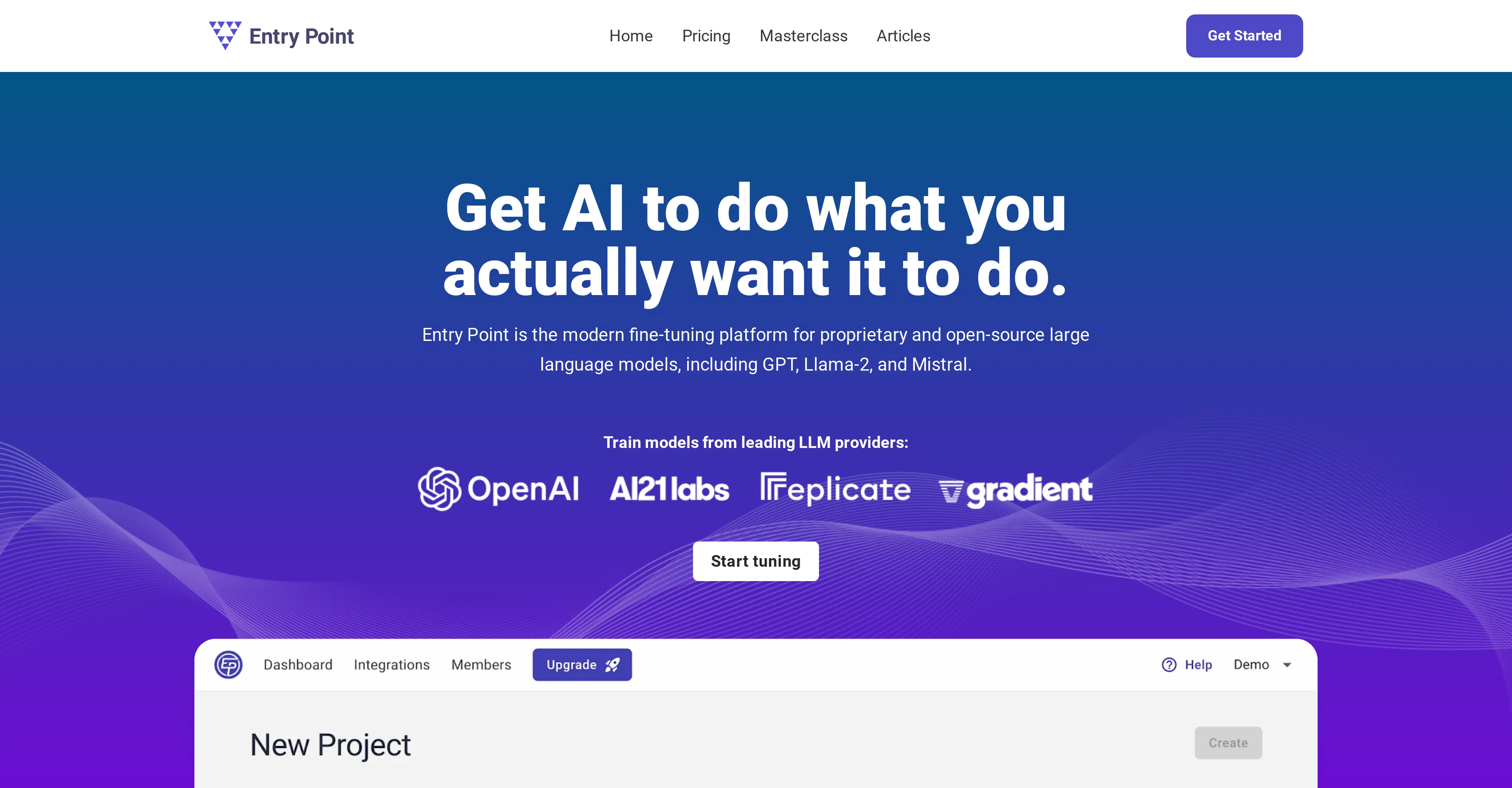
Entry Point AI is a fine-tuning platform designed for managing, training, and evaluating large language models (LLMs). This tool provides a means to optimize the performance of open-source and proprietary LLMs, including those from leading providers such as OpenAI, AI21, Replicate, and Gradient.
With this platform, users can enhance prompt engineering, retrieval-augmented generation (RAG), and various aspects of model behavior through fine-tuning, a process that teaches a model how to behave without the need for a lot of data or advanced infrastructure.
Fine-tuning also allows for higher quality prompts, faster model generation, and more predictable outputs. Furthermore, Entry Point AI offers features for improving collaboration, such as the ability to invite teams to keep track of training data and fine-tuning jobs in one place, evaluate performance, and compare hyperparameters.
It also includes an advanced templating engine for rapid iteration and optimization of fine-tuning data structure. Moreover, data import and export functions are provided, allowing users to move their data into and out of the platform easily.
Other features of Entry Point AI include a one-click deployment option for frontend model testing, comprehensive model sharing options, and built-in features to avoid the common problems associated with fine-tuning.
Access & connections
Where you can use Entry Point AI.
Platforms
Capabilities
What this tool accepts, produces, and is strongest at.
Input
- API
- Tabular
- Text
Output
- Code
- API
- Text
Supported features
- Fine-tuning
Pros & cons
Pros
- No-code platform
- Manage data, models, performance
- Fine-tune large language models
- Precise data classification
- Outperforms traditional machine learning
- Organize content in editable fields
- High-quality example generation
- Optimize performance with enhancements
Show 37 more
- Preserve data integrity
- Rapid training with synthetic data
- Address various business challenges
- Task-specific model fine-tuning
- Credential of big LLM providers
- Improved prompt engineering
- Improved collaboration features
- Advanced templating engine
- Data import/export functions
- One-click frontend model deployment
- Model sharing options
- Built-in problem avoidances
- Unified interface for LLM providers
- Monitoring of training data/jobs
- Easy data transfer
- Comprehensive dataset export
- Customizable syntax and structure
- Test models in frontend
- Fine-tuning data adjustments
- Flexible across API and models
- Quality increase through fine-tuning
- Latency and cost reduction
- Higher predictability in outputs
- Scale with team input
- Edge case and model control
- Suitable for various usages
- Effective tagging and classification
- Support issue prioritization
- Automated redaction in documents
- Automated lead scoring
- No heavy data infrastructure needed
- Helps cover edge cases
- Template impact on outcomes
- Aware of pitfalls and nuances
- Integrated top LLM provider APIs
- Direct access to hyperparameters
- Implemented user-friendly interface
Cons
- Doesn't support real-time testing
- Requires manual data handling
- Limited model type support
- No multi-language support
- Not open-source
- Long model training times
- Lacks API for integration
- No simultaneous model training
Show 2 more
- Closed system - not stackable
- No direct model export
Compare alternatives
Similar tools in the catalog — with a clear reason to open each one.

Commissioned ✓
FreemiumFine-tuning in minutes not weeks
Why look Freemium alternative
Full comparison
TrainEngine ✓
FreemiumTrain AI models, generate unlimited assets.
Why look Freemium alternative
Full comparison


Thinking Machines Tinker ✓
PaidA training API for researchers and developers.
Why look Typically cheaper
Full comparisonReleases 1
FAQ 12
What is Entry Point AI and what is it used for?
Can I use Entry Point AI without having coding expertise?
How does Entry Point AI optimize the performance of LLMs?
What are the advanced fine-tuning management capabilities mentioned?
What is the structured data approach utilized by Entry Point AI?
What are some use cases for Entry Point AI?
How does Entry Point AI ensure data integrity?
What is meant by rapid training with synthetic data in Entry Point AI?
What does it mean when you say Entry Point AI is a fine-tuning platform?
How do users improve prompt engineering in Entry Point AI?
What does retrieval-augmented generation (RAG) refer to in the context of Entry Point AI?
How does Entry Point AI enhance the data import and export functions?
Related tools
Recommended

LearningStudioAI ✓
Free TrialAI-powered authoring tool for effortless online course creation.

VenturusAI ✓
FreemiumBusiness idea analysis and reporting.

Scisummary ✓
Free TrialCutting-edge scientific articles summarization.

TutorAI ✓
FreemiumInstant knowledge on any topic

Photo AI ✓
PaidCreate beautiful AI photos and videos of real people

Agentgpt ✓
FreemiumDeploy autonomous AI Agents effortlessly in your browser.