

AmuRing ✓
Dual form factor wearable AI: an amulet and ring assistant.
from $298
Verdict
A quick read before you dig into the full page.
- Best if
- Dual form factor wearable AI: an amulet and ring assistant
- Skip if
- Complex 'untraining' mechanism
- Pick this when
- Dual form factor
Considering Notis instead? Compare side by side
Overview
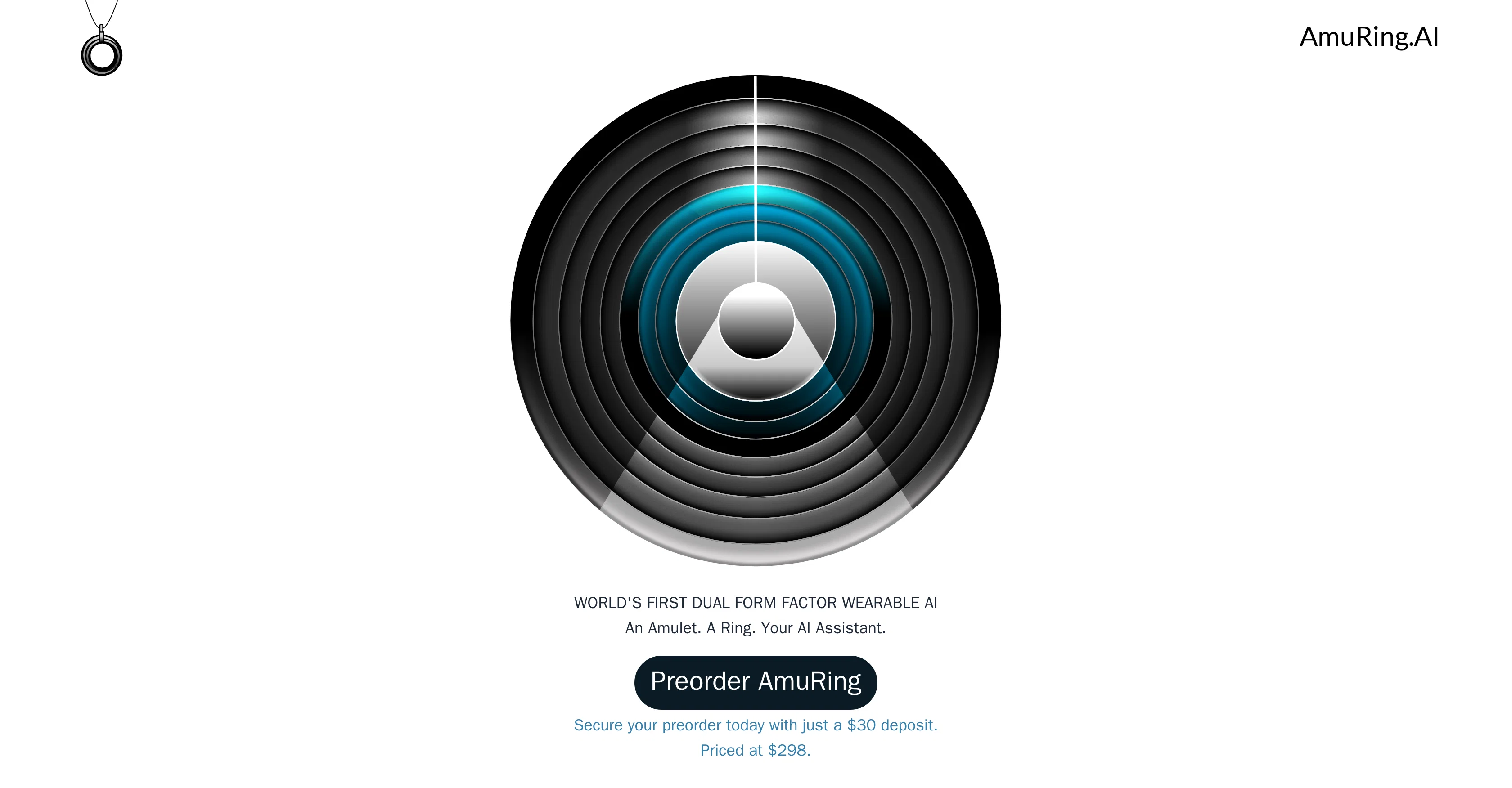
AmuRing.AI is a dual form factor wearable AI device that can be worn as an amulet or a ring. It functions as a personal AI assistant and is designed to offer assistance in a variety of daily tasks.
Featuring a multilingual interface, the AI provides enhanced communication capabilities and user accessibility. The software follows an Open Core model, with the core software being open-source and additional proprietary features.
One distinct feature is discomfort detection, which alerts the user when it detects someone else's discomfort being captured. Users can also 'untrain' the AI from recognizing specific people and delete recordings as per their preference.
AmuRing.AI's default model is GPT-4, but it provides the flexibility to use other models. Users can self-host their data or opt for a cloud subscription, with different tiers offering varying lengths of snapshot storage.
With its novel form, interoperability, and ethical features, AmuRing.AI is a wearable AI assistant that integrates technology with daily life.
Access & connections
Where you can use AmuRing.
Platforms
Capabilities
What this tool accepts, produces, and is strongest at.
Input
- Sensor data
Output
- Audio
Pros & cons
Pros
- Dual form factor
- Wearable device
- Multilingual interface
- Open core model
- Discomfort detection
- Deletable recordings
- Self-host option for data
- Different cloud subscription tiers
Show 14 more
- Snapshot storage options
- Daily life integration
- First of its kind
- Refundable preorder deposit
- Free cloud storage tier
- Option for more storage
- Alerts for recording consent
- Time machine feature
- Data server self-hosting
- Multiple cloud service tiers
- 24/7 support for early orders
- Open source core software
- GPT-4 default model
- Recognizes discomfort in others
Cons
- Expensive
- Delayed delivery (2025 estimated)
- Compulsory cloud subscription/storage
- Limited free cloud storage
- Partial open-source only
- Prior GPT-4 knowledge required
- Potential for privacy issues
- Complex 'untraining' mechanism
Show 2 more
- Limited discomfort detection
- Potentially misinterpret discomfort signals
Compare alternatives
Similar tools in the catalog — with a clear reason to open each one.

Notis ✓
Free TrialThe first WhatsApp assistant that runs on your ChatGPT and Claude subscriptions
Why look Typically cheaper
Full comparison
Alice - AI Automation App ✓
Free TrialStop chatting. Start doing.
Why look Typically cheaper
Full comparison

Assindo ✓
Free TrialManaged AI agent like OpenClaw but with real phone calls included
Why look Typically cheaper
Full comparison

Botlor ✓
Free TrialYour AI butler that books, shops, creates, advises.
Why look Typically cheaper
Full comparisonReleases 1
FAQ 12
What is AmuRing.AI?
How can AmuRing.AI be worn?
What functions does AmuRing.AI serve as a personal AI assistant?
Can I edit or delete recordings on AmuRing.AI?
What do you mean by 'untraining' the AI in AmuRing.AI?
Which AI model does AmuRing.AI default to?
Can I use other AI models with AmuRing.AI?
How is user data stored by AmuRing.AI?
What is the Open Core model in AmuRing.AI?
What is discomfort detection in AmuRing.AI?
How does AmuRing.AI integrate with my daily life?
What ethical features does AmuRing.AI offer?
Related tools
Recommended

Hyperis ✓
FreemiumOrganized task prioritization.

Beeyond AI ✓
Free TrialBeeyond AI: Unlock 50+ AI tools under one subscription

MICRO LLM ✓
FreeEnjoy uLlama on all your Apple devices.

Scholarcy ✓
FreemiumConvert long articles into summary flashcards.

Kin - Personal AI Advisors ✓
FreePrivacy-first & designed your for mind, and life at work

IllumiChat ✓
FreemiumFrom Ticket Backlog to Instant Answers Powered by AI