

Model training 2026 Rank: #3224
Adaptive Engine ✓
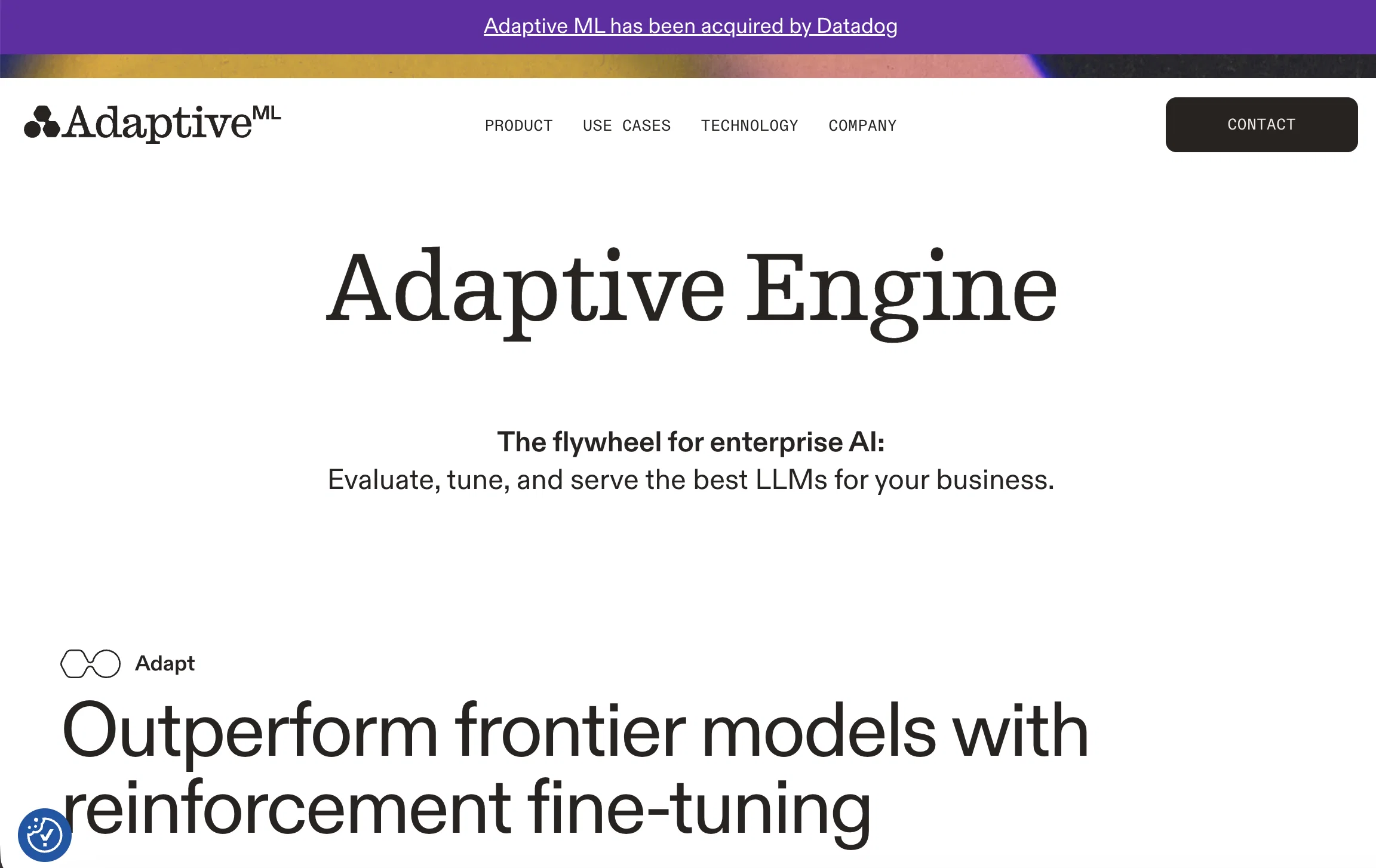
The flywheel for enterprise AI.
Verdict
A quick read before you dig into the full page.
- Best if
- The flywheel for enterprise AI
- Skip if
- Limited inference engine providers
- Pick this when
- Dynamic performance evaluations
Considering Commissioned instead? Compare side by side
Overview
Adaptive Engine is an AI tool designed to streamline enterprise AI workflows through dynamic performance evaluations, tuning, and serving of language learning models (LLMs).
Developed by Adaptive ML, this tool employs cutting-edge artificial intelligence techniques such as reinforcement learning and synthetic data to fine-tune models and optimize business outcomes.
One of the unique features of Adaptive Engine is its in-built reinforcement learning framework that helps businesses continuously tweak their AI models and drive the results they care about most.
The tool provides capabilities for comparing and evaluating both proprietary and open models with personalized evaluations and AI judges. Moreover, it also allows for A/B testing of models with subsets of users for risk-free performance assurances.
Providing granular observability, it ensures businesses can track key metrics and traces in production. The Adaptive Engine also offers efficient inference capabilities with a proprietary inference engine which minimizes GPU cost and reduces latency.
It provides versatility in deployment options including on-premise and private cloud, offering enhanced data control. Ultimately, Adaptive Engine stands as a comprehensive AI tool designed to enable businesses effectively leverage AI for optimal performance.
Access & connections
Where you can use Adaptive Engine.
Platforms
Capabilities
What this tool accepts, produces, and is strongest at.
Input
- Structured data
Output
- API
Supported features
- Fine-tuning
Pros & cons
Pros
- Dynamic performance evaluations
- In-built reinforcement learning framework
- A/B testing capabilities
- Granular observability
- Track key metrics in production
- Proprietary inference engine
- Minimizes GPU cost
- Reduces latency
Show 29 more
- Versatility in deployment options
- On-premise and private cloud deployment
- Enhanced data control
- Continuous model enhancement
- Comparing proprietary and open models
- Synthetic data usage
- Continual performance optimization
- Risk-free performance assurances
- One-click PPO, GRPO, DPO
- Full model or adapter tuning
- Efficient learning with synthetic data
- Automated reasoning tuning
- Test-time search
- Refining with production feedback
- Metrics-logging API
- Customizable tuning pipelines
- Online user testing
- Offline annotator feedback
- Model interactions browser
- Up to 30% faster inference
- Prefix caching
- Quantization
- Serving adapters at scale
- Shares GPU resources across workflows
- All-in-one inference platform
- Support for NVIDIA NIMs
- Enhanced data security
- Control over model updates
- Supports external inference providers
Cons
- No public cloud deployment
- Requires in-house ML expertise
- No multi-language support
- Lack of automation features
- Limited inference engine providers
- No real-time model updating
- No comprehensive API documentation
- No feature for model visualization
Show 1 more
- Lacks generic model tuning
Compare alternatives
Similar tools in the catalog — with a clear reason to open each one.




Entry Point AI ✓
PaidTrain custom LLMs with no code required.
Why look Better fit for coding
Full comparison
Releases 1
FAQ 12
What is the Adaptive Engine?
How does Adaptive Engine streamline enterprise AI workflows?
What are the key features of Adaptive Engine's reinforcement learning framework?
How does Adaptive Engine use reinforcement learning and synthetic data?
What are the capabilities of Adaptive Engine in evaluating AI models?
What does Adaptive Engine mean by 'granular observability'?
How can Adaptive Engine assist in A/B testing?
Can Adaptive Engine be used for on-premise and private cloud deployments?
How does Adaptive Engine minimize GPU cost and reduce latency?
How can Adaptive Engine optimize my business outcomes?
What is the benefit of Adaptive Engine's personalized evaluations and AI judges?
How does Adaptive Engine handle model selection and dynamic tuning?
Related tools
Recommended

MagicSlides.app AI PPT Maker ✓
FreemiumCreate Stunning PPTs in Seconds with the AI PPT Maker

GetLogit ✓
FreemiumArtificial intelligence, available for everyone.

ChatGPT ✓
FreemiumAsk anything, create anything, and move from idea to action.

Automateed ✓
Free TrialCreate eBooks effortlessly with Automateed, the AI-powered writing tool.

Kin - Personal AI Advisors ✓
FreePrivacy-first & designed your for mind, and life at work

Aiter.io | Paste a URL. Ship a Campaign That Sounds L... ✓
FreemiumAI marketing that sounds like you, not everyone else.