

Repository
INTACT-JEPA
INTACT: Isomorphic Intent-to-Action Learning for Search-Free World Models Train a world model to answer the control query it will receive at deployment. End-to-end JEPA world model · License unknown · Maintenance unknown
- License
- Unknown
- Component
- Role
- Forward predictor
- Forward predictor
- Physical intent call
- Physical intent call
Specs
- ComponentRole
- Forward predictorForward predictor
- Physical intent callPhysical intent call
- Goal intent callGoal intent call
- Matched interactionMatched interaction
- Direct controllerDirect controller
- Guarded local verificationGuarded local verification
- ArtifactStatus
- Method and result documentationAvailable in this repository
- Reproducibility contractAvailable in docs/REPRODUCIBILITY.md
- Training and evaluation codeRelease qualification in progress
- Configurations and checkpoint manifestsRelease qualification in progress
- Model checkpointsPlanned
- PaperarXiv preprint 2607.26056 (2026-07-28)
- Project websitezju3dv.github.io/INTACT-JEPA
README
INTACT: Isomorphic Intent-to-Action Learning for Search-Free World Models
Train a world model to answer the control query it will receive at deployment.
End-to-end JEPA world modeling for goal-conditioned robot control without broad action search.
Junhan Sun1,4 · Hao Zhao2,4,† · Guofeng Zhang1,3,†
1State Key Laboratory of CAD&CG, Zhejiang University 2Institute for AI Industry Research (AIR), Tsinghua University 3InSpatio · 4RoboParty Lab †Corresponding authors




Why INTACT? · Method Notes · Audited Results · Reproducibility · 中文
Project Film
Watch the 61.9-second project film in 1080p · Download the share edition with project QR · Open the interactive project page
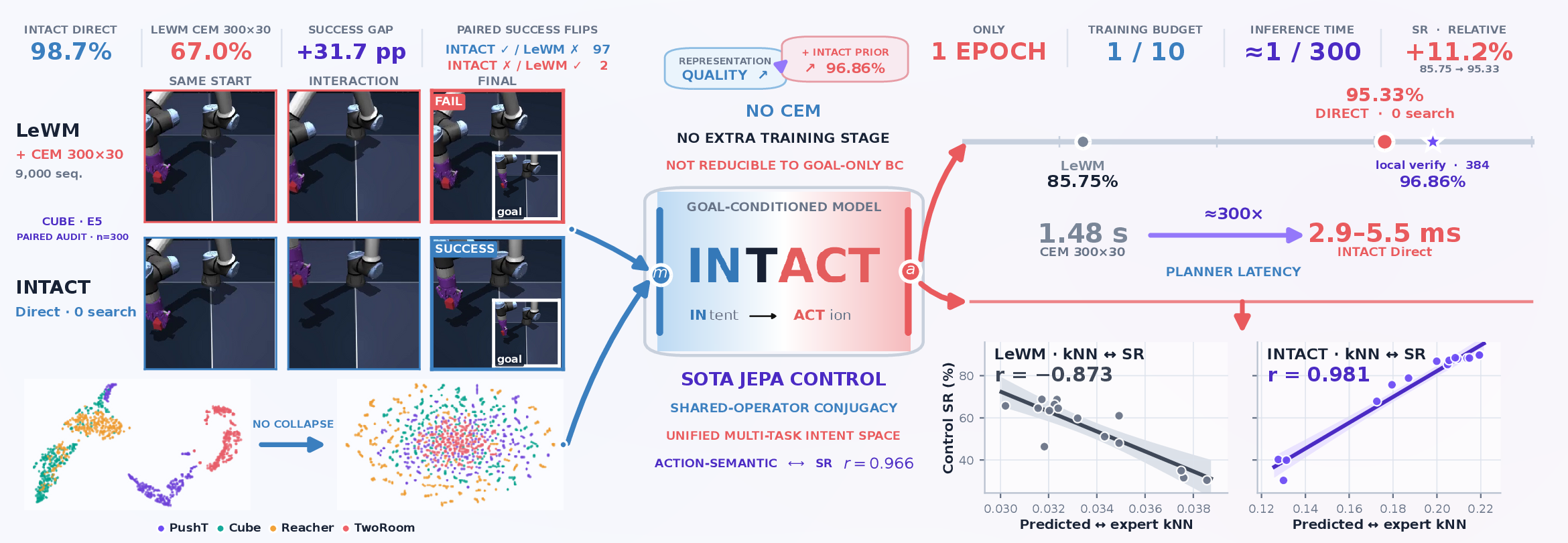
A strong representation keeps the information that matters intact. INTACT does exactly that, turning LeWM into a stronger world model.
Why INTACT?
We introduce INTACT (INtent-To-ACTion), an end-to-end JEPA that
turns action-labeled, reward-free trajectories into a deployable
intent-to-action interface. The name captures both the structure we impose and
the information we preserve:
- Isomorphic between predictor graphs. Local and goal motion-intent calls
use the same four-slot input grammar and the same parameters. - Isomorphic between supported families. Local and goal intent families
correspond through the action-law semantics induced by that shared
predictor, not through pointwise latent equality. - Intact from RGB evidence to latent intent. End-to-end action gradients
retain action-effective visual information while suppressing nuisance that
is unrelated to motion intent. - Intact from intent families to action-law families. The shared predictor
preserves the supported family correspondence all the way to direct action
readout.
TL;DR
Forward world models answer "what will happen if I execute this action?"
Yet deployment asks the inverse question: "which action realizes this
intent?" CEM and MPPI answer it by numerically searching over many candidates,
leaving training and inference without a learned semantic correspondence. The
result is often a predictor plus an action searcher, rather than a
self-consistent intent-action model.
INTACT learns that missing correspondence end to end. One conditional
operator maps both observed physical change and deployable goal intent to an
action law. Its conditional mean is a zero-search controller; sampling is
retained only for diversity or optional local verification. No frozen encoder,
extra policy-training stage, or globally linear latent dynamics is required.
1 epoch training · 95.33% Direct macro · 0 search · 2.9-5.5 ms latency
89.39% Shared E5 Direct · 96.86% Guarded · 23.44x fewer candidates
Core Insight: One Input Grammar, Two Intent Instances
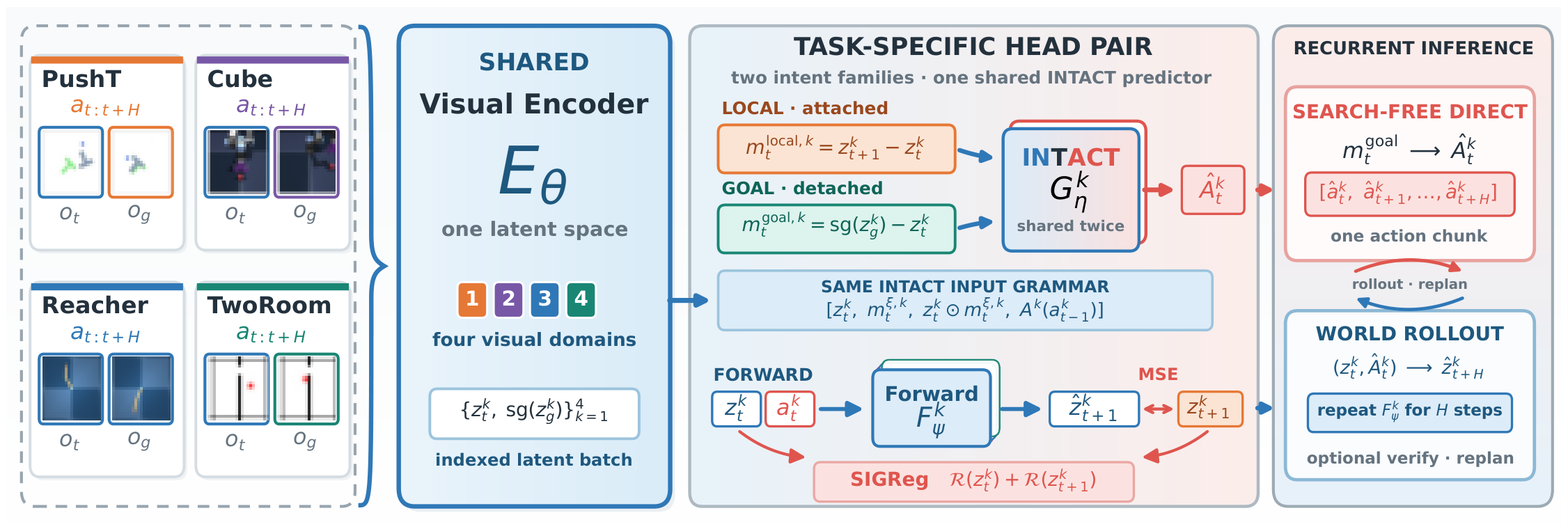
INTACT has one predictor input form. For either intent instance $m_t$, it uses
$$
x_t(m_t)=\big[z_t,m_t,z_t\odot mt,A(a{t-1})\big],
\qquad
G_\eta\left(x_t(mt)\right)
=p\eta(a_t\mid x_t(m_t)).
$$
Only the value and gradient role of $m_t$ change:
$$
mt^{\mathrm{local}}=z{t+1}-z_t,
\qquad
m_t^{\mathrm{goal}}=\mathrm{sg}(z_g)-z_t.
$$
The local instance uses a realized successor to ground which physical
change produced the demonstrated action. The goal instance presents the
same operator with the intent available before acting. Both come from the same
demonstration and are supervised against the same correct $a_t$, but each
supervised conditional remains one triplet $(z_t,m_t,a_t)$ with one endpoint
and one proper NLL:
$$
\mathcal L{\mathrm{I2A}}
=\lambda{\mathrm{local}}[-\log p_\eta(a_t\mid x_t(mt^{\mathrm{local}}))]
+\lambda{\mathrm{goal}}[-\log p_\eta(a_t\mid x_t(m_t^{\mathrm{goal}}))].
$$
There is no direct loss between the two endpoints or their latent
displacements. Instead, the shared likelihood creates a conditional action
quotient: at a fixed state, intents are equivalent when they induce the same
expert action law. Under a task-appropriate tolerance, nearby predictions
$\hat a_t^{(1)}$, $\hat a_t^{(2)}$, and the demonstrated $a_t$ can therefore
belong to the same action-equivalence neighborhood. This distributional view
makes direct control less sensitive to small prediction errors and helps limit
closed-loop drift, while the forward JEPA keeps the richer world information
needed for prediction.
Method
The physical successor remains attached to ground reachability; the future
goal is a stop-gradient deployment anchor. INTACT aligns the two supported
condition families through the actions they induce, without matching their
endpoints, imposing globally linear latent dynamics, freezing the encoder, or
adding a phase-2 controller. The goal likelihood alone is a goal-conditioned
imitation objective; full INTACT is its shared, end-to-end coupling with the
attached physical likelihood and forward JEPA.
INTACT retains the forward JEPA and adds one action-law predictor with a matched
input grammar for physical and deployable intents. The key construction is not
two unrelated auxiliary losses: both calls share parameters and a proper action
likelihood, while their upstream gradient routes remain deliberately asymmetric.
| Component | Role |
|---|---|
| Forward predictor | Preserves latent dynamics, contacts, topology, and visual information needed for rollout. |
| Physical intent call | Uses the observed successor with attached gradients to preserve action-recoverable change. |
| Goal intent call | Uses a detached future goal to train the same interface on a condition available before acting. |
| Matched interaction | Pairs first-order intent $m_t$ with the state-intent feature $z_t\odot m_t$. |
| Direct controller | Emits an action chunk with no candidate search or terminal latent-cost call. |
| Guarded local verification | Optionally refines the coherent Direct plan with a small local CEM budget. |
The four-domain model shares one visual encoder and keeps lightweight,
task-specific forward/action heads:
See Method Notes for the statistical construction, gradient
contract, and the distinction from inverse dynamics, goal-conditioned behavior
cloning, and post-hoc sampling priors.
Results
Task-Specific, One Epoch
The matched task-specific setting trains three models per task. Each checkpoint
is evaluated with three seeds and 100 episodes per seed on the official LeWM
protocol.
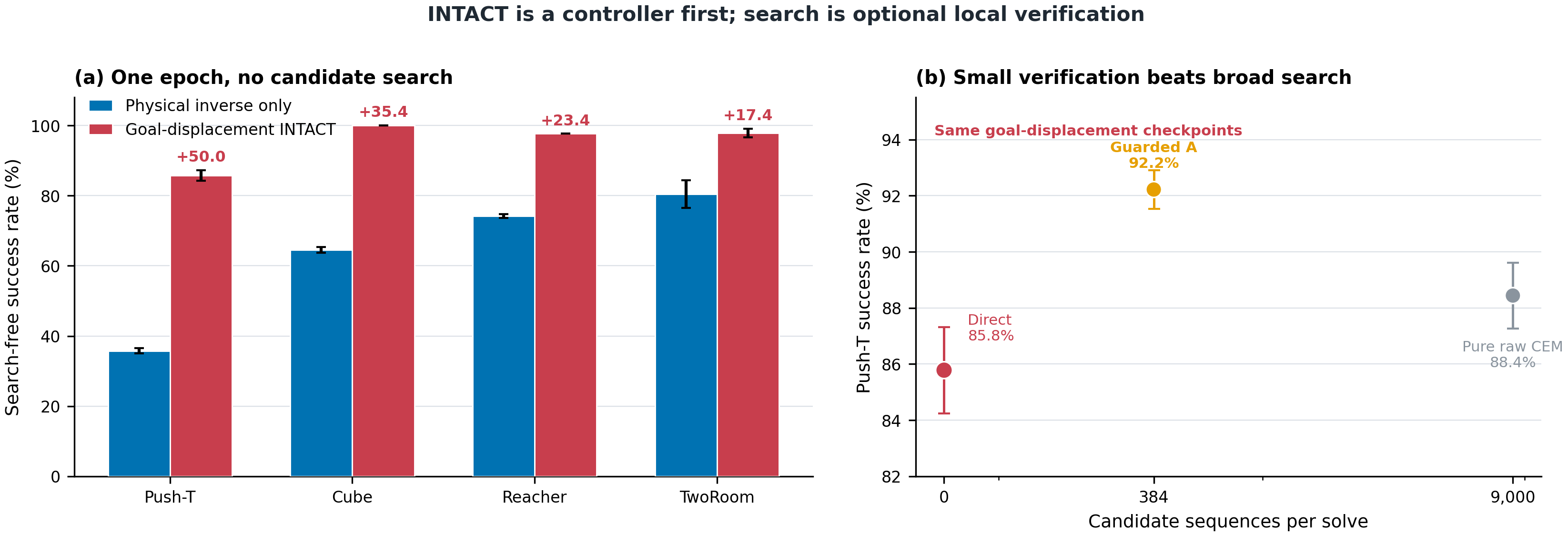
One epoch of goal-displacement INTACT reaches 95.33 +/- 0.58% Direct macro
SR with no candidate search. The same checkpoints reach 96.86 +/- 0.38%
with 384-sequence local verification. Published LeWM numbers use its separate
10-epoch CEM protocol and serve only as landscape context, not paired
significance controls. Exact task values and the full matched inference matrix
remain available in Audited Results.
One Shared Encoder
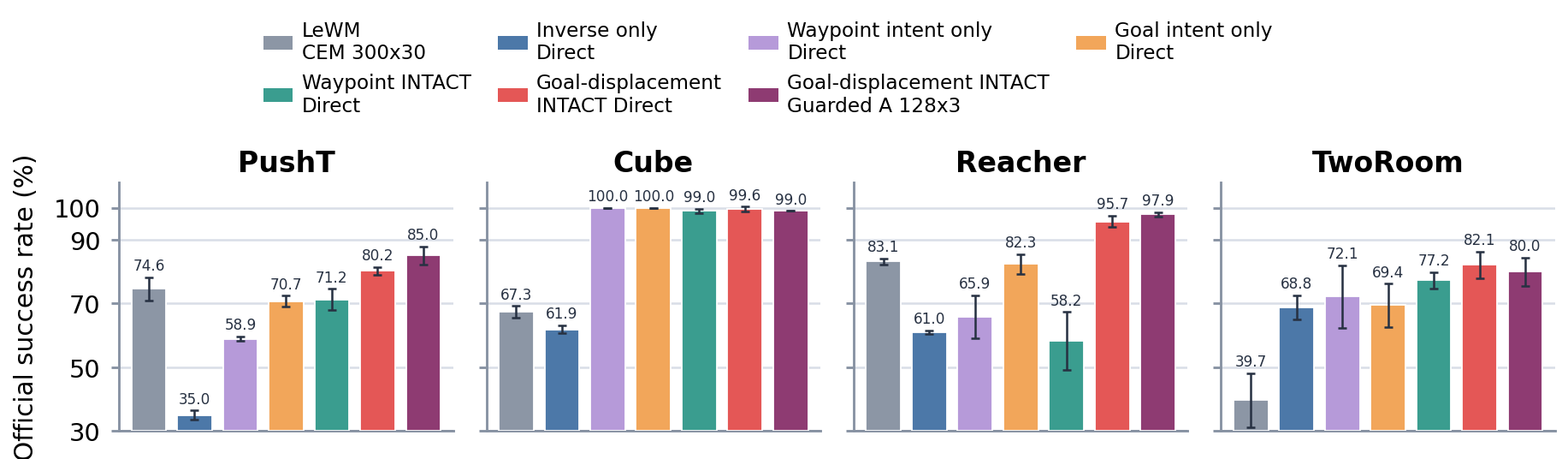
At epoch 5, Goal-displacement INTACT reaches 89.39 +/- 0.77% Direct macro SR
with one encoder shared across all four visual domains. The matched shared LeWM
baseline reaches 66.17 +/- 2.67% with CEM 300x30. With all INTACT action heads
disabled, pure-CEM macro still rises to 70.08 +/- 1.13%, separating
representation shaping from direct action readout.
Theory Meets Measurement
At fixed state $z$, INTACT treats two endpoint conditions as equivalent when
they induce the same expert action law:
$$
y\sim_z y' \iff p_E^\star(a\mid z,y)=p_E^\star(a\mid z,y').
$$
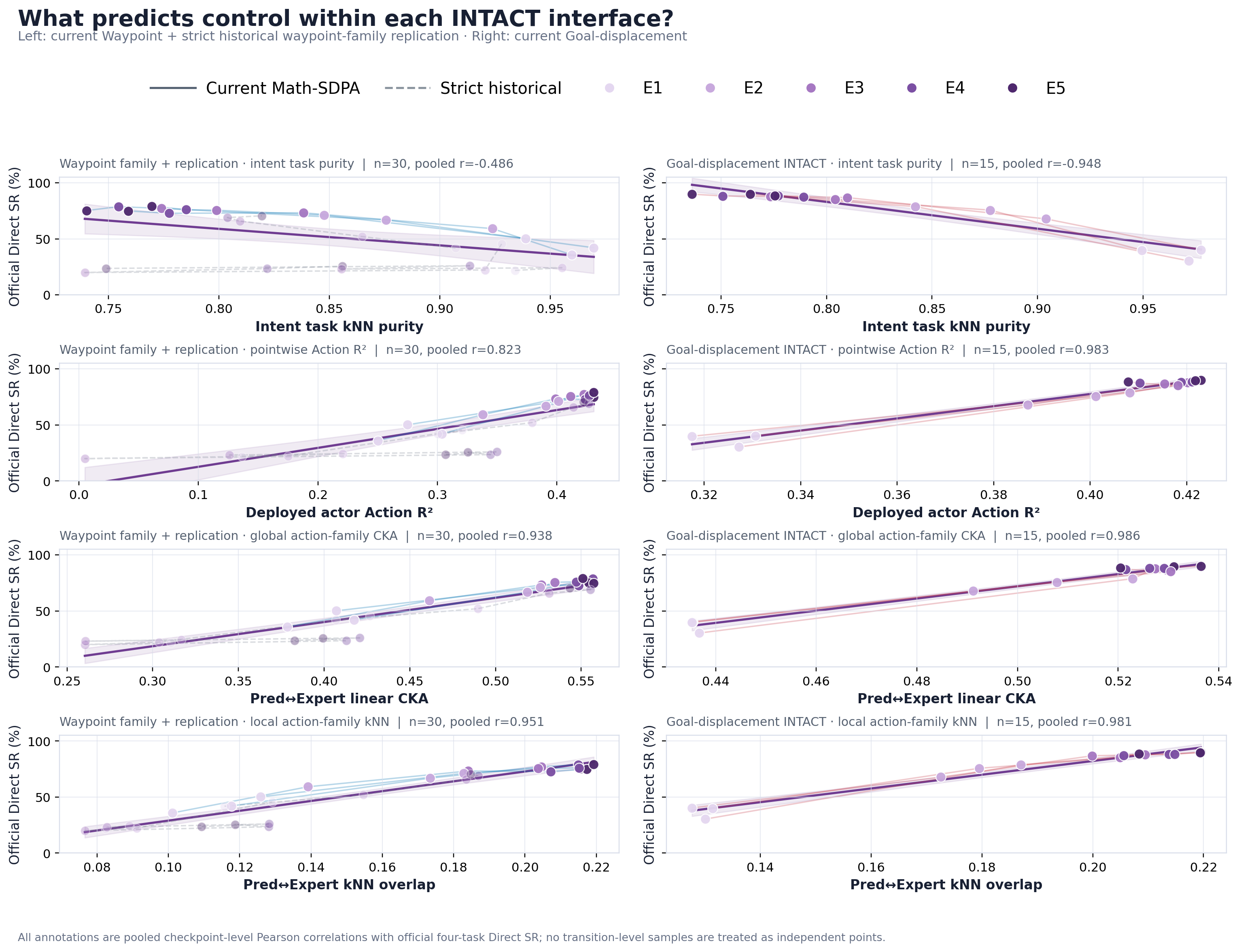
This conditional action quotient predicts that control should track the
relation between predicted and expert action-law families, not task clustering
or latent rank alone. Across 45 eligible shared-encoder checkpoints,
predicted-expert kNN overlap correlates with Direct SR at r = 0.954 and
linear CKA at r = 0.897; pointwise action $R^2$ is weaker at r = 0.815.
Paper, Website, and Code
This repository is currently a public research preview. The method record,
audited result tables, attribution, and reproducibility contract are organized
here first. Training/evaluation source, anonymous submission artifacts, and
checkpoints will be released in stages after their licensing, provenance, and
double-blind review checks are complete.
| Artifact | Status |
|---|---|
| Method and result documentation | Available in this repository |
| Reproducibility contract | Available in docs/REPRODUCIBILITY.md |
| Training and evaluation code | Release qualification in progress |
| Configurations and checkpoint manifests | Release qualification in progress |
| Model checkpoints | Planned |
| Paper | arXiv preprint 2607.26056 (2026-07-28) |
| Project website | zju3dv.github.io/INTACT-JEPA |
The detailed release gates are tracked in Release Plan.
Citation
An arXiv preprint is available at arXiv:2607.26056.
Please prefer the machine-readable CITATION.cff record.
@misc{sun2026intact,
  title         = {INTACT: Isomorphic Intent-to-Action Learning for Search-Free World Models},
  author        = {Sun, Junhan and Zhao, Hao and Zhang, Guofeng},
  year          = {2026},
  eprint        = {2607.26056},
  archivePrefix = {arXiv},
  url           = {https://arxiv.org/abs/2607.26056}
}
Acknowledgements
INTACT builds on the LeWM and stable-worldmodel research ecosystem. Evaluation
is reported on the official LeWM protocol and, where explicitly marked, the
separate CLEAR-LeWM evaluator.
See NOTICE.md for provenance and licensing boundaries.
Questions: [email protected]