

Repository
U4D
U4D: Uncertainty-Aware 4D World Modeling from LiDAR Sequences <a href="https://arxiv.org/abs/2512.02982" target="_blank"> <a href="" target="_blank"> <a href="" target="_blank"> <a · License unknown · Maintenance unknown
- License
- Unknown
README
English | 简体中文
U4D: Uncertainty-Aware 4D World Modeling from LiDAR Sequences
Xiang Xu Ao Liang Youquan Liu Linfeng Li Lingdong Kong Ziwei Liu Qingshan Liu
<p align="center">
  <a href="https://arxiv.org/abs/2512.02982" target="_blank">
</a>
<a href="" target="_blank">

</a>
<a href="" target="_blank">

</a>
<a href="" target="_blank">
</a>
</p>
</p>
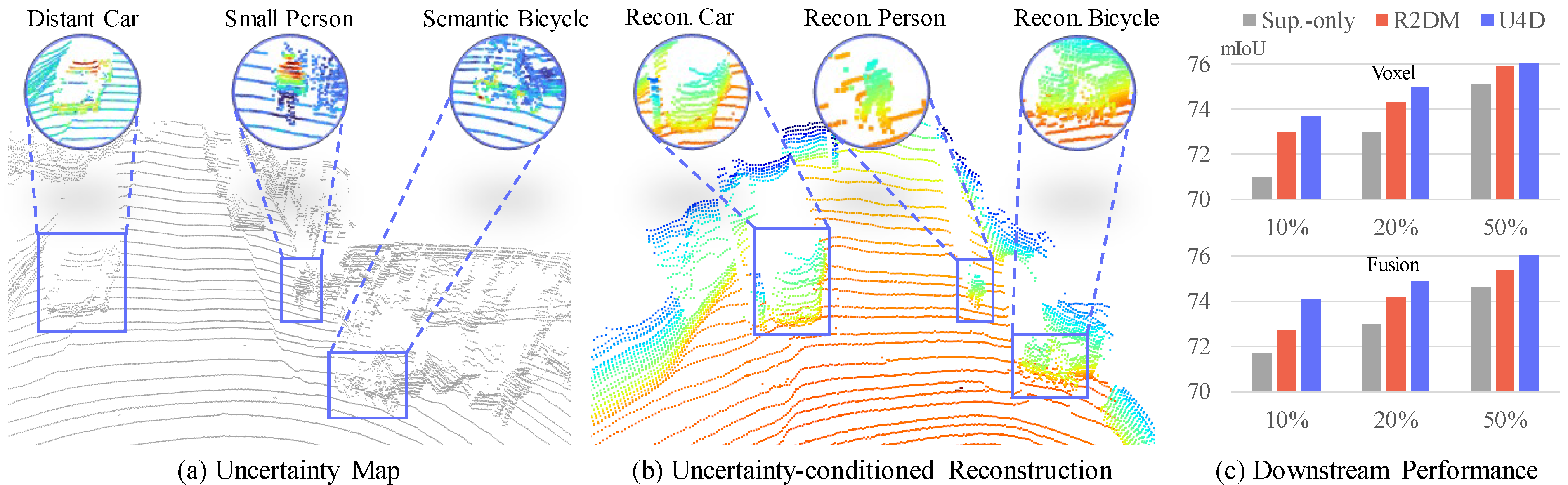
In this work, we introduce U4D, an uncertainty-aware framework for 4D LiDAR world modeling. The main contributions are:
- We introduce the first uncertainty-aware LiDAR generation framework that explicitly models spatial difficulty to enhance reliability in 4D world modeling.
- We design a two-stage hard-to-easy generation paradigm that reconstructs uncertain regions first and then completes the full scene under these priors.
- We develop a Mixture of Spatio-Temporal (MoST) block that ensures temporal consistency across frames by adaptively balancing spatial geometry and temporal dynamics.
:books: Citation
If you find this work helpful for your research, please kindly consider citing our paper:
@article{xu2025U4D,
    title   = {{U4D}: Uncertainty-Aware {4D} World Modeling from {LiDAR} Sequences},
    author  = {Xu, Xiang and Liang, Ao and Liu, Youquan and Li, Linfeng and Kong, Lingdong and Liu, Ziwei and Liu, Qingshan},
    journal = {arXiv preprint arXiv: 2512.02982},
    year    = {2025}
}
Updates
- [12.2025] - The technical report of U4D is available on arXiv.
License
This work is under the <a rel="license" href="https://www.apache.org/licenses/LICENSE-2.0">Apache License Version 2.0</a>, while some specific implementations in this codebase might be with other licenses. Kindly refer to LICENSE.md for a more careful check, if you are using our code for commercial matters.
Acknowledgements
This work is developed based on the R2DM codebase.