

Repository
cdaf
CDAF — Cached Descriptive Asset Files Stop making AI agents watch the same video twice. CDAF is an open sidecar format for video: a plain-text, timestamped description that lives n · License MIT · Install via pip · Maintenance unknown
- License
- MIT
- Component
- Where
- Spec
- Spec
- Engine
- Engine
Specs
- ComponentWhere
- SpecSpec
- EngineEngine
- CLICLI
- Local providerLocal provider
- Agent SkillAgent Skill
- BenchmarksBenchmarks
- PaperPaper
- CommandInstalls to
- npx cdaf-skill~/.claude/skills/cdaf (all your projects)
- npx cdaf-skill --project./.claude/skills/cdaf (this project only)
- npx cdaf-skill --dir <path>anywhere you want
- npx cdaf-skill --printstdout — for pasting into other agent frameworks
- ConditionAccuracy
- Direct video19/20 (95%)
README
CDAF — Cached Descriptive Asset Files


Stop making AI agents watch the same video twice.
CDAF is an open sidecar format for video: a plain-text, timestamped description that
lives next to the video file with the same basename. Generate it once, and every AI
agent that touches that footage afterward reads a few hundred text tokens instead of
running a full video-understanding pass.
Teach your agent the format — one command
npx cdaf-skillWorks on Windows, macOS, and Linux. That installs the agent skill, so
your coding agent checks for a .cdaf sidecar and verifies it against the video's hash
before it ever spends tokens watching. Then describe your footage once:
pip install "cdaf[generate] @ git+https://github.com/UditAkhourii/cdaf.git#subdirectory=cli"
cdaf generate ./footage
footage/
├── sunset-drone.mp4 ← plays everywhere, untouched
└── sunset-drone.cdaf ← what agents read instead of watching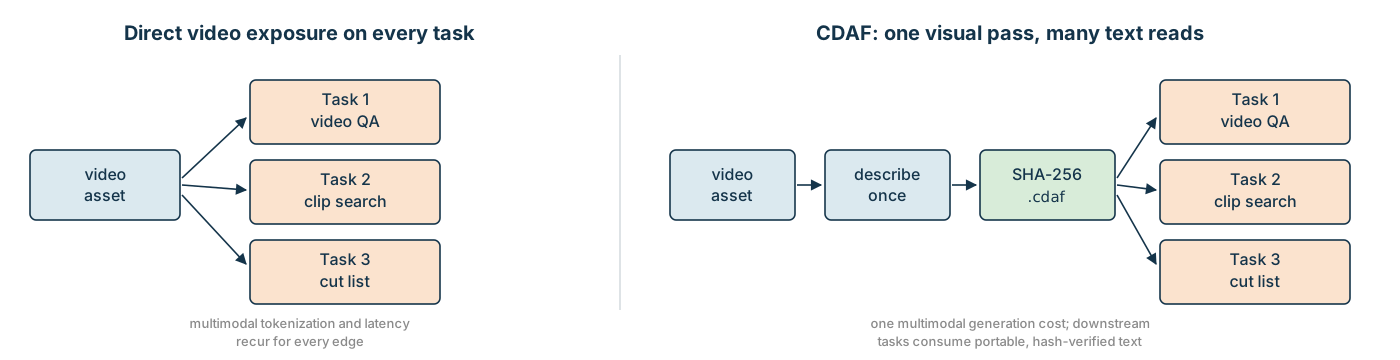
Measured (reproducible benchmark, gemini-2.5-flash, 20 questions): answering
from the sidecar matched direct video analysis on accuracy — 20/20 vs 19/20 — at
10.1× fewer prompt tokens per question (303 vs 3,066) and ~35% lower latency. The
ratio grows linearly with clip length (~50× for 60-second footage). In production use
at scale, this pattern cut video-workflow AI costs to roughly 1/25th.
Components
| Component | Where | What it does |
|---|---|---|
| Spec | SPEC.md | The normative format definition (v1.0) |
| Engine | cli/cdaf/ | Python library: parse, validate, hash, generate |
| CLI | cli/ | cdaf command: generate / validate / read / status |
| Local provider | cli/cdaf/local.py | --local: generate with a local model, no API key |
| Agent Skill | skills/ | Teaches agents the sidecar-first protocol · npx cdaf-skill |
| Benchmarks | benchmarks/ | Reproducible eval: sidecar vs direct video |
| Paper | paper/PREPRINT.md | arXiv preprint draft built on the benchmark |
📄 Spec
A CDAF asset is clip.mp4 + clip.cdaf: a UTF-8 sidecar with a minimal key: value
header and a markdown body. The header carries the SHA-256 and byte size of the
exact video described — edit the video and every conforming tool detects the sidecar
as stale and refuses to use it. The body is optimized for the actual reader (an LLM):
--- CDAF/1.0
video: sunset-drone.mp4
sha256: 4a7d1ed4…
bytes: 48211394
duration: 00:00:31.500
generator: gemini-2.5-flash
created: 2026-08-26T14:03:12Z
---

## Summary
A 31-second aerial drone clip of a coastal highway at golden hour…

## Segments
[00:00.0-00:05.2] Wide aerial establishing shot: a two-lane coastal highway…
[00:05.2-00:12.8] The drone pushes in and descends toward the highway…

## Transcript
(no speech)

## On-screen Text
(none)

## Tags
drone, aerial, coastal highway, golden hour, sunset, b-roll, …
Full normative rules (freshness semantics, versioning, section grammar):
SPEC.md. A complete example:
examples/sunset-drone.cdaf.
⚙️ Engine (core library)
The cdaf Python package is split by dependency weight:
- Zero-dependency core (sidecar.py) — parse, serialize,
chunked SHA-256, freshness checking, segment extraction. Agents and CI can validate
sidecars with nothing but the standard library. - Generator (generate.py) — Gemini Files API,
bring-your-own-key,brief/standard/richdetail profiles, token-usage capture.
Only imported when you generate. - Probe (probe.py) — optional ffprobe metadata
(duration/resolution/fps), degrades gracefully when ffprobe is absent.
from cdaf import load, check_freshness, sidecar_path_for

sc = load(sidecar_path_for("footage/sunset-drone.mp4"))
if check_freshness("footage/sunset-drone.mp4", sc) == "fresh":
    context_for_llm = sc.body
The format is model-agnostic: the engine's Gemini backend is one implementation, and
Claude/GPT/local-VLM backends slot in behind the same Sidecar type.
💻 CLI
Requires Python ≥ 3.10. Bring your own Gemini API key
(free tier available) — your footage goes to
your key, not to us.
pip install "cdaf[generate] @ git+https://github.com/UditAkhourii/cdaf.git#subdirectory=cli"
export GEMINI_API_KEY=your-key          # PowerShell: $env:GEMINI_API_KEY="your-key"

cdaf generate ./footage                 # describe every video, skip fresh sidecars
cdaf status ./footage                   # FRESH / STALE / MISSING report
cdaf read ./footage/sunset-drone.mp4    # print the description (verifies hash first)
cdaf validate ./footage/clip.mp4        # exit 0 iff sidecar is well-formed and fresh
Working from a clone instead? pip install ./cli[generate]. A PyPI release
(pip install cdaf) is on the roadmap.
Flags: --detail brief|standard|rich, --model <gemini-model>, --force.
validate/read/status need no dependencies and no API key. Safety lives in
the tool, not just in guidance: cdaf read refuses to print a stale sidecar.
🤖 Agent Skill
The skill turns the format into behavior: before analyzing any video, check for the
sidecar; verify freshness (size check for exploration, full hash for consequential
decisions); read it instead of watching; grep .cdaf files to search whole libraries;
regenerate when stale.
Install it with npx cdaf-skill (see above),
or pick a scope:
| Command | Installs to |
|---|---|
npx cdaf-skill |
~/.claude/skills/cdaf (all your projects) |
npx cdaf-skill --project |
./.claude/skills/cdaf (this project only) |
npx cdaf-skill --dir <path> |
anywhere you want |
npx cdaf-skill --print |
stdout — for pasting into other agent frameworks |
Re-running is safe: an unchanged skill is left alone, and a modified one is backed up
to SKILL.md.bak before updating. Prefer to copy it by hand? The file is
skills/claude-code/cdaf/SKILL.md.
Any other agent framework — the whole contract is one system-prompt paragraph:
Before analyzing a video file, look for a
.cdaffile with the same basename. If
itsbytes/sha256header matches the video file, read it instead of processing
the video.
Why agentic video editors care
Programmatic and agent-native editors (Remotion, HyperFrames, prompt-to-edit tools)
already do everything in text — compositions are code, cut decisions are data. Video
understanding is the one step that forces them out of the text domain, priced per
exposure (~263 tokens per second of footage on Gemini-class models). With CDAF:
- Selection becomes retrieval — "sunset coastal shots, no people" is a grep over
.cdaffiles, not a multimodal sweep of the library. - Cut lists come from segment timestamps —
[00:05.2-00:12.8]lines map straight
to Remotion<Sequence>s or HyperFrames clips. - Captions and audio sync for free — the Transcript section aligns speech to the
timeline. - The library appreciates — 40 candidate clips ≈ 473k tokens to watch, ~24k to
read — every session after the first.
📊 Benchmarks
Fully reproducible: bench.py synthesizes test videos with
ffmpeg from scripted recipes (known colors, hard cuts, timed word overlays), so ground
truth is exact and grading is objective — no LLM judge, no dataset license.
python benchmarks/bench.py make     # synthesize testset (needs ffmpeg)
python benchmarks/bench.py run     # both conditions via Gemini (needs GEMINI_API_KEY)
python benchmarks/bench.py report  # writes benchmarks/RESULTS.md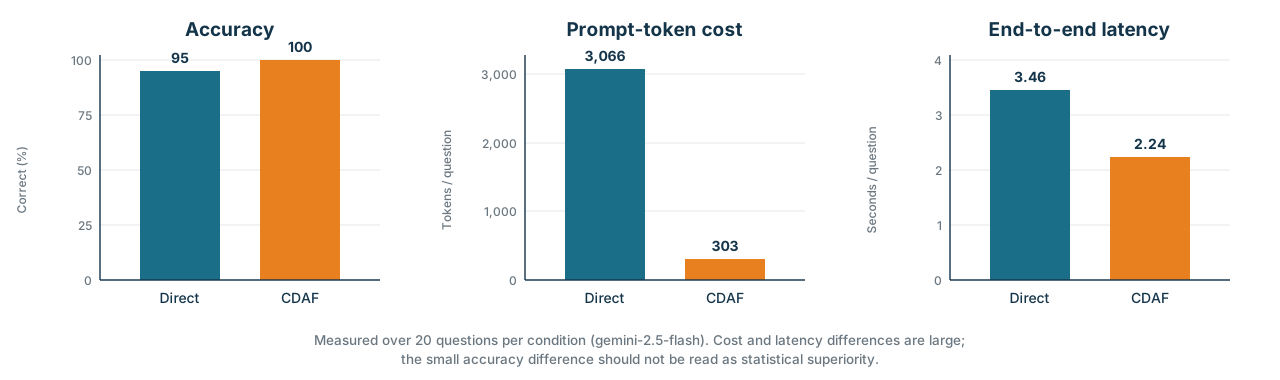
| Condition | Accuracy | Mean prompt tokens/question | Mean latency |
|---|---|---|---|
| Direct video | 19/20 (95%) | 3,066 | 3.46 s |
| CDAF sidecar | 20/20 (100%) | 303 | 2.24 s |
Each sidecar-answered question saves 2,763 prompt tokens, so generating a sidecar
(3,601 tokens) breaks even after ≈1.3 questions per video — everything after that
is the ~10× saving. Per-clip and per-question detail:
benchmarks/RESULTS.md.
📝 Paper
https://zenodo.org/records/22110594 — Cached Descriptive Asset Files (CDAF):
A Sidecar Format for Token-Efficient Video Understanding in Agentic Pipelines —
arXiv draft (cs.MM / cs.AI): format rationale, benchmark methodology and results,
production case study, integration analysis for agentic editors, limitations.
Roadmap
- PyPI release of the
cdafCLI (pip install cdaf) - MCP server exposing
cdaf_read/cdaf_status/cdaf_generateto any MCP client - Hosted free converter (no local install; bring-your-own-key or free quota)
- Additional generator backends (Claude, GPT, local VLMs)
- Node/TypeScript port of the engine
- Natural-footage benchmark extension with human-verified QA
- Signed sidecars (
signatureheader) for cross-organization trust
License
MIT — see LICENSE.