

Repository
T2S-Bench
T2S-Bench & Structure-of-Thought Benchmarking Comprehensive Text-to-Structure Reasoning Large Language Models (LLMs) have demonstrated remarkable capabilities across a wide range o · License unknown · Install via pip · Maintenance unknown
- License
- Unknown
- Task name
- Track
- t2sbench_multichoice
- MR
- t2sbench_structure_nodes
- E2E
Specs
- Task nameTrack
- t2sbench_multichoiceMR
- t2sbench_structure_nodesE2E
- t2sbench_structure_linksE2E
- t2sbenchBoth
README

 T2S-Bench & Structure-of-Thought
Benchmarking Comprehensive Text-to-Structure Reasoning
🌐 Project Page • 📚 Paper • 🤗 T2S-Bench Dataset
📊 Leaderboard • 🔮 Examples
Large Language Models (LLMs) have demonstrated remarkable capabilities across a wide range of language understanding and reasoning tasks. However, their ability to explicitly structure information from complex text—capturing key entities, relations, and higher-order semantic organization—remains poorly understood and insufficiently evaluated.
To bridge this gap, we present T2S-Bench, the first benchmark specifically designed to evaluate and improve models' text-to-structure capabilities. T2S-Bench comprises 1.8K high-quality samples spanning 6 scientific domains, 17 subfields, and 32 distinct structural types, covering a wide spectrum of real-world semantic structures. Solving tasks in T2S-Bench requires models to move beyond fluent text generation and instead perform explicit semantic structuring, which proves challenging for existing models. Using T2S-Bench, we conduct a comprehensive evaluation of 45 mainstream models across 10 model families.
Outlines
🎯 About T2S-Bench
T2S-Bench is a comprehensive benchmark for evaluating models' ability to extract structured representations from scientific text. It includes three curated components: T2S-Train-1.2k for training, T2S-Bench-MR (500 samples) for multi-hop reasoning, and T2S-Bench-E2E (87 samples) for end-to-end structuring. Covering 6 scientific domains, 17 subfields, and 32 structure types, T2S-Bench provides high-quality, structure-grounded samples drawn from peer-reviewed academic papers. Every sample underwent 6K+ model search, 6 rounds of validation, and 3 rounds of human review, ensuring correctness in structure, text, and reasoning logic.
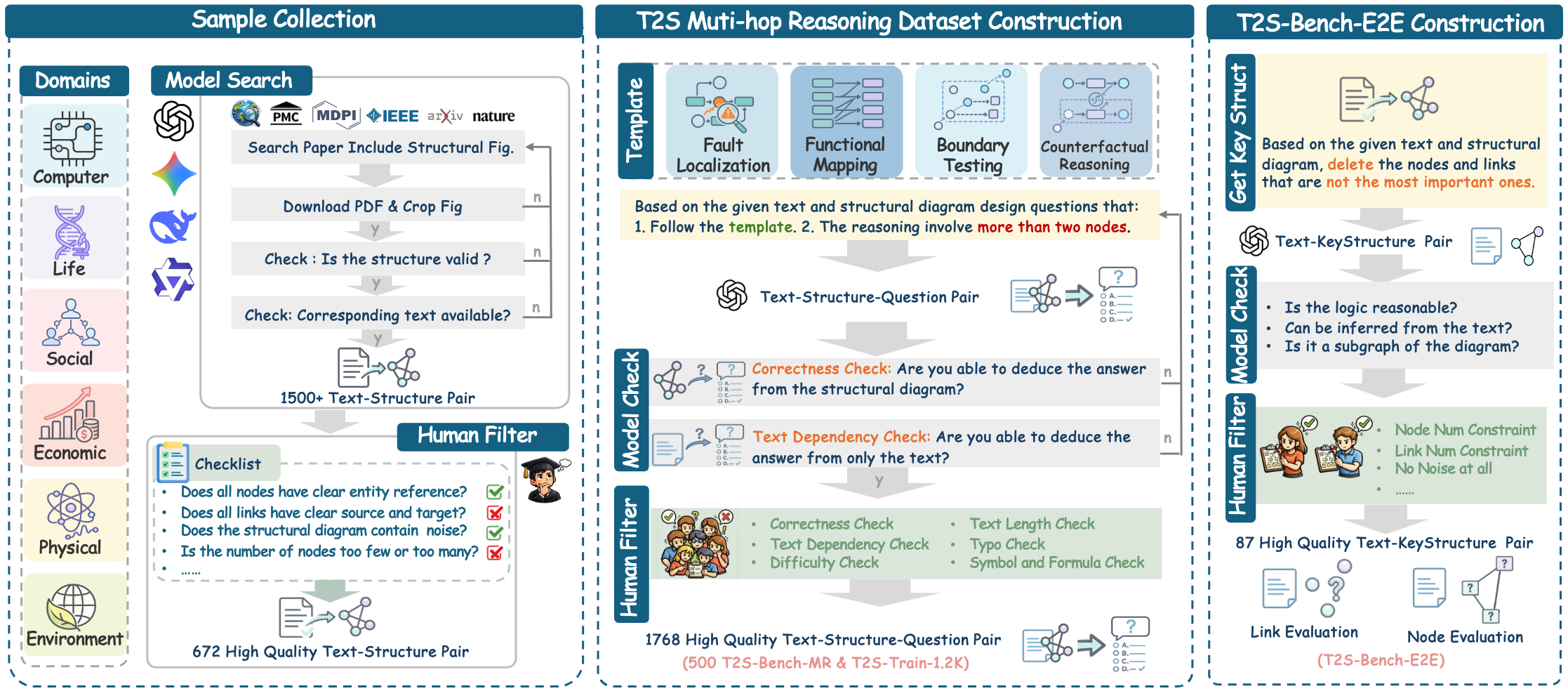
📊 Datasets
T2S-Bench is organized into three subsets:
| Subset | Size | Dataset (Location) | Goal | Design | Metrics |
|---|---|---|---|---|---|
| T2S-Train-1.2k | 1,200 samples | T2SBench/T2S-Train-1.2k | Provide verified text–structure pairs for training / instruction tuning | Multi-hop QA; supports single-select & multi-select | Exact Match (EM), F1 |
| T2S-Bench-MR | 500 samples | T2SBench/T2S-Bench-MR | Answer multi-choice questions requiring reasoning over an implicit/explicit structure extracted from text | Multi-hop QA; supports single-select & multi-select | Exact Match (EM), F1 |
| T2S-Bench-E2E | 87 samples | T2SBench/T2S-Bench-E2E | Extract a node-link graph from text that matches the target key-structure | Fixes key nodes/links; partially constrains generation to reduce ambiguity | Node Similarity (SBERT-based), Link F1 (connection-based) |
🚀 Quick Evaluation
Here we provide a simple and quick evaluation on T2S-Bench.
Step1. Setting Environment
git clone https://github.com/T2S-Bench/T2S-Bench.git
cd T2S-Bench
conda create -n t2sbench python=3.10 -y
conda activate t2sbench

pip install -e .
Step2. Download from Hugging Face
You can download the dataset and benchmark from Hugging Face and save locally:
# Multi-hop Reasoning benchmark (500 samples)
hf download T2SBench/T2S-Bench-MR --repo-type dataset --local-dir data/T2S-Bench-MR

# End-to-End Structuring benchmark (87 samples)
hf download T2SBench/T2S-Bench-E2E --repo-type dataset --local-dir data/T2S-Bench-E2E

# Training split (1,200 samples)
hf download T2SBench/T2S-Train-1.2k --repo-type dataset --local-dir data/T2S-Train-1.2k
Alternatively, download benchmark splits directly with the datasets library:
from datasets import load_dataset

# Multi-hop Reasoning benchmark (500 samples)
mr_dataset = load_dataset("T2SBench/T2S-Bench-MR")

# End-to-End Structuring benchmark (87 samples)
e2e_dataset = load_dataset("T2SBench/T2S-Bench-E2E")

# Training split (1,200 samples)
train_dataset = load_dataset("T2SBench/T2S-Train-1.2k")
Step3. Running the Evaluations
Note: Template scripts for tested models are provided in the
scripts/directory. Copy any script, update theMODELvariable, and run it to evaluate a new model.
(1) Evaluation with API
Set your API credentials as environment variables, then run evaluate_model.py (MR) and evaluate_structure.py (E2E):
export OPENAI_API_KEY="<your-key>"
export OPENAI_BASE_URL="<your-base-url>"   # omit to use the default OpenAI endpoint

MODEL="claude-haiku-4-5"
MODEL_SAFE="${MODEL##*/}"

# MR — Multi-hop Reasoning
python evaluate_model.py \
    --data_dir    data/T2S-Bench-MR \
    --model_type  api \
    --model_name  "${MODEL}" \
    --output      "results/MR/${MODEL_SAFE}.json" \
    --num_workers 8

# E2E — End-to-End Structuring
python evaluate_structure.py \
    --data_dir    data/T2S-Bench-E2E \
    --model_type  api \
    --model_name  "${MODEL}" \
    --output      "results/E2E/${MODEL_SAFE}.json" \
    --num_workers 8 \
    --resume
--resume lets you continue an interrupted E2E run without re-evaluating already-completed samples.
(2) Evaluation on Hugging Face model
Pass a HuggingFace model identifier (or local path) with --model_type hf and --model_name_or_path:
MODEL="meta-llama/Meta-Llama-3-8B"
MODEL_SAFE="${MODEL##*/}"

# MR — Multi-hop Reasoning
python evaluate_model.py \
    --data_dir           data/T2S-Bench-MR \
    --model_type         hf \
    --model_name_or_path "${MODEL}" \
    --output             "results/MR/${MODEL_SAFE}.json" \
    --num_workers        8

# E2E — End-to-End Structuring
python evaluate_structure.py \
    --data_dir           data/T2S-Bench-E2E \
    --model_type         hf \
    --model_name_or_path "${MODEL}" \
    --output             "results/E2E/${MODEL_SAFE}.json" \
    --num_workers        8 \
    --resume
Results are written to results/MR/<model>.json and results/E2E/<model>.json respectively.
💪 Evaluation via lm-evaluation-harness
T2S-Bench is also supported through EleutherAI's lm-evaluation-harness, allowing standardized evaluation of HuggingFace models using the lm_eval CLI.
Step1. Setup
Install the harness from the included fork:
cd lm-evaluation-harness
pip install -e .
pip install sentence-transformers   # required for structure evaluation
The T2S-Bench is written in the task below
| Task name | Track | Description |
|---|---|---|
t2sbench_multichoice |
MR | Multi-choice QA over scientific text (EM & F1) |
t2sbench_structure_nodes |
E2E | Node labeling stage (SBERT node similarity) |
t2sbench_structure_links |
E2E | Link extraction stage (Link F1) |
t2sbench |
Both | Full benchmark (all three tasks) |
Step2. Running Evaluations
HuggingFace local model:
CUDA_VISIBLE_DEVICES=1 lm_eval --model vllm \
  --model_args pretrained=Qwen/Qwen3-8B,trust_remote_code=True,tensor_parallel_size=1,dtype=auto,gpu_memory_utilization=0.8 \
  --tasks t2sbench \
  --batch_size auto \
  --apply_chat_template
OpenAI-compatible API (e.g. vLLM, local server, or OpenAI):
export OPENAI_API_KEY="<your-key>"

lm_eval --model local-chat-completions \
  --model_args model="gpt-4o-mini",base_url="https://api.openai.com/v1" \
  --tasks t2sbench \
  --batch_size 1 \
  --apply_chat_template
Output Format
All evaluation scripts write a JSON file with the following structure:
{
  "overall": {
    "em": 0.521,
    "f1": 0.563,
    "num_samples": 500
  },
  "by_major_class": {
    "CS": { "em": 0.55, "f1": 0.59, "num_samples": 80 },
    "Life-Science": { "em": 0.50, "f1": 0.54, "num_samples": 90 }
  },
  "by_question_type": {
    "single": { "em": 0.61, "f1": 0.61, "num_samples": 300 },
    "multi": { "em": 0.37, "f1": 0.50, "num_samples": 200 }
  },
  "all_samples": [
    {
      "sample_name": "CS_Networks_001",
      "major_class": "CS",
      "minor_class": "CS_Networks",
      "question_type": "single",
      "gold_answer": ["B"],
      "pred_answer": ["B"],
      "em": 1.0,
      "f1": 1.0,
      "response": "..."
    }
  ]
}
For E2E structure evaluation, the output additionally includes node_similarity and link_f1 fields per sample.
📄 Citation
If you find T2S-Bench useful for your research and applications, please cite:
@misc{wang2026t2sbenchstructureofthoughtbenchmarking,
      title={T2S-Bench & Structure-of-Thought: Benchmarking and Prompting Comprehensive Text-to-Structure Reasoning},
      author={Qinsi Wang and Hancheng Ye and Jinhee Kim and Jinghan Ke and Yifei Wang and Martin Kuo and Zishan Shao and Dongting Li and Yueqian Lin and Ting Jiang and Chiyue Wei and Qi Qian and Wei Wen and Helen Li and Yiran Chen},
      year={2026},
      eprint={2603.03790},
      archivePrefix={arXiv},
      primaryClass={cs.CL},
      url={https://arxiv.org/abs/2603.03790},
}