

Repository
TBSM
TBSM: Three-Body Scattering for Generative Modeling<br> <sub><sub>Three-Body Interaction. One-Step Generation!</sub></sub> 3University College London https://github.com/user-attach · License unknown · Maintenance unknown
- License
- Unknown
README
<h1 align="center">
TBSM: Three-Body Scattering for Generative Modeling<br>
<sub><sub>Three-Body Interaction. One-Step Generation!</sub></sub>
</h1>
Peng Sun1,2 · Zhenglin Cheng1,2 · Deyuan Liu1 · Jun Xie1,2 · Xinyi Shang3 · Tao Lin1
1Westlake University 2Zhejiang University 3University College London
Paper · Why TBSM? · Quick start · TODO · Citation
https://github.com/user-attachments/assets/6edc364e-b7e4-4bc6-9806-e255939b41c1
TBSM in two acts: from three-body scattering to one-step generation.
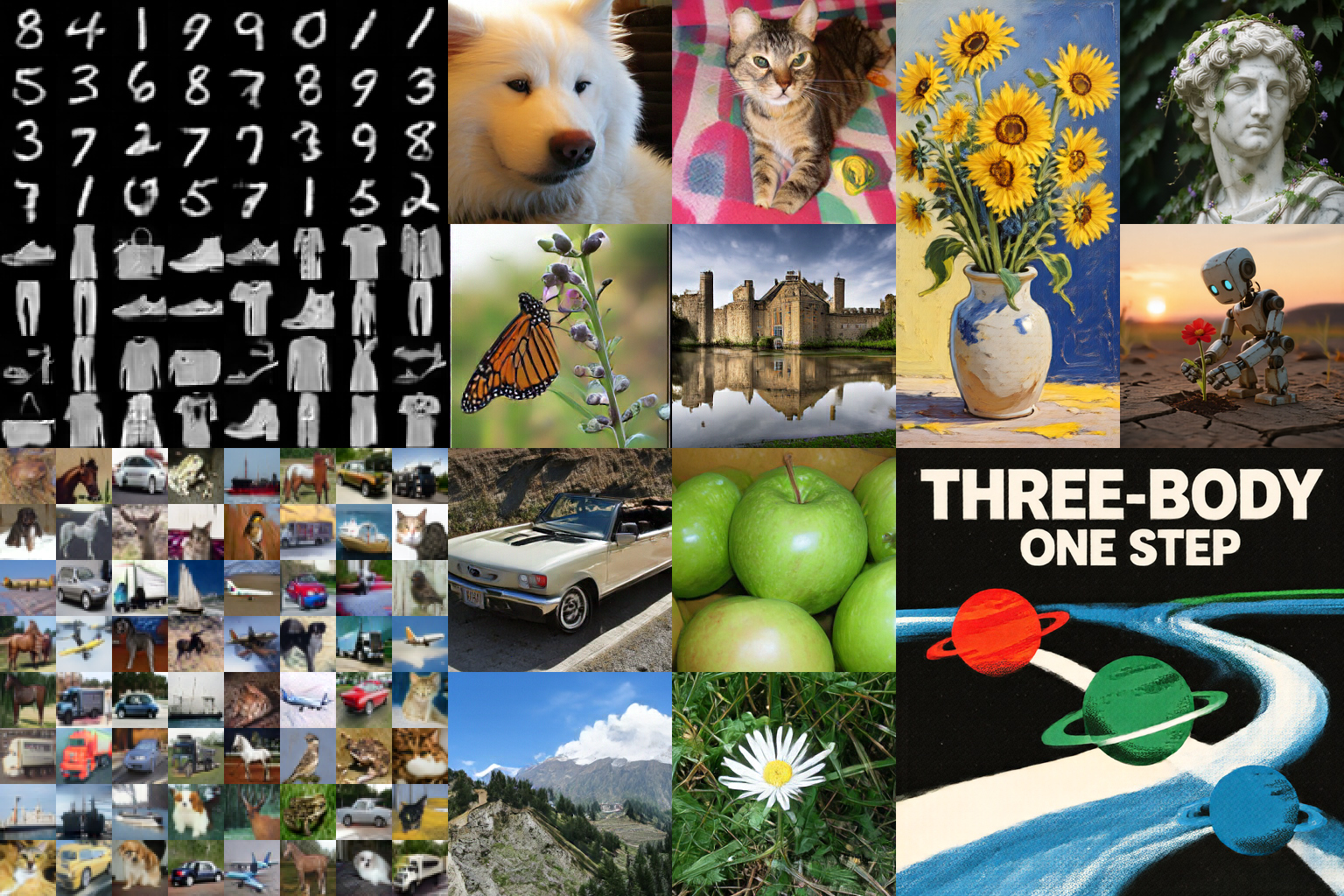
One-step generation across datasets, resolutions, and output spaces.
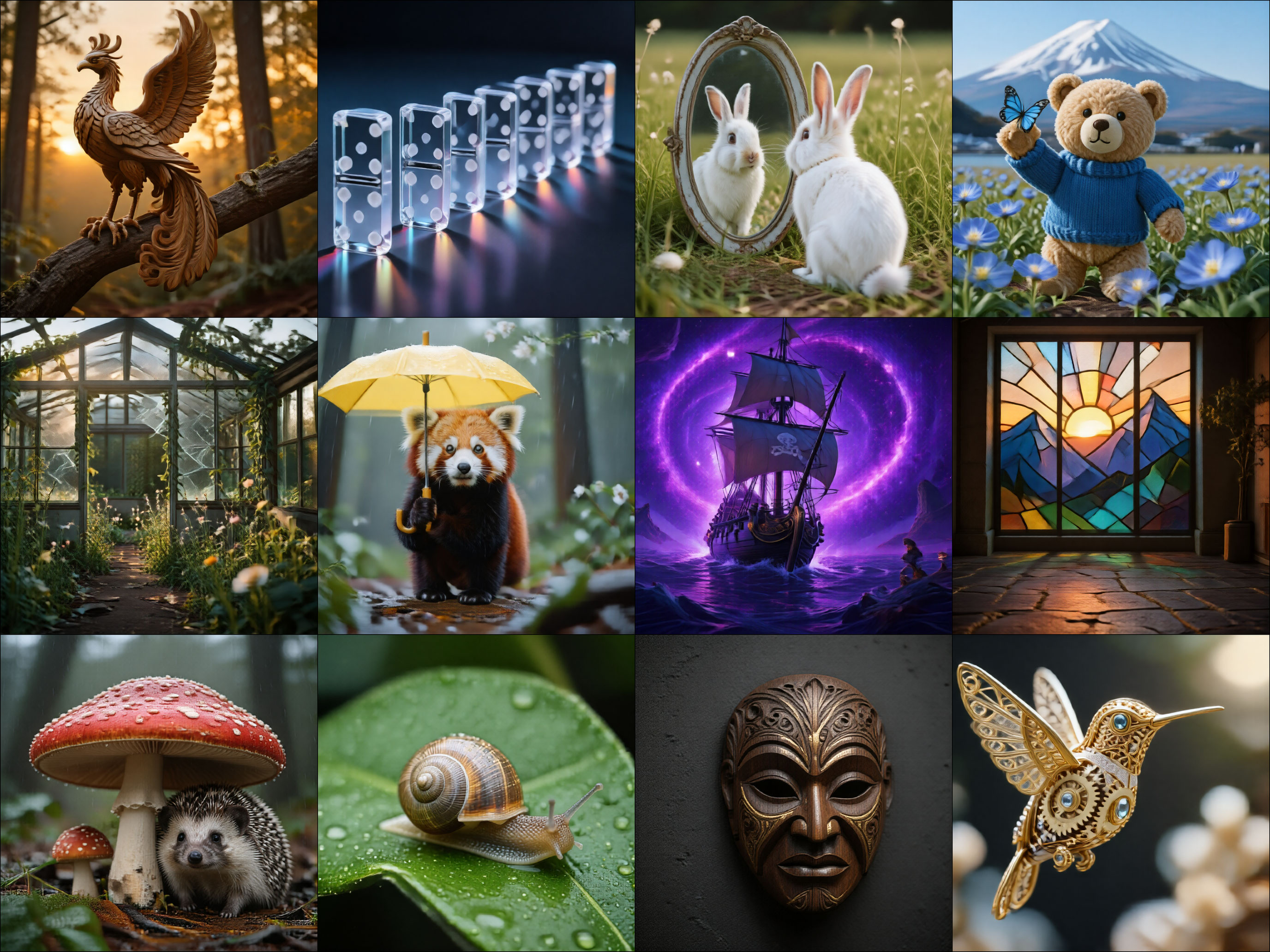
One-step text-to-image generation at 1024 × 1024 resolution.
Why TBSM?
<table align="center" width="100%">
<tr>
<th>Structural bottleneck</th>
<th>Practical limitation</th>
</tr>
<tr><td><strong>GANs</strong><br>learned adversarial critic</td><td>training is sensitive to the adversarial min–max objective</td></tr>
<tr><td><strong>AR / Diffusion</strong><br>ordered factorization or path-indexed objective</td><td>sequential decoding or iterative sampling slows inference</td></tr>
<tr><td><strong>Drifting Models</strong><br>minibatch-wide pairwise field</td><td>all-pairs cost grows with batch size<br>same-condition batches poorly fit one-image-per-caption T2I data</td></tr>
<tr><td><strong>Diffusion distillation</strong><br>often requires extra distillation losses, auxiliary training models, schedules, or stabilization tricks</td><td>some pipelines require additional teacher or online score networks during training, increasing systems complexity and potentially peak GPU memory</td></tr>
</table>
At its energy-distance endpoint, TBSM turns a proper distributional energy into direct, sample-level supervision for one-step generation—without an adversarial critic, teacher queries, or a batch-wide all-pairs field.
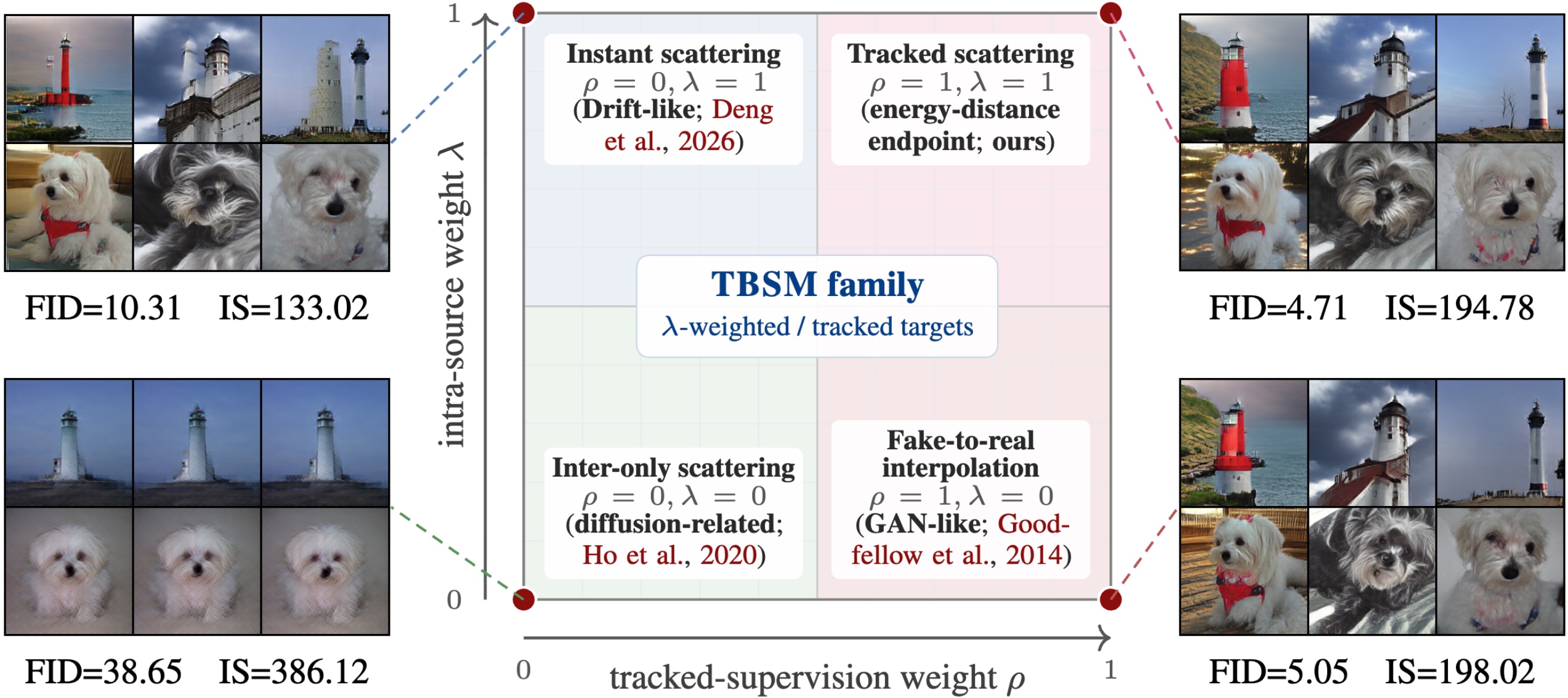
Two parameters, one design space. The (ρ, λ) map links four TBSM configurations to Drift-like dynamics, diffusion-related supervision, and GAN-like objectives.
Quick start
Performance
<table align="center">
<tr>
<th align="center">Resolution</th>
<th align="center">Space</th>
<th>Backbone</th>
<th align="center">NFE</th>
<th align="center">FID ↓</th>
<th align="center">IS ↑</th>
</tr>
<tr><td align="center">256²</td><td align="center">latent</td><td>DiT-XL/2</td><td align="center"><strong>1</strong></td><td align="center"><strong>1.63</strong></td><td align="center">243.0</td></tr>
<tr><td align="center">256²</td><td align="center">pixel</td><td>PixelDiT-XL/16</td><td align="center"><strong>1</strong></td><td align="center"><strong>2.23</strong></td><td align="center">230.9</td></tr>
<tr><td align="center">256²</td><td align="center">pixel</td><td>JiT-B/16</td><td align="center"><strong>1</strong></td><td align="center"><strong>2.69</strong></td><td align="center">247.4</td></tr>
<tr><td align="center">512²</td><td align="center">latent</td><td>DiT-XL/4</td><td align="center"><strong>1</strong></td><td align="center"><strong>1.92</strong></td><td align="center">252.1</td></tr>
</table>
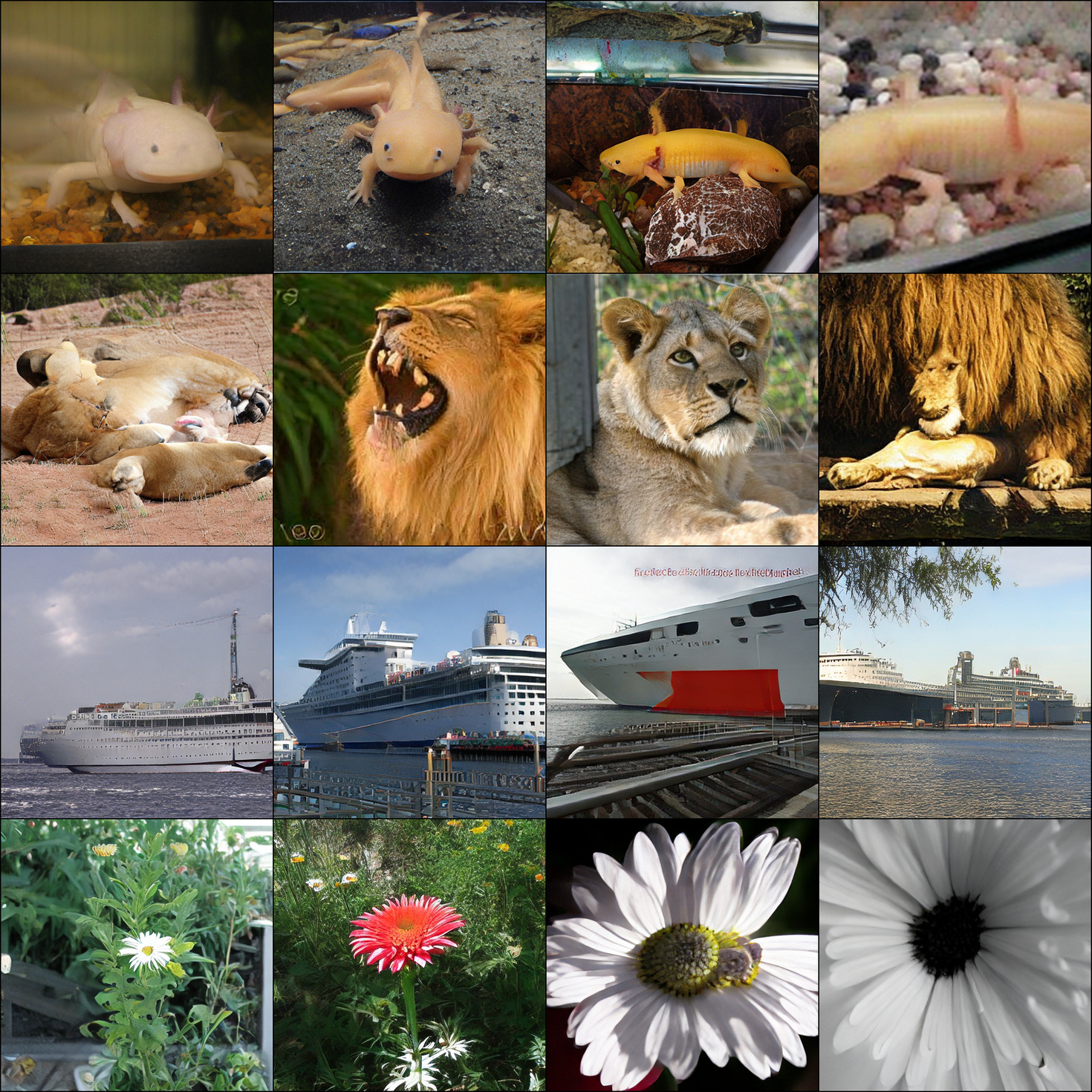
Before and after · ImageNet-512
<table align="center" width="100%">
<tr>
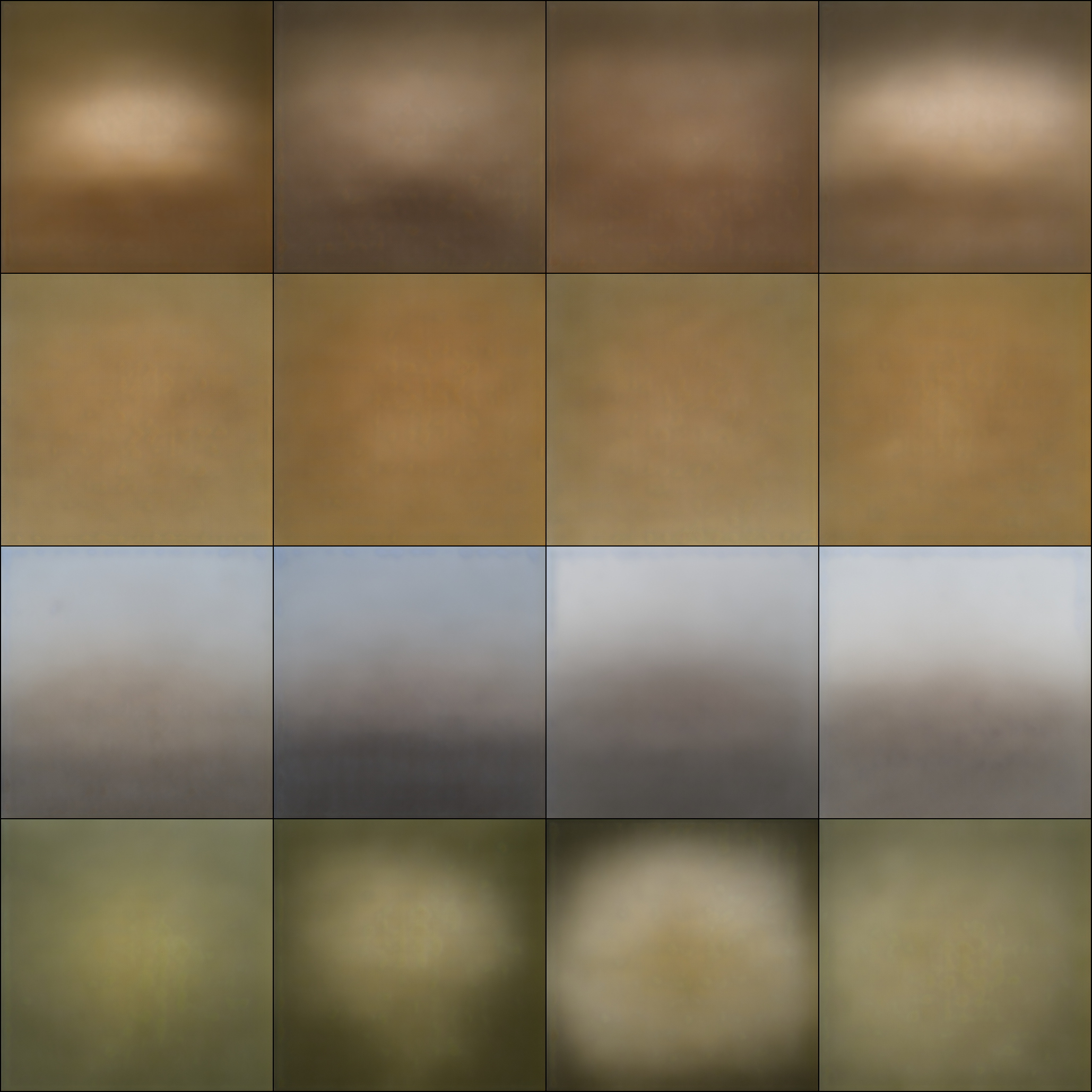
<th align="center" width="50%">Before TBSM · NFE 1 · FID 398.20</th>
<th align="center" width="50%">After TBSM · NFE 1 · FID 1.92</th>
</tr>
<tr>
<td>
</td>
<td>
</td>
</tr>
</table>
Run
The minimal MNIST implementation provides a lightweight, low-cost path to understanding the core TBSM training algorithm through a compact, runnable example.
For full ImageNet-1K experiments, see the ImageNet training and evaluation code, including configurations for pixel- and latent-space generators.
TODO
- [x] Release a minimal TBSM implementation for quick experimentation
- [x] Release the ImageNet-1K training codebase
- [x] Release ImageNet-1K training assets used by the provided configurations (Hugging Face)
- [ ] Release the Qwen-Image-20B checkpoint
- [ ] Release the Qwen-Image-20B training code
- [ ] Update the paper
Citation
@article{sun2026three,
  title   = {Three-Body Scattering for Generative Modeling},
  author  = {Sun, Peng and Cheng, Zhenglin and Liu, Deyuan and Xie, Jun and Shang, Xinyi and Lin, Tao},
  journal = {arXiv preprint arXiv:2607.18198},
  year    = {2026}
}
License
This is a mixed-license repository. Unless otherwise noted, original TBSM code is licensed under the Apache License 2.0. Vendored or adapted third-party files remain subject to their upstream licenses. In particular, imgnet/networks/backbones/pixeldit/ is governed by the NVIDIA License (NSCLv1), which permits use only for non-commercial research or evaluation. See Third-Party Notices for file-level scope, attribution, and applicable license texts. External model weights and datasets remain subject to their upstream terms.