

Repository
dual-pixel-disparity
Revisiting Disparity from Dual-Pixel Images: Physics-Informed Lightweight Depth Estimation (WACV 2025) Teppei Kurita, Yuhi Kondo, Legong Sun, Takayuki Sasaki, Sho Nitta, Yasuhiro H · License MIT · Maintenance unknown
- License
- MIT
README
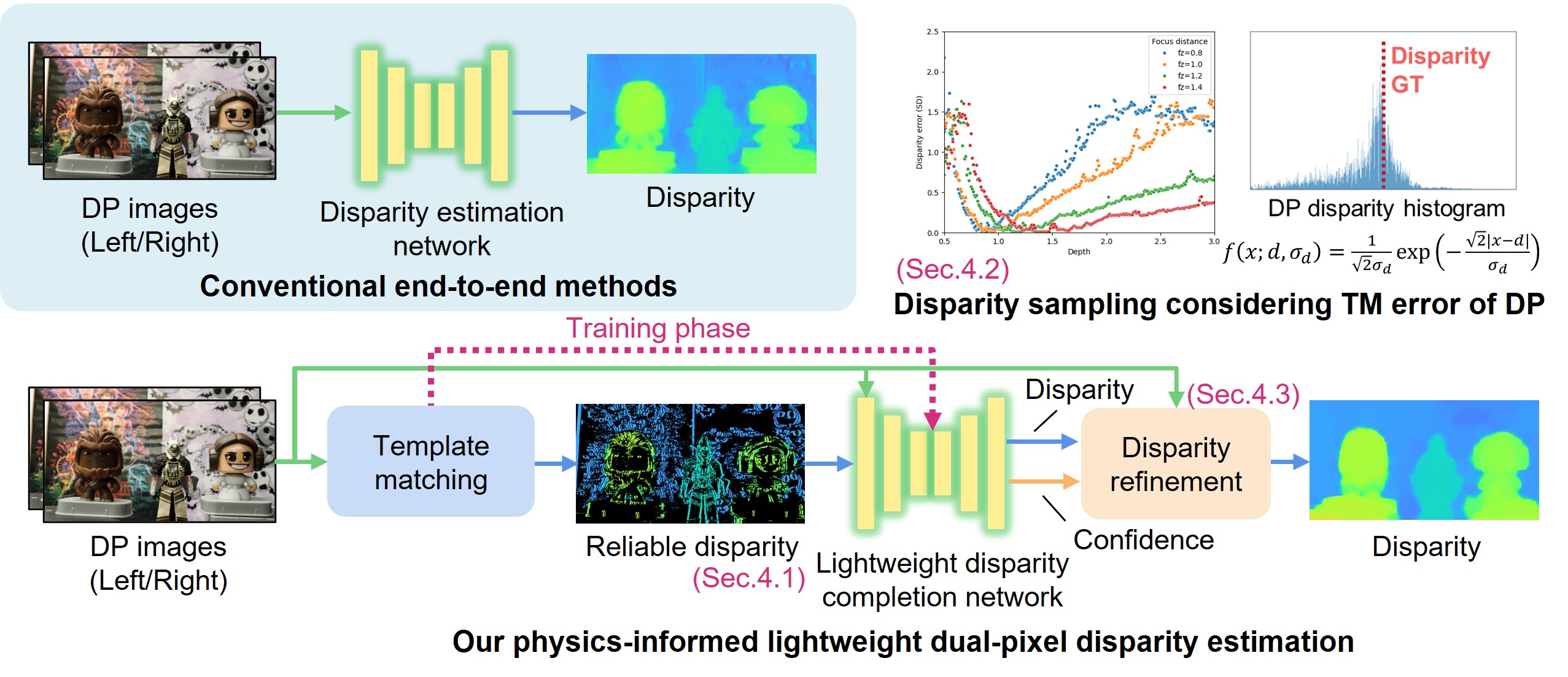
Revisiting Disparity from Dual-Pixel Images: Physics-Informed Lightweight Depth Estimation (WACV 2025)
Teppei Kurita, Yuhi Kondo, Legong Sun, Takayuki Sasaki, Sho Nitta, Yasuhiro Hashimoto, Yoshinori Muramatsu and Yusuke Moriuchi\
Sony Semiconductor Solutions Corporation, Tokyo, Japan\
paper(arxiv/cvf) | dataset\
Contents
Dependencies
The dependencies required to run this project are as follows:
- Python 3.7+
- PyTorch 1.9.1
- CUDA 11.1
Docker Usage
To build the Docker image and use the program, follow these steps:
-
Build the Docker image:
docker build -t dual-pixel-disparity:latest . -
Run the Docker container:
docker run --gpus all -v $(pwd)/data:/workspace/data -it dual-pixel-disparity:latest -
Inside the Docker container, you can use the same commands for training and evaluation as mentioned above.
Directory Structure
An example of the project's directory structure is as follows:
./dual-pixel-disparity/
./data/
├── models/
│   ├── costdcnet-based.tar
│   └── nlspn-based.tar
├── results/
├── dataset/
│   ├── Punnappurath_ICCP2020/
│   │   └── test/
│   ├── SEDC/
│   │   ├── train/
│   │   └── val/
Dataset
The Punnappurath_ICCP2020 dataset can be downloaded from the following link: dual-pixel-defocus-disparity
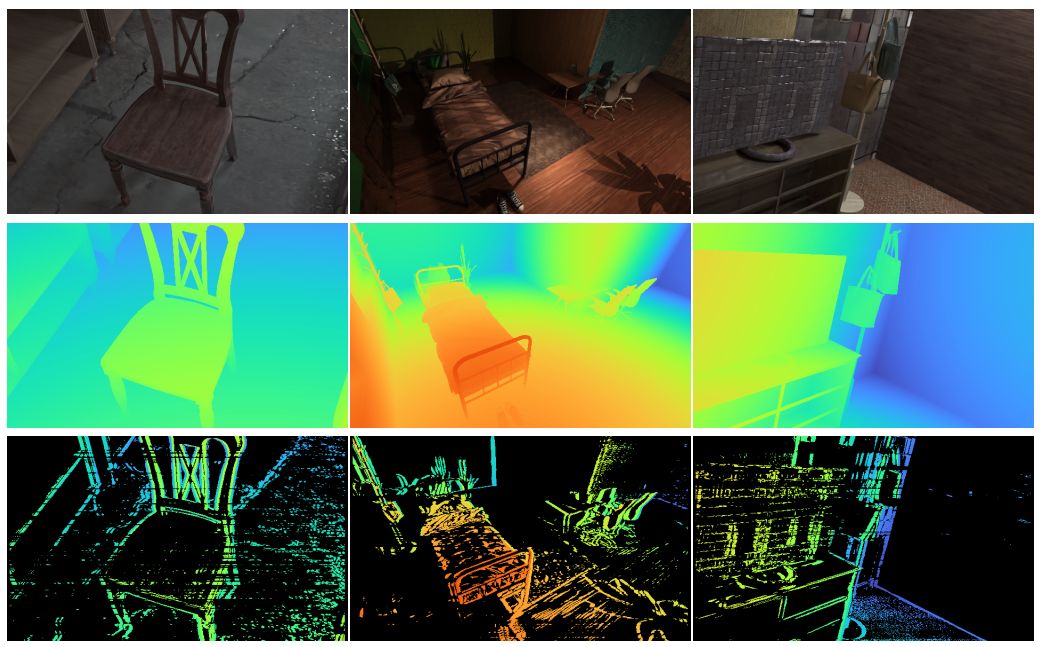
Our Synthetic Edge Depth Completion Dataset (SEDC Dataset) can be downloaded from the following link: SEDC Dataset
*Access to data requires a Microsoft account. After creating your Microsoft account, please contact us with your Microsoft E-mail address to grant access. The access right is revoked after a certain period of time , and your account information is not retained.
Pretrained Model
Our pretrained model can be downloaded from the following link.
*Access to data requires a Microsoft account. After creating your Microsoft account, please contact us with your Microsoft E-mail address to grant access. The access right is revoked after a certain period of time , and your account information is not retained.
The latest models costdcnet-based_250127.tar and nlspn-based_250127.tar have improved performance compared to the quantitative evaluation values in the paper.
Commands
Training
Use the following command to start training the model:
python main.py --data-type ed --depth-to-phase --add-phase-noise --network-model c --network-variant costdcnet --criterion l1c --epochs 50 --batch-size 8 --data-folder ../data/dataset/SEDC/ --result ../data/results/Evaluation
Use the following command to evaluate an existing model:
python main.py --evaluate ../data/model/costdcnet-based.tar --data-type cdp --network-model c --network-variant costdcnet --epochs 50 --batch-size 4 --data-folder ../data/dataset/Punnappurath_ICCP2020/ --result ../data/results/ --vis-depth-min 0.0 --vis-depth-max 3.0 --vis-phase-min -8.0 --vis-phase-max 5.0 --test-with-gt --lowres-phase --lowres-pscale 0.5 --lowres-cnn --lowres-scale 0.5 --post-process --post-refine wfgs --wfgs-conf --wfgs-prefillFor evaluation, please place dp_matching in ./dual-pixel-disparity/utils/. It can be downloaded from the following link:
dp_matching
*Access to data requires a Microsoft account. After creating your Microsoft account, please contact us with your Microsoft E-mail address to grant access. The access right is revoked after a certain period of time , and your account information is not retained.
dp_matching is an executable file.
License
This software is released under the MIT License. See LICENSE for details.
Citation
@InProceedings{Kurita_2025_WACV,
    author    = {Kurita, Teppei and Kondo, Yuhi and Sun, Legong and Sasaki, Takayuki and Hashimoto, Yasuhiro and Muramatsu, Yoshinori and Moriuchi, Yusuke},
    title     = {Revisiting Disparity from Dual-Pixel Images: Physics-Informed Lightweight Depth Estimation},
    booktitle = {Proceedings of the IEEE/CVF Winter Conference on Applications of Computer Vision (WACV)},
    month     = {February},
    year      = {2025},
}