

Repository
self-opd
Self-OPD: On-Policy Distillation for Flow Matching Models without Teacher
- Component
- Hugging Face repository
- Base model
- stabilityai/stable-diffusion-3.5-medium
- Self-OPD LoRA
- ShiyiZhang/Self-OPD
Specs
- ComponentHugging Face repository
- Base modelstabilityai/stable-diffusion-3.5-medium
- Self-OPD LoRAShiyiZhang/Self-OPD
README
<h1 align="center">Self-OPD: On-Policy Distillation for Flow Matching Models without Teacher</h1>
Overview
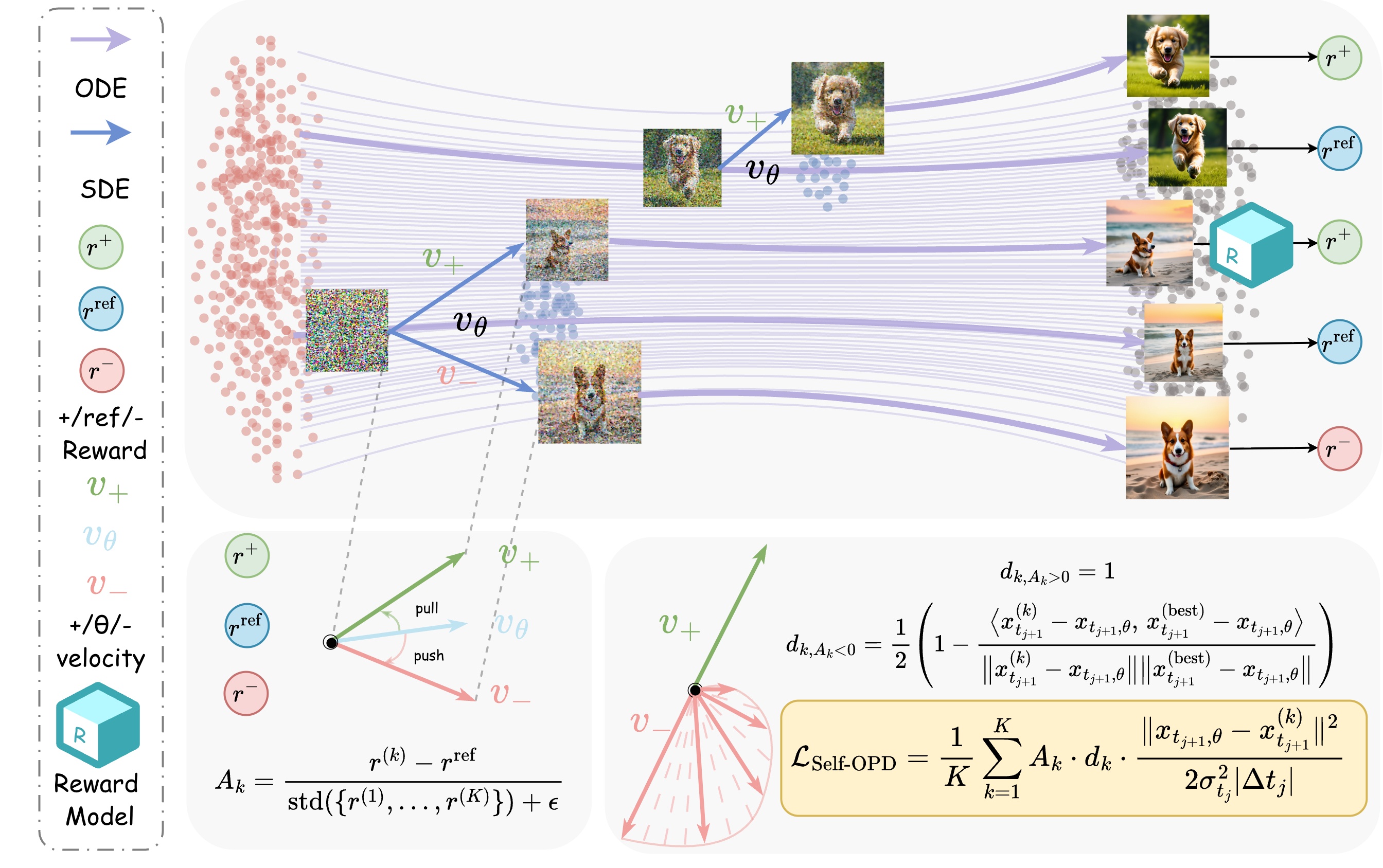
Self-OPD is a teacher-free, on-policy distillation framework for flow-matching text-to-image models. It turns the current policy's self-exploration into dense, step-wise supervision without training a separate task-specific teacher.
At each denoising step, Self-OPD samples multiple stochastic SDE branches around the deterministic next-state prediction, rolls each branch out with an ODE sampler, and compares its reward against a deterministic self-reference baseline. The resulting normalized advantages drive an all-branch pull-push objective with direction-aware attenuation and SDE-variance normalization. For multi-objective alignment, normalized scores are fused at the reward level to avoid direct gradient conflict.
This release provides the general Self-OPD training implementation, an SD3.5-Medium recipe using OCR as the first public reward example, standalone inference, and the evaluation protocol used for the paper. Additional reward configurations and checkpoints will be released progressively.
Method
- Teacher-free dense supervision: local exploration replaces a separately trained teacher while retaining per-step distillation targets.
- All-branch learning: both positive and negative branches contribute to the update instead of discarding all but the best sample.
- Direction-aware updates: repulsion is attenuated when it conflicts with the best local direction.
- Reward-level fusion: black-box rewards are combined before branch selection, avoiding direct gradient competition between reward models.
Results
Environment Setup
Python 3.10 or newer is recommended.
git clone https://github.com/Shiy-Zhang/Self-OPD.git
cd Self-OPD

python -m venv .venv
source .venv/bin/activate
pip install -r requirements.txt
Install the PaddlePaddle build appropriate for the local CPU/CUDA environment before OCR training or evaluation. GenEval additionally requires compatible MMDetection and MMCV builds; follow the MMDetection installation guide for the installed PyTorch and CUDA versions.
Model Download
Model weights are hosted on the Hugging Face Hub and are not stored in this repository.
| Component | Hugging Face repository |
|---|---|
| Base model | stabilityai/stable-diffusion-3.5-medium |
| Self-OPD LoRA | ShiyiZhang/Self-OPD |
The training, inference, and evaluation scripts accept either a local path or a Hugging Face model ID. Hugging Face weights are downloaded and cached automatically on first use. Make sure the base model's access conditions have been accepted and authenticate with hf auth login when required.
Training
Multi-GPU training uses the paper-scale defaults of eight processes, eight branches, and sixteen samples per prompt:
bash scripts/train_multi_gpu.shSet NUM_PROCESSES to use a different number of GPUs. A reduced single-GPU configuration is provided for functional testing and smaller experiments; it is not the paper-scale setting:
bash scripts/train_single_gpu.shInference
The following command loads the released LoRA directly from the Hugging Face Hub and runs the default OCR-oriented prompt:
bash scripts/infer.shEvaluation
The unified evaluator generates each required benchmark once and reuses the GenEval/OCR images for the same-test-image PickScore and HPSv2 scores. For the separate-test-set scores, PickScore uses DrawBench and HPSv2 uses Pick-a-Pic.
Download the official GenEval Mask2Former configuration/checkpoint and the official HPSv2 checkpoint, then run:
export GENEVAL_DETECTOR_CONFIG=/path/to/mask2former_config.py
export GENEVAL_DETECTOR_CHECKPOINT=/path/to/mask2former_checkpoint.pth
export HPSV2_CHECKPOINT=/path/to/HPS_v2.1_compressed.pt

bash scripts/evaluate.sh \
  --lora-path ShiyiZhang/Self-OPD \
  --output-dir outputs/evaluation \
  --metrics all
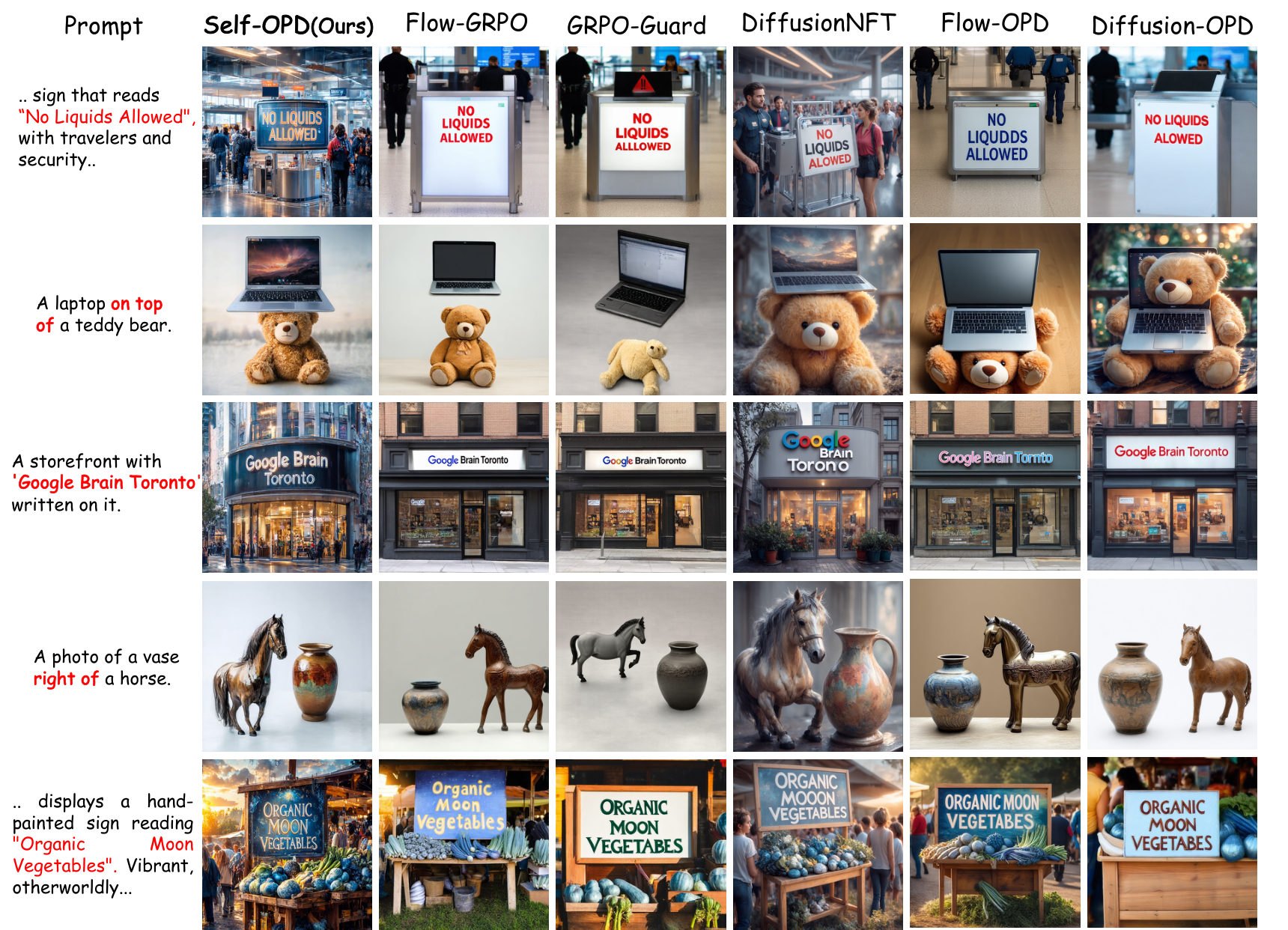
The evaluator reports GenEval strict and continuous accuracy, OCR character-level accuracy, PickScore and HPSv2 on the GenEval/OCR images (“same test images”), PickScore on held-out DrawBench prompts, and HPSv2 on held-out Pick-a-Pic prompts (“separate test set”).
Repository Layout
configs/                  Training configurations
data/                     OCR, GenEval, Pick-a-Pic, and DrawBench prompts and metadata
scripts/train.py          Self-OPD training implementation
scripts/train_*_gpu.sh    Single- and multi-GPU training launchers
scripts/infer.py/.sh      SD3.5-Medium LoRA inference and launcher
scripts/evaluate.py/.sh   End-to-end paper evaluation and launcher
self_opd/                 Self-OPD objective, rewards, and evaluation modules
Acknowledgements
Self-OPD is implemented with Hugging Face Diffusers, Accelerate, and PEFT. Parts of the SD3 sampling and prompt-encoding helpers are adapted from Diffusers under the Apache License 2.0, and the stochastic flow transition follows the public implementation pattern from ddpo-pytorch. Evaluation uses the official GenEval, PaddleOCR, PickScore, and HPSv2 implementations; benchmark sources are documented in data/README.md.
Citation
@article{zhang2026selfopd,
  title={Self-OPD: On-Policy Distillation for Flow Matching Models without Teacher},
  author={Zhang, Shiyi and Liu, Mushui and Tong, Yunze and He, Wanggui and Zou, Siyu and Liu, Jinlong and Yu, Yunlong and Song, Jian and Jiang, Hao and Huang, Pipei and Zheng, Bo},
  year={2026}
}
License
Released under the MIT License.