

Repository
legend-of-elya-n64
Legend of Elya — N64 game with a real 819K-parameter transformer running on the VR4300 MIPS III CPU. Zelda-style dungeon, AI NPCs, byte-level inference at 60 tok/s. Built with libdragon SDK.
- Parameter
- Value
- Parameters
- 6,356,992 (6.36M)
- Layers
- 8
- Embedding dim
- 256
Specs
- ParameterValue
- Parameters6,356,992 (6.36M)
- Layers8
- Embedding dim256
- Attention heads8 (32-dim each)
- Vocabulary256 (byte-level ASCII)
- Context window128 tokens
- QuantizationTernary (SEQ2, 2-bit weights + float16 block scales, 32-weight blocks)
- Weight file1,984 KB on cartridge ROM ( filesystem/sophia_weights.bin , 2,031,628 B)
- Inference mathFloat32 on MIPS R4300i FPU
- Speed1.23 tok/s scalar, 2.19 tok/s RSP overlay — measured under ares, never on silicon ( how )
- KV cache256 KB in RDRAM
- Total RDRAM~263 KB (KV cache + 7KB scratch)
- buildvblanks for 19 tokens
- buildvblanks
- buildoutput-phase (correct)
- claimcycles/token
- 60 tok/s1,562,500
- measured scalar, 1.23 tok/s76,172,413
- measured RSP overlay, 2.19 tok/s42,849,440
- FilePurpose
- nano_gpt.cFloat32 GPT inference engine (MIPS R4300i)
- nano_gpt.hModel struct definitions, KV cache, API
- rsp_matmul.S / matmul_rsp_drv.cRSP vector-unit matmul microcode + CPU driver ( make base-rsp )
- rpi/RPI zero-multiply permutation inference engine + 868KB game model
- multi_npc.cExpansion Pak multi-NPC mode (3 AI characters)
- legend_of_elya.cGame: dungeon scene, sprites, dialog, music, HUD, D-pad keyboard
- train_sophia_v5.pyPyTorch training + Q8 weight export
- train_sophia_v8.pyv8 training pipeline — 4 NPC personality packs
- reference_cli.cHost-side reference CLI ( make reference ) for x86 parity testing
- weights/sophia_weights.binPre-trained v5 weights (458KB, ready to use)
- Makefilelibdragon build system
- src/Latest source snapshots
- screenshots/Working N64 LLM screenshots
- mining/Optional RustChain mining attestation module
- OffsetSize
- 04
- 41
- 52
- 71
README
Legend of Elya — World's First LLM on Nintendo 64

An original N64 homebrew ROM featuring Sophia Elya — an AI NPC
powered by a nano-GPT transformer running live inference on the MIPS R4300i CPU.
No precomputed responses. No lookup tables. Real matrix multiply, real softmax, real
attention — on a 93.75 MHz CPU from 1996.
Video demos:
- Full Demo (58s) — Complete walkthrough with multiple prompts
- First Coherent Output (69s) —
61.8 tok/sgenerating coherent English
(the 61.8 tok/s in this video is withdrawn — the counter on screen was
broken and the real figure is 1.2 tok/s; see The tok/s counter was wrong
below)Download ROM:
legend_of_elya.z64— ready to run in ares emulator or EverDrive 64
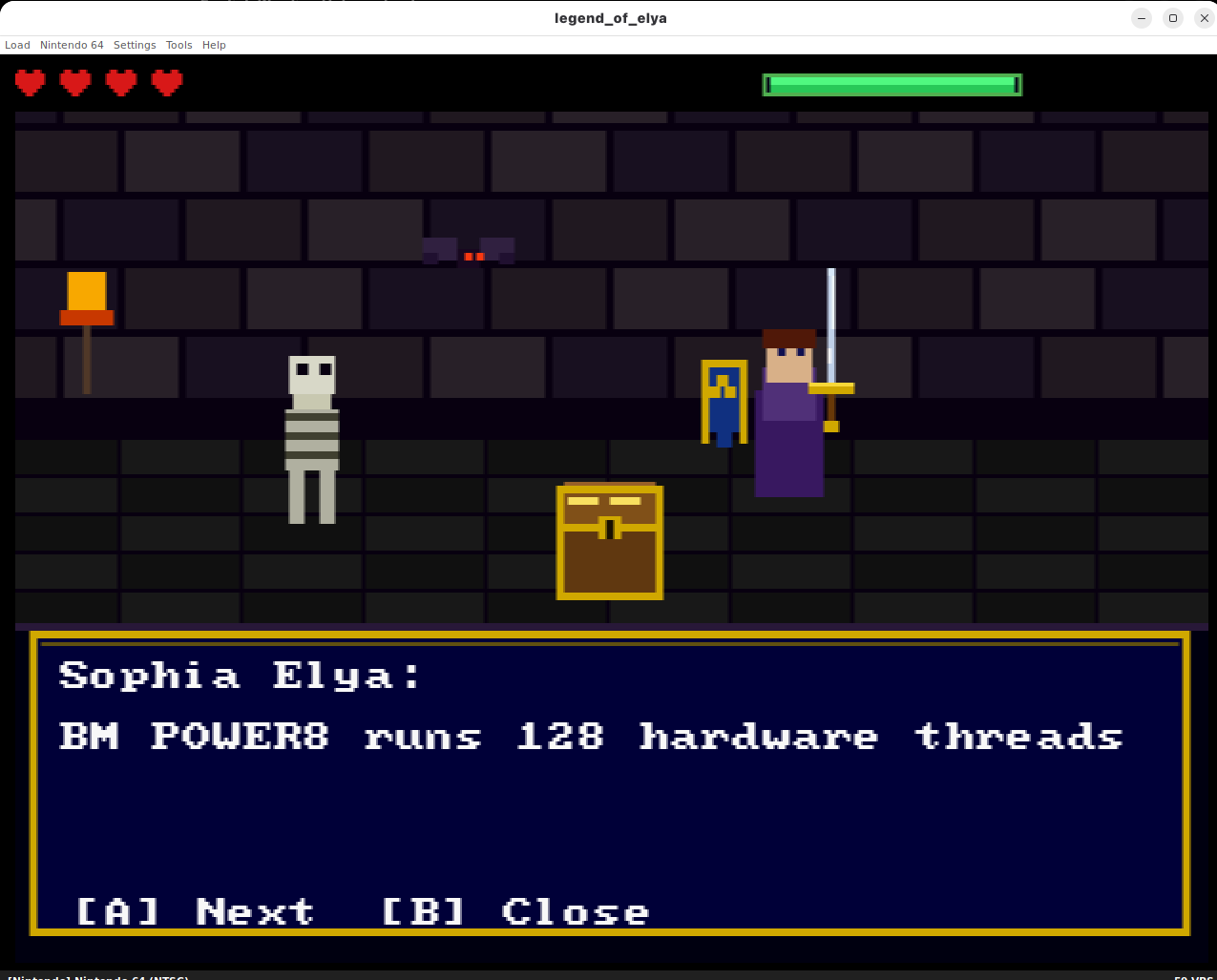
What It Does
- Press A near Sophia Elya to trigger AI dialog
- The N64 CPU runs a full 8-layer transformer: embedding → attention → FFN → logits → sampling
- Output tokens appear character-by-character with a live tok/s counter
- Each response is different — seeded by CPU oscillator jitter (hardware entropy)
- 32 prompts covering identity, Elya lore, RustChain, hardware trivia
- Runs in the ares emulator and on real N64 hardware via EverDrive 64
Architecture
| Parameter | Value |
|---|---|
| Parameters | 6,356,992 (6.36M) |
| Layers | 8 |
| Embedding dim | 256 |
| Attention heads | 8 (32-dim each) |
| Vocabulary | 256 (byte-level ASCII) |
| Context window | 128 tokens |
| Quantization | Ternary (SEQ2, 2-bit weights + float16 block scales, 32-weight blocks) |
| Weight file | 1,984 KB on cartridge ROM (filesystem/sophia_weights.bin, 2,031,628 B) |
| Inference math | Float32 on MIPS R4300i FPU |
| Speed | 1.23 tok/s scalar, 2.19 tok/s RSP overlay — measured under ares, never on silicon (how) |
| KV cache | 256 KB in RDRAM |
| Total RDRAM | ~263 KB (KV cache + 7KB scratch) |
Key Implementation Details
- Float32 inference — all activations, attention scores, and accumulations are IEEE 754 float32
- On-the-fly dequantization — weights stay compressed in ROM (2 bits each in the shipped
ternary blob, 8 in an int8 blob); dequantized per matmul - Custom Taylor exp() — range-reduction
exp(x) = exp(x/128)^128with degree-4 Taylor series and 7 squarings. Uses zero float-to-int casts to avoid the R4300i's missingtrunc.w.sinstruction - Quake III fast inverse sqrt —
0x5f3759dfbit trick with 2 Newton-Raphson iterations for RMS normalization - Big-endian aware — weight file is little-endian (Python export), N64 is big-endian.
swap16/swap32helpers handle byte-order conversion for header fields and float16 scales - Hardware entropy — MIPS CP0 Count register XOR'd with frame counter for RNG seeding
- Greedy sampling — pure argmax over printable ASCII (32-126), matching proven x86 reference quality
- Embedding scale restoration — Q8 export normalizes to [-1,1]; the original scale factor (em=3.5) is stored in header byte and restored at init
The tok/s counter was wrong (2026-08-13)
This project published ~60 tok/s. The real figure is 1.23 tok/s. The counter
that produced the 60 was not measuring anything.
The number reached four places — this README, the video description, the
elyanlabs.ai homepage, and the launch article — before anyone audited it. It has
been pulled from the homepage and the article. This section is the correction,
and it stays visible.
What the old counter computed
From src/legend_of_elya.c at bf97959 (2026-02-22), the build whose on-screen
readout was filmed:
int elapsed = G.frame - G.gen_start_frame;
if (elapsed > 0)
    G.gen_toks_sec = (float)G.gen_out_count * 60.0f / (float)elapsed;
G.frame counts game-loop iterations, and this loop generates exactly one
token per iteration (update_generating_step() is called once per pass through
main()'s while(1), and makes exactly one sgai_next_token() call). So
gen_out_count and elapsed both advance by exactly 1 every time that line runs.
Their ratio is pinned at ~1 by construction, and the readout is pinned at the
literal 60.0f in the source.
Nothing on the right-hand side depends on how long anything took. It reports ~60
on any machine at any speed — it is a constant wearing the costume of a
measurement. The 60.0f encodes an assumption that one loop iteration takes 1/60 s.
It takes 0.81 s.
The published 61.8 is the same expression's off-by-one: the first-token fix
sets gen_out_count = 1 in the same iteration that zeroes gen_start_frame, so
the readout is 60·(k+1)/k, converging on 60 from above. At k = 33,
60 × 34 / 33 = 61.818 → displayed 61.8. That is the number in the video
description, to the digit.
This is not a rounding error or a clock problem. The old counter never measured
elapsed time at all.
Reproduced, not argued
The old expression is evaluated alongside the new one, on the same tokens, in the
same run, under the same emulator (make base EXTRA="-DRATE_PROBE -DRATE_INGAME"):
RATE HUD n=1  vbl=48  toks_vbl=1.24  toks_cp0=1.24  toks_legacyframe=60.00
RATE HUD n=10 vbl=485 toks_vbl=1.23  toks_cp0=1.23  toks_legacyframe=60.00
RATE HUD n=19 vbl=934 toks_vbl=1.21  toks_cp0=1.22  toks_legacyframe=60.00
toks_legacyframe is 60.00 on every token of every run, on the scalar build and
on the RSP build, while the real rate differs between those two by 1.8x. It is a
constant. Full logs: docs/rate_logs/.
Was the emulator lying about the clock? No.
The suspicion going in was that CP0 COUNT — the CPU cycle counter the counter's
CYCLES_TO_US() reads — does not advance against real time under emulation, which
would make the emulator the culprit. It does not hold up. ares advances CP0 COUNT
correctly, and that matters more than the counter bug, because it means every
CP0-derived measurement in docs/ stands.
The experiment: burn a known number of CP0 counts in a spin loop, count the VI
vblanks that elapse. Vblank is 59.94 Hz by video standard, not by opinion about CPU
speed.
| CP0 target | CP0 counts | → seconds | vblanks | expected @ 59.94 | disagreement |
|---|---|---|---|---|---|
| 1 s | 46,875,001 | 1.0000 | 60 | 59.94 | +0.10 % |
| 5 s | 234,375,000 | 5.0000 | 299 | 299.70 | −0.23 % |
| 20 s | 937,500,000 | 20.0000 | 1,197 | 1,198.80 | −0.15 % |
| 28.4 s | 1,330,032,704 | 28.3740 | 1,698 | 1,700.9 | −0.17 % |
| 90 s | 4,218,750,002 | 90.0000 | 5,385 | 5,394.6 | −0.18 % |
The two clocks inside the emulated console agree to better than a quarter of a
percent, and the disagreement does not grow with duration — a clock running
fast would accumulate error linearly. So CP0 does not drift against wall clock.
There is no fabricated denominator, and every CP0-derived number in docs/
stands.
What is left after quantisation is a constant −0.18 %, and it is not the CPU
clock: 5,385 fields in 90.0000 s of CP0 time is 59.833 ± 0.011 Hz, which
excludes 59.94 by ten times the uncertainty and sits on a real N64's ~59.83 Hz
NTSC progressive output rather than the 60/1.001 broadcast standard the ROM's
constant assumes. Every vblank rate below is therefore 0.18 % high — 1.232
becomes 1.230 — which is why nothing here is quoted past three significant
figures. Details and the five runs: docs/N64_RATE_FINDINGS.md
F-RT010.
A third clock settles what the first two cannot, since both come from inside the
emulated machine: the host clock, from scripts/ares_rate_run.py. 5.000
emulated seconds took 9.4–14.5 host seconds across runs — headless ares runs
this workload at 0.35–0.63x real time, varying with load on the host GPU.
That is the emulator being slow, which is honest and harmless: emulated time is faithful, so a rate derived from it is a rate the
console would show. It is host wall clock that must not be quoted.
Honest figures
Shipped configuration — SEQ2 ternary blob (2,031,628 B), ctx=128, SGAI_KV_INT8,
PSE_FIX=1, REP_FIX=1, output at temperature_q8 = 64, 16 generated tokens,
ares 147 headless. Both clocks quoted; both arms emit byte-identical text.
| build | CP0 counts | vblanks | tok/s (CP0) | tok/s (vblank) | s/token |
|---|---|---|---|---|---|
scalar CPU (make base) |
609,379,304 | 778 | 1.230 | 1.23 | 0.81 |
RSP overlay (make base-rsp-ovl) |
342,795,521 | 438 | 2.187 | 2.19 | 0.46 |
Those are pure inference, headless. Driving the real vsync-locked game loop
(-DRATE_INGAME, so the RDP renders a frame between tokens as it does for a
player) costs a little more, and this is what is actually on screen:
| build | vblanks for 19 tokens | in-game tok/s | vs headless |
|---|---|---|---|
| scalar CPU | 934 | 1.22 | −1.1 % |
| RSP overlay | 528 | 2.16 | −1.5 % |
Both builds emit the same 19 characters, Call me Sophia Elya, in every arm above —
the instrumentation changed no token.
RSP overlay speedup over scalar: 1.78x (1.776x on vblanks, 1.778x on CP0), with
rsp=1968 cpu=0 — every matmul really did go to the vector unit.
Two things that number is not:
- It is not the 4.769x quoted elsewhere in this repo. That figure is a ratio of
CP0 cycle counts, not tok/s, measured on the int8 blob, which is not what
ships. On the shipped ternary blob the RSP wins 1.78x, because ternary already
cut the scalar path's work by more than half. - It is not a real-hardware number. See What has not been checked below.
Prompt ingestion is quoted separately and is not folded into tok/s. The game's
25-token persona-prefixed prompt, before the first output character exists:
| build | vblanks | seconds | s/token |
|---|---|---|---|
| scalar CPU | 1,169 | 19.5 | 0.78 |
| RSP overlay | 637 | 10.6 | 0.43 |
Ingestion is slightly cheaper per token than generation (0.78 vs 0.81 s) because it
runs at temperature 0 and skips the softmax and repetition penalty. That the two
agree to 4 % is itself a check on the measurement.
What the new counter does
It counts VI vblanks. Vblank is ~59.9 Hz on NTSC hardware because that is the
rate the console shoves fields at a television — a property of the video standard,
not of anyone's belief about CPU speed. (The build assumes exactly 59.94; ares
measures 59.833, which is the 0.18 % above.) The Sega Genesis port of this engine already
counts vblanks for exactly this reason.
A consequence worth stating, because it is the tell that the number came off a
clock: each token takes 48–50 vblanks on the scalar build and 27–28 on the RSP
build, so the reported rate is quantised to 59.94/k — 1.25, 1.22, 1.20 and
nothing in between. Arithmetic that is not
measuring time does not quantise like that.
CP0 COUNT is still computed, into perf_toks_cp0, and never displayed. It is kept
so the two clocks can be compared on any target — including silicon — without a
rebuild. On the two builds above they agree to 0.16 % and 0.09 %.
The denominator was also fixed to cover the output phase only. It previously ran
from the start of prompt ingestion while the numerator counted output tokens only,
which made the readout a cumulative average that crept upward and never arrived.
Both denominators are printed on the same tokens of the same run, so the size of
that error is measured rather than argued:
| build | output-phase (correct) | prompt-inclusive (old) | error |
|---|---|---|---|
| scalar CPU | 1.219 tok/s | 0.539 tok/s | −2.26x |
| RSP overlay | 2.156 tok/s | 0.970 tok/s | −2.22x |
Under-reporting by 2.3x is still misreporting.
Was ~60 tok/s ever physically possible? No
Worth settling separately from where the number came from, because a figure that
is merely wrong and one that is unreachable are different kinds of error.
The model is dense — every one of its 6,356,992 parameters is read and multiplied
once per token. At 93.75 MHz:
| claim | cycles/token | cycles per parameter |
|---|---|---|
| 60 tok/s | 1,562,500 | 0.246 |
| measured scalar, 1.23 tok/s | 76,172,413 | 12.0 |
| measured RSP overlay, 2.19 tok/s | 42,849,440 | 6.7 |
0.246 cycles per parameter is four multiply-accumulates per clock on a
single-issue in-order scalar CPU that must also extract and sign-extend a 2-bit
weight for each one. Not a hard target missed — not reachable in principle. Nor
could the RSP have reached it, and the filmed build did not use the RSP: 8 lanes
at 62.5 MHz is 500 M MAC/s, so 60 tok/s would be 76 % of the vector unit's
theoretical peak with zero DMA, zero dispatch and zero CPU work.
The model in the table was the wrong model, too
The counter audit turned up a second error one table away. The Architecture table
above used to describe 819,200 parameters, 4 layers, embedding 128, Q8, 458 KB,
context 64. That is weights/sophia_weights.bin, a v5 reference file. The ROM
loads filesystem/sophia_weights.bin, which is 6,356,992 parameters, 8 layers,
embedding 256, ternary, 1,984 KB, context 128 — 7.8x the parameter count. Two
different files, one table. The table now describes the shipped file.
That also disposes of a suspicion raised while auditing: the blob's size,
2,031,628 = 12 + 65,536 + 8×196,608 + 8×49,152, is not evidence of an
8-expert mixture. The 8 is the layer count, and it is not inferred — it is byte 4
of the blob's own header. Run it yourself:
python3 scripts/blob_layout.py filesystem/sophia_weights.binwhich walks the file to its last byte, and cross-checks against SGAI_N_LAYERS 8
in nano_gpt.h and the plain for (int l = 0; l < SGAI_N_LAYERS; l++) in
nano_gpt.c that applies every layer to every token. There is no router, no
selection, and no expert-count field in the format. src/expert_cache.c is real
streaming-MoE code but is in no build target — see docs/STREAMING_MOE.md, which
is a design for a model that does not exist yet.
What has not been checked
- Nothing here has been run on real N64 silicon. Every number in this section is
ares 147. ares's cycle model is the reason to trust it — independently calibrated
indocs/EMULATOR_ACCURACY.mdat 1.00 cycle per instruction, 40.25 cycles per
D-cache miss and 268.62 cycles per uncached cartridge read, all of which are the
documented real R4300i figures — but a cycle model is not a console. An EverDrive
64 run is the outstanding check, and the new counter is built to survive it: on
silicon the vblank and CP0 numbers must agree, and if they do not, the ROM prints
both. - The RSP overlay has never been run on silicon either, and ares emits a
cache-coherency warning at the first overlay switch (FINDINGS.mdF-O004) that
could not be confirmed benign off-hardware. - The two clocks differ by a constant 0.18 % and it is not known which of them
is off relative to silicon (see the table above). Nothing in this repo should be
quoted past three significant figures until an EverDrive 64 run settles it. - PAL is untested.
g_vi_hzcomes fromget_tv_type(); every run here
reported NTSC. - The RPI engine's "~100x faster" claim is an estimate, not a measurement. No
RPI build has been through this counter. - Reproduce it:
make base EXTRA="-DRATE_PROBE"then
python3 scripts/ares_rate_run.py <rom.z64> <log>. Add-DRATE_INGAMEto drive
the real vsync-locked game loop instead of the headless probe. The full audit,
with every raw log, isdocs/N64_RATE_FINDINGS.md
anddocs/rate_logs/.
Acceleration: RSP Build and the RPI Engine
The scalar 1.23 tok/s figure above is the scalar CPU baseline — the plain
legend_of_elya.z64 build runs everything on the VR4300. Two faster paths ship in this repo:
RSP-accelerated build (make base-rsp)
rsp_matmul.S is hand-written RSP microcode that runs the matmul on the N64's
8-lane vector unit: the CPU driver (matmul_rsp_drv.c) converts float32 activations
to int16 fixed-point, DMAs tiles into the RSP's 4KB DMEM, and dispatches 8 output
rows per call. nano_gpt.c uses it when built with USE_RSP_MATMUL
(the legend_of_elya_rsp.z64 target). Measured 1.78× over the scalar baseline
on the shipped ternary blob under ares (2.19 vs 1.23 tok/s). The "projected 4-8×"
that stood here was never a tok/s measurement: the 4.769× it came from is a ratio of
CP0 cycle counts on the int8 blob, which is not what ships. Still pending on real
hardware — benchmark reports welcome.
RPI engine (rpi/) — zero-multiply inference
RPI (Resonant Permutation Inference) is a second, separate engine: instead of
matrix multiply, Sophia speaks through permutation tables (bigram/trigram
counts distilled from a larger teacher model, xorshift32 PRNG, zero multiplies,
zero FPU). The 868KB sophia_game_n64.rpi model fits in ROM alongside the game.
Roughly ~100× faster than the transformer on the R4300i (estimated, not measured —
no RPI build has been through the vblank counter) —
a different quality/speed trade, not a transformer.
Files
| File | Purpose |
|---|---|
nano_gpt.c |
Float32 GPT inference engine (MIPS R4300i) |
nano_gpt.h |
Model struct definitions, KV cache, API |
rsp_matmul.S / matmul_rsp_drv.c |
RSP vector-unit matmul microcode + CPU driver (make base-rsp) |
rpi/ |
RPI zero-multiply permutation inference engine + 868KB game model |
multi_npc.c |
Expansion Pak multi-NPC mode (3 AI characters) |
legend_of_elya.c |
Game: dungeon scene, sprites, dialog, music, HUD, D-pad keyboard |
train_sophia_v5.py |
PyTorch training + Q8 weight export |
train_sophia_v8.py |
v8 training pipeline — 4 NPC personality packs |
reference_cli.c |
Host-side reference CLI (make reference) for x86 parity testing |
weights/sophia_weights.bin |
Pre-trained v5 weights (458KB, ready to use) |
Makefile |
libdragon build system |
src/ |
Latest source snapshots |
screenshots/ |
Working N64 LLM screenshots |
mining/ |
Optional RustChain mining attestation module |
Quick Start
Option 1: Use Pre-built ROM
Download legend_of_elya.z64 from Releases and load in ares emulator or copy to EverDrive SD card.
Option 2: Build from Source
Requires libdragon toolchain:
# Set toolchain path
export N64_INST=/path/to/mips64-toolchain

# Place weights in filesystem/
cp weights/sophia_weights.bin filesystem/

# Build (base ROM)
make clean && make base

# Or build the RSP-accelerated variant
make base-rsp   # -> legend_of_elya_rsp.z64

# Run in ares
ares legend_of_elya.z64
Option 3: Train Your Own Model
# Requires PyTorch + CUDA GPU
python3 train_sophia_v5.py
# ~20 min on RTX 5070, exports filesystem/sophia_weights.bin
Pre-trained Weights
The weights/sophia_weights.bin file contains a pre-trained v5 model (819K params, Q8 format, 458KB).
This is not the model the ROM ships. The shipped blob is
filesystem/sophia_weights.bin — a SEQ2 ternary 6.36M-parameter model, 2,031,628 B,
retrained 2026-08-06. The v5 file is kept for reference and for the small-config arm
of the scaling table below.
Training corpus covers: Sophia Elya identity, RustChain blockchain, Elya lore, N64 hardware, PowerPC architecture, dungeon/RPG dialog.
Weight file format:
| Offset | Size | Field |
|---|---|---|
| 0 | 4 | Magic: 0x53454149 ("SEAI"), little-endian |
| 4 | 1 | n_layers (4) |
| 5 | 2 | n_embed (128) |
| 7 | 1 | n_heads (4) |
| 8 | 2 | vocab_size (256) |
| 10 | 1 | ctx_len (64) |
| 11 | 1 | em_scale_x16 (56 = 3.5 × 16) |
| 12 | 32768 | Embedding table (256 × 128, int8) |
| 32780 | ... | Layer weights (int8) + scales (float16) × 4 layers |
Honest Limitations
- 6.36M parameters, ternary weights. Responses are short and sometimes imprecise. Expected at this scale and quantization. The achievement is real-time transformer inference on 1996 hardware.
- 1.23 tok/s scalar, 2.19 tok/s on the RSP overlay — a sentence takes the better part of a minute, and the 25-token prompt costs ~20 s before the first character appears. Measured under ares; see The tok/s counter was wrong above.
- Context window is 128 tokens. Prompt + response must fit in 128 bytes.
- No memory between dialogs. KV cache resets each conversation.
- Byte-level vocabulary. One ASCII character per token — no subword tokenization.
- Training corpus is small. More data and epochs will improve coherence.
Roadmap: N64 LLM SDK
The goal is to shrink, optimize, and package this into a reusable SDK that any N64 homebrew developer can drop into their game to give NPCs real language understanding.
Phase 1: Core Engine (DONE)
- [x] Float32 transformer inference on MIPS R4300i
- [x] Q8 quantized weights with on-the-fly dequantization
- [x] Custom math (Taylor exp, fast inverse sqrt) avoiding missing R4300i instructions
- [x] Big-endian weight loading from ROM filesystem
- [x] Hardware entropy from CPU oscillator
- [x] Working demo ROM with dialog system
Phase 2: Model Quality (IN PROGRESS)
- [ ] Extended training corpus (500+ QA pairs across game domains)
- [ ] Longer training runs (200K+ steps) for better convergence
- [ ] Context-aware prompting (NPC name, location, game state as prefix tokens)
- [x] Multiple personality weights — Personality Pack Trainer, 4 distinct NPC personas (
train_sophia_v8.py) - [ ] Fine-tune for specific game genres (RPG, adventure, puzzle)
Phase 3: Performance Optimization
- [x] RSP microcode acceleration — implemented (
rsp_matmul.S+matmul_rsp_drv.c,make base-rsp): 8-lane int16 matmul on the RSP, 8 output rows per dispatch. Measured 1.78× over scalar VR4300 on the shipped ternary blob under ares (2.19 vs 1.23 tok/s); on-hardware tok/s still pending - [ ] Q4 quantization — halve weight size to ~230KB, fit more model or more NPCs
- [ ] Tiled matmul — process weights in cache-friendly blocks to reduce RDRAM stalls
- [ ] Speculative generation — pre-generate during idle frames (exploration, cutscenes)
- [ ] KV cache sharing — multiple NPCs sharing embedding + early layers, diverging at output
Phase 4: SDK Release
-
[ ]
n64_llm.h/n64_llm.c— single-file drop-in library -
[ ] Simple API:
// Init with weight data from ROM N64LLM_State *npc = n64llm_init(rom_weights, weight_size); // Set NPC personality context n64llm_set_context(npc, "You are a blacksmith in the Crystal Caverns."); // Generate response to player input char response[128]; n64llm_generate(npc, "Do you sell shields?", response, sizeof(response)); // Per-frame generation (non-blocking, 1 token per frame) int done = n64llm_step(npc); -
[x] Multiple NPC support — Expansion Pak multi-NPC mode, 3 AI characters (
multi_npc.c) -
[x] Weight format tools — Python training pipeline for custom NPC personalities (
train_sophia_v8.py) -
[x] Expansion Pak support — 8MB mode working: 6.36M-param Large model with two-phase training, multi-NPC mode
-
[ ] Example ROMs — tavern scene with 3 NPCs, shop with merchant, quest giver
Phase 5: Advanced Features
- [x] Player text input — on-screen D-pad keyboard
- [ ] Game state injection — feed inventory, health, location as context tokens
- [ ] Emotional state — NPC mood affects response style (scared, friendly, hostile)
- [ ] Memory — persist key facts across conversations using save file
- [ ] Multi-language — vocabulary supports full 256-byte range for accented characters
- [ ] RSP-only inference — entire forward pass on RSP, freeing VR4300 for game logic
Size Targets
| Config | Layers | Embed | Params | Weight Size | RAM (KV+scratch) | Use Case |
|---|---|---|---|---|---|---|
| Tiny | 2 | 64 | ~100K | ~60KB | ~70KB | Simple responses, many NPCs |
| Small | 4 | 128 | 819K | 458KB | 263KB | Legacy v5 (weights/sophia_weights.bin) |
| Medium | 6 | 192 | ~2.8M | ~1.5MB | 600KB | Rich dialog, Expansion Pak |
| Large | 8 | 256 | 6.36M | 1,984KB ternary | 576KB int8 KV | Current — Expansion Pak, two-phase training |
Why This Matters
Every "AI NPC" in modern games is a cloud API call. This runs entirely on the cartridge — no internet, no server, no loading screen. The VR4300 does the matrix math. The ROM holds the weights. The RDRAM holds the KV cache.
It's the same transformer architecture as GPT — just 6.36M parameters instead of 175 billion. And it runs on hardware that predates Google.
If we can make a transformer talk on 8MB of RAM and a 93MHz MIPS CPU, the excuses for cloud-dependent "AI" in games evaporate.
Screenshots
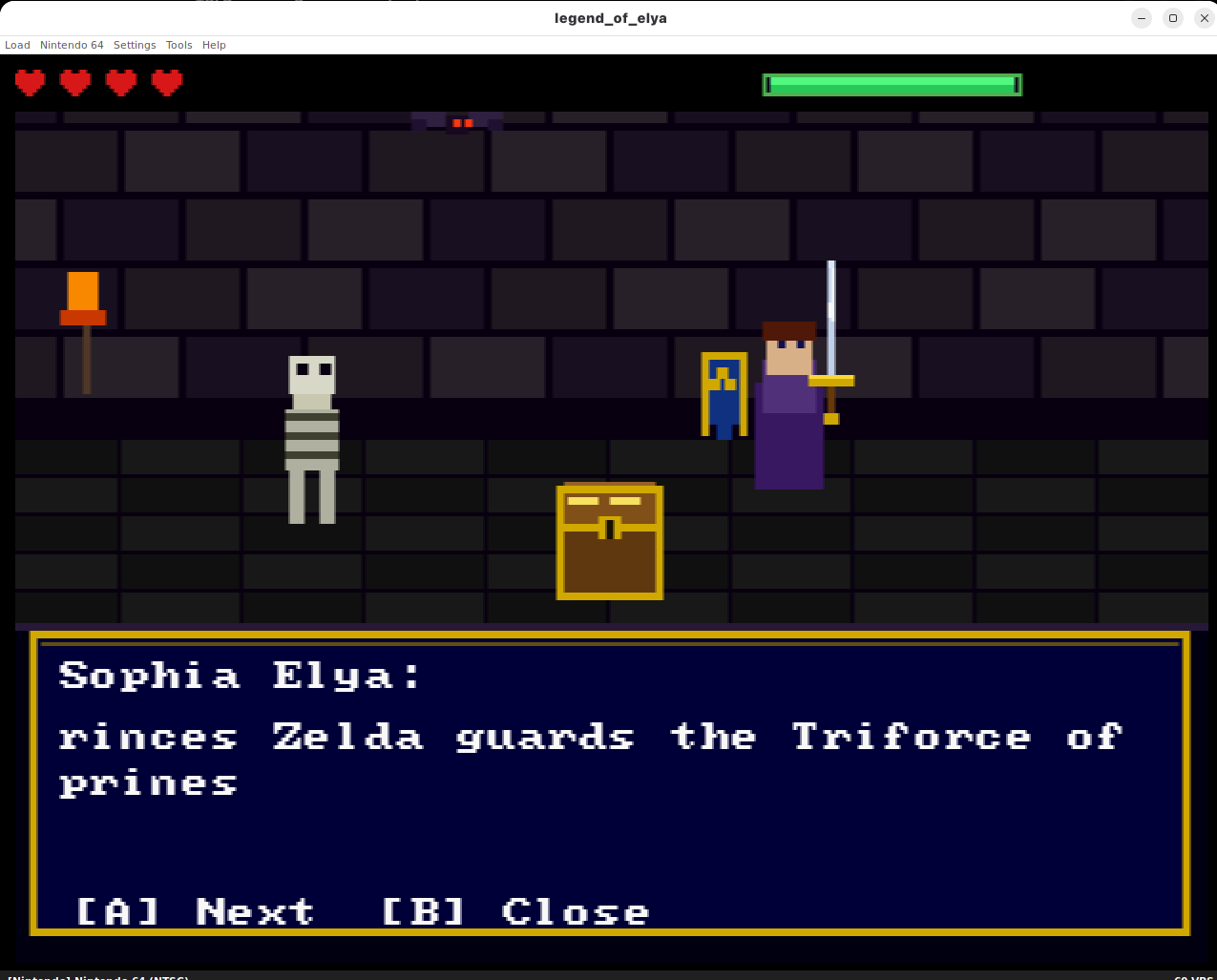
| IBM POWER8 Response | Elya Crystal Response |
|---|---|
|
 |
Optional: RustChain Mining Module
The mining/ directory contains an optional proof-of-antiquity mining module that lets a real N64 earn RTC (RustChain Token) rewards by submitting hardware attestations to the RustChain blockchain.
How it works:
- N64 runs 5 hardware fingerprint checks (CPU PRId, COUNT timing, VI scan, memory ratio, anti-emulation)
- Results are written to controller pak via joybus → Raspberry Pi Pico relays over USB → Python host bridge submits to RustChain node
- Real chain data (epoch, slot, balance, miner count) flows back: RustChain API → Python → USB → Pico → pak READ → N64 display
- N64 gets a 3.0x antiquity multiplier as vintage hardware (1996 silicon)
- Wallet is hardware-derived from RDRAM config registers + CP0 PRId — unique per console
Requirements: N64 + EverDrive 64 + Raspberry Pi Pico + USB cable
See mining/README.md for full setup instructions.
Credits
Built by Elyan Labs.
- Engine: nano-GPT float32 inference on MIPS R4300i
- Game: libdragon SDK, pixel art, dungeon adventure
- Training: PyTorch on RTX 5070
- Platform: BoTTube for video hosting
Source is open — build it, train it, improve it, port it.
RSP-accelerated build ( make base-rsp )
1
-
rsp_matmul.S is hand-written RSP microcode that runs the matmul on the N64's 8-lane vector unit: the CPU driver ( matmul_rsp_drv.c ) converts float32 activations to int16 fixed-point, DMAs tiles into the RSP's 4KB DMEM, and dispatches 8 output rows per call. nano_gpt.c uses it when built with USE_RSP_MATMUL (the legend_of_elya_rsp.z64 target). Measured 1.78× over the scalar baseline on the shipped ternary blob under ares (2.19 vs 1.23 tok/s). The "projected 4-8×" that stood here was never a tok/s measurement: the 4.769× it came from is a ratio of CP0 cycle counts on the int8 blob, which is not what ships. Still pending on real hardware — benchmark reports welcome.
RPI engine ( rpi/ ) — zero-multiply inference
1
-
RPI (Resonant Permutation Inference) is a second, separate engine: instead of matrix multiply, Sophia speaks through permutation tables (bigram/trigram counts distilled from a larger teacher model, xorshift32 PRNG, zero multiplies, zero FPU). The 868KB sophia_game_n64.rpi model fits in ROM alongside the game. Roughly ~100× faster than the transformer on the R4300i ( estimated, not measured — no RPI build has been through the vblank counter) — a different quality/speed trade, not a transformer.