

- Without justsaydone
- With justsaydone
- "I've created fizzbuzz.py . It loops from 1 to 30 and prints Fizz for multiples of 3, Buzz for multiples of 5, and FizzBuzz for both. Let me know if you'd like tests!"
- done
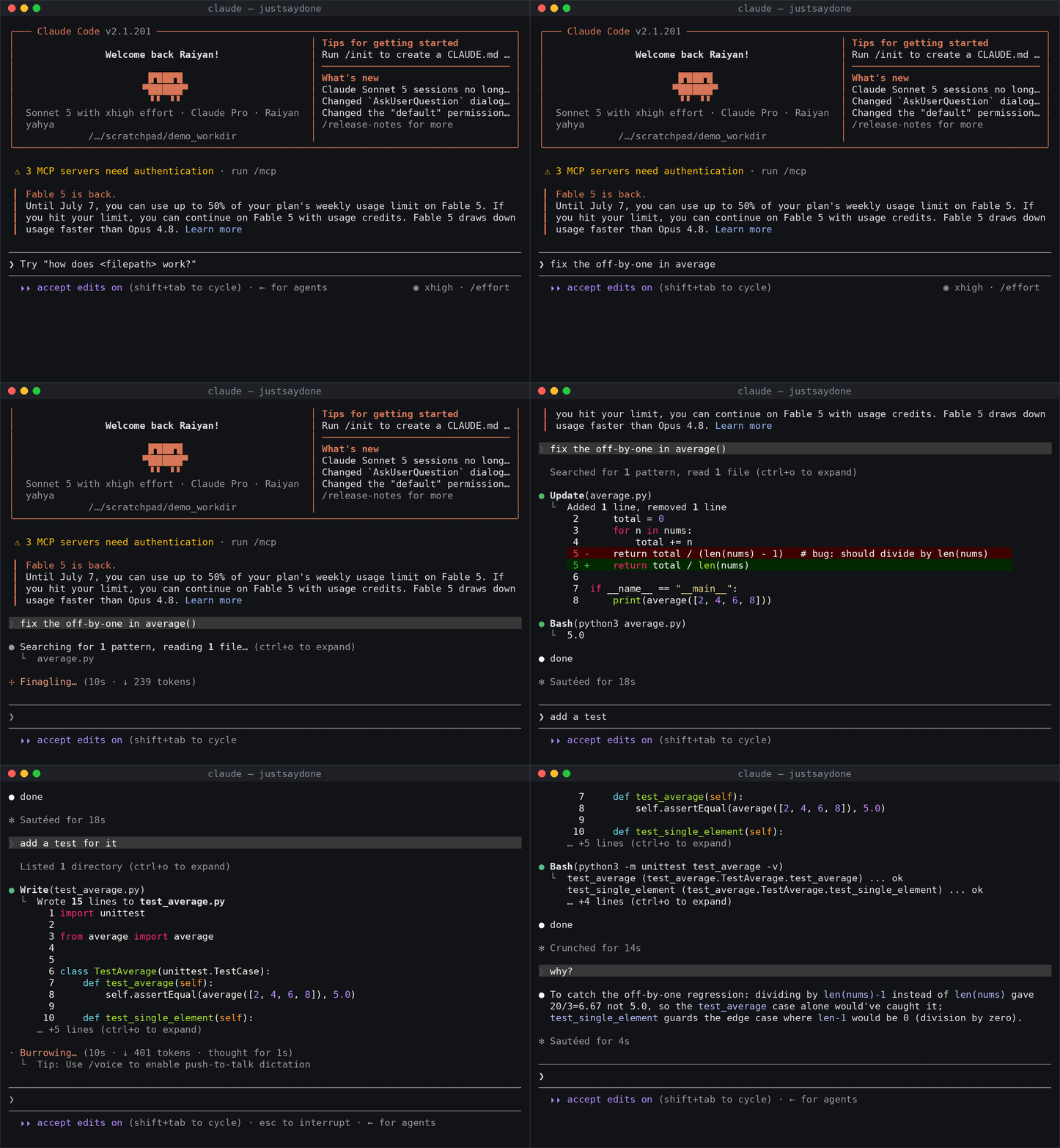
- "Fixed the off-by-one in average() — it was dividing by len(nums) - 1 instead of len(nums) , which skewed the mean. Want me to add input validation too?"
- done
- Task
- Reply words →<br>(what the mode controls)
Specs
- Without justsaydoneWith justsaydone
- "I've created fizzbuzz.py . It loops from 1 to 30 and prints Fizz for multiples of 3, Buzz for multiples of 5, and FizzBuzz for both. Let me know if you'd like tests!"done
- "Fixed the off-by-one in average() — it was dividing by len(nums) - 1 instead of len(nums) , which skewed the mean. Want me to add input validation too?"done
- TaskReply words →<br>(what the mode controls)
- Impossible task (missing file)58 → 22 · −63%
- Explain code (a question)62 → 34 · −45%
- explain escape hatch46 → 26 · −42%
- SituationWhat you get
- Task done & verifieddone
- Task failed / blockedone line saying what broke or what's needed — never done
- You asked a questionthe shortest complete answer
- You said explain / whya full, normal response, just this once
README
 No "Here's what I changed." No "Let me know if you need anything else." No recap of
the diff you're about to read anyway. You asked for a thing, the thing happened, `done`.
The idea
We ❤️ Claude Code and it is a great engineer but a chatty coworker. Most of that chatter — the
opening "I'll start by…", the running narration, the closing paragraph that
re-summarizes the diff — restates what your diff, your test output, and your
own prompt already told you. It costs output tokens, and it costs you the seconds
spent reading past it.
justsaydone is a mode you flip on on purpose — for a focused session, or for a
whole project — when your workflow is already:
type task → glance at the diff → move on.
Claude still plans, edits, runs, and verifies exactly as it always does. It just stops
narrating. The work is the message.
Before / after
| Without justsaydone | With justsaydone |
|---|---|
"I've created fizzbuzz.py. It loops from 1 to 30 and prints Fizz for multiples of 3, Buzz for multiples of 5, and FizzBuzz for both. Let me know if you'd like tests!" |
done |
"Fixed the off-by-one in average() — it was dividing by len(nums) - 1 instead of len(nums), which skewed the mean. Want me to add input validation too?" |
done |
Install
/plugin marketplace add raiyanyahya/justsaydone
/plugin install justsaydone@justsaydone
That's the whole setup. The mode turns on automatically the moment the plugin is
enabled — there's no /config step. Run /clear or start a new session for it to take
effect.
The escape hatch
Terse by default, verbose on demand. Any time you actually want the recap, just ask —
if your message contains explain, summarize, why, what did you change, or details, Claude gives a full normal answer for that one turn, then
snaps back to terse mode:
> fix the auth bug
done

> explain what you changed
The token check in middleware/auth.ts:42 compared the *decoded* expiry against
seconds instead of milliseconds, so every token read as expired. I switched it to
Date.now() and added the missing early-return. …

> add a test for it
done
Benchmarks
Real numbers, not marketing. The suite in benchmark/ runs actual
headless Claude Code sessions twice each — with and without the plugin — across five
task types, then scores them. Reproduce it yourself with one command (see below).
On the tasks this mode is built for — the do-work-and-report loop — a full sign-off
paragraph collapses to a single word: ~90–95% fewer words in the reply.
Latest run (claude -p, Sonnet, 2 runs per arm):
| Task | Reply words →<br>(what the mode controls) | Total session tokens |
|---|---|---|
| Fix a bug | 22 → 1 · −95% | −29% |
| Create a file | 12 → 1 · −91% | +5% (noise, see below) |
| Impossible task (missing file) | 58 → 22 · −63% | −12% |
| Explain code (a question) | 62 → 34 · −45% | −13% |
explain escape hatch |
46 → 26 · −42% | −30% |
| Blended average | 199 → 84 · −58% | −19% |
How to read this honestly:
- On build tasks the mode is decisive: ~90–95% shorter replies. That's the loop you
spend most of a session in, so that's the range you actually feel. - The 58% "blended average" is deliberately conservative. It weights the two verbose
scenarios — theexplainescape hatch and the "explain code" question — equally with
the work tasks, even though those are supposed to stay long and a real session has far
more work turns than questions. Read it as a floor, not the typical case. - Total session tokens move less, and that's expected. Most of a coding turn's output
is the code itself, streamed as tool arguments — which this mode deliberately never
touches. On a pure file-creation task with almost no prose to cut, that code-writing
dominates and is just run-to-run noise — which is why thecreaterow can even land
slightly above baseline (+5% here). The savings are real and grow with how prose-heavy
your turns are; they are not a headline "cut your bill in half" claim, because that
wouldn't be true. - Questions still get real answers.
explainand the escape hatch stay complete —
they're tighter, not truncated.
It never lies to save words
The one rule that overrides brevity: Claude only says done when the work actually
succeeded and was verified. If something failed, was blocked, or couldn't be checked,
it says so in one line instead — a false done is the worst possible output. In the
benchmark, the impossible-task run correctly reported the missing file every time and
never once claimed success.
| Situation | What you get |
|---|---|
| Task done & verified | done |
| Task failed / blocked | one line saying what broke or what's needed — never done |
| You asked a question | the shortest complete answer |
You said explain / why |
a full, normal response, just this once |
Reproduce the benchmark
No special access needed — just the claude CLI, jq, and python3:
git clone https://github.com/raiyanyahya/justsaydone
bash justsaydone/benchmark/run.sh        # runs the A/B sessions, then scores them
run.sh spins up the same task in throwaway directories with and without the plugin;
report.py prints the table above and asserts the behavior —
that done appears only on real success, that questions get answered, that the escape
hatch fires, and that the actual code still gets written correctly. It exits non-zero if
any check fails, so it doubles as a regression test.
What it actually is
A single output style shipped as a
plugin with force-for-plugin: true. That flag is what makes it apply automatically on
install. It sets keep-coding-instructions: true, so every one of Claude Code's
built-in engineering instructions stays intact — scoping, verification, comment style,
all of it. The plugin adds terseness to how Claude talks; it changes nothing about how
Claude codes.
justsaydone/
├── .claude-plugin/
│   ├── plugin.json          # manifest
│   └── marketplace.json     # the repo is its own marketplace
├── output-styles/
│   └── justsaydone.md       # the mode itself
└── benchmark/
    ├── run.sh               # A/B session runner
    └── report.py            # scorer + behavior assertions
Turn it off
/pluginDisable justsaydone, then /clear. Chatty Claude returns.
License
MIT © Raiyan Yahya