

- What personalization requires
- Claude Code / Codex / OpenCode
- Agent
- Role
- CodeAgent
- CodeAgent
- PlanAgent
- PlanAgent
Specs
- What personalization requiresClaude Code / Codex / OpenCode
- AgentRole
- CodeAgentCodeAgent
- PlanAgentPlanAgent
- TestAgentTestAgent
- DatabaseLanguage
- SQLiteSQLite
- PostgreSQLPostgreSQL
- DuckDBDuckDB
- ClickHouseClickHouse
- AgentIntegration Path
- Claude CodeRecipes via CLAUDE.md or recipe packages on the skills path
- CodexAGENTS.md context + MCP
- OpenCode / OpenClawPlugin package path
- TRAEProject-local context
- Any agentSerialize recipes into the system prompt
- ProviderExample Models
- AnthropicClaude Sonnet 4.6, Claude Opus 4.6
- OpenAIGPT-4o, GPT-5
- GoogleGemini 2.5 Pro
- DeepSeekDeepSeek-V3, DeepSeek-Coder
- Zhipu / Qwen / DouBaoGLM-5, Qwen3-Coder
- Azure / OpenRouterAny deployed endpoint
- OllamaAny local model (fully offline)
- StepWhat to implement
- 1Template : code scaffolding for the target language/framework
- 2Test harness : domain-specific build and execution runner
- 3Extraction utils : symbol/schema extraction helpers
- 4Recipes : domain knowledge in SKILL.md recipe packages
README
 OpenCook
Project-Specific Personalization for Coding Agent Harness
"Start with a generic project. End with a perfectly tailored solution."
🗞️ News
- [04 / 2026] OpenCook v1.0 is live, the first project-specific personalization layer purpose-built for coding agents. The demo video can be found on YouTube. We are currently working to prepare reusable coding recipes. Community contributions are welcome! 🔔 👫
- [02 / 2026]: Our paper "Automating Database-Native Function Code Synthesis with LLMs" has been accepted by SIGMOD 2026! 🎉 🎉 🎉
✨ Introduction
Coding agents are powerful but generic. They can navigate your codebase, but they struggle to deeply personalize it: injecting a production-ready feature that respects internal conventions, passes the build system, clears regression tests, and ships as a mergeable patch, all without hand-holding.
OpenCook is the missing layer. It wraps any coding agent with three project-local primitives:
- Recipes: step-by-step domain guides that teach the agent exactly how to implement a feature in your specific codebase
- Rules: per-project constraint files that encode conventions, style, and invariants the agent must respect
- Memory: a 4-layer stack (Working → Episodic → Project → Long-Term) that keeps the agent coherent across long sessions
Why OpenCook?
Generic coding agents (Claude Code, Codex, OpenCode) treat every project the same. Personalization demands more. OpenCook addresses five requirements they leave unmet:
| What personalization requires | Claude Code / Codex / OpenCode | OpenCook |
|---|---|---|
| Know your project's rules | Agent re-infers conventions and entry points from scratch each session | Recipes + Rules encode exact conventions, registration patterns, and constraints, all injected before the first line is written |
| Know precisely what to change | Edits broadly, often missing required dependencies or touching unrelated code | PlanAgent scopes exactly which files and entry points need to change before coding begins |
| Verify the result fits | Generates code and stops; you compile and test manually | Plan → Code → Test loop runs until the patch compiles and all tests pass; the session does not end until the change works |
| Remember what it learned | Context resets each run; the same project knowledge is re-explained every time | 4-layer persistent memory retains decisions and discoveries across sessions, so the agent improves with each run |
| Produce a mergeable artifact | Output is a chat response; turning it into a commit requires manual work | Every run produces a file diff, a trajectory record, and a structured report, ready to review and merge |
📚 Features
<table>
<tr>
<td width="50%">
🧩 Project-Local Personalization
Per-project recipe roots and rule files are auto-discovered and injected. Every agent knows the local conventions before writing a single line.
</td>
<td width="50%">
🔄 Built-in Delivery Loop
Fixed Plan → Code → Test cycle with self-correcting subagents. Iterates until the patch compiles and tests pass.
</td>
</tr>
<tr>
<td>
🧠 4-Layer Memory Stack
Working → Episodic → Project → Long-Term. Agents stay coherent across hours-long personalization sessions.
</td>
<td>
📖 Dynamic Recipe System
Drop a recipe package with a SKILL.md entry file anywhere on the discovery path. Auto-loaded at runtime, injected at the right agent stage.
</td>
</tr>
<tr>
<td>
🔎 Context-Aware Injection
Understands cross-unit dependencies and build conventions. Features land exactly where they belong.
</td>
<td>
📋 Patch-Oriented Traceability
Every run emits a trajectory record, a file diff, and a structured report. Full reproducibility out of the box.
</td>
</tr>
</table>
🆚 Comparison
How OpenCook compares on each of the five personalization requirements covered above.
| Feature | OpenCook | Claude Code | Codex | OpenCode | OpenClaw |
|---|---|---|---|---|---|
| Project rules injection | ✦ | ✦ | ~ | ✦ | ✦ |
| Targeted change scoping | ✦ | ~ | ~ | ~ | ~ |
| Built-in delivery loop (Plan→Code→Test) | ✦ | ~ | ~ | ~ | ~ |
| Persistent multi-layer memory | ✦ | ~ | ~ | ~ | ~ |
| Structured patch output | ✦ | ~ | ~ | ~ | ~ |
<sub>✦ Clearly present ~ Present but narrower or less structured ✗ Not observed in inspected source</sub>
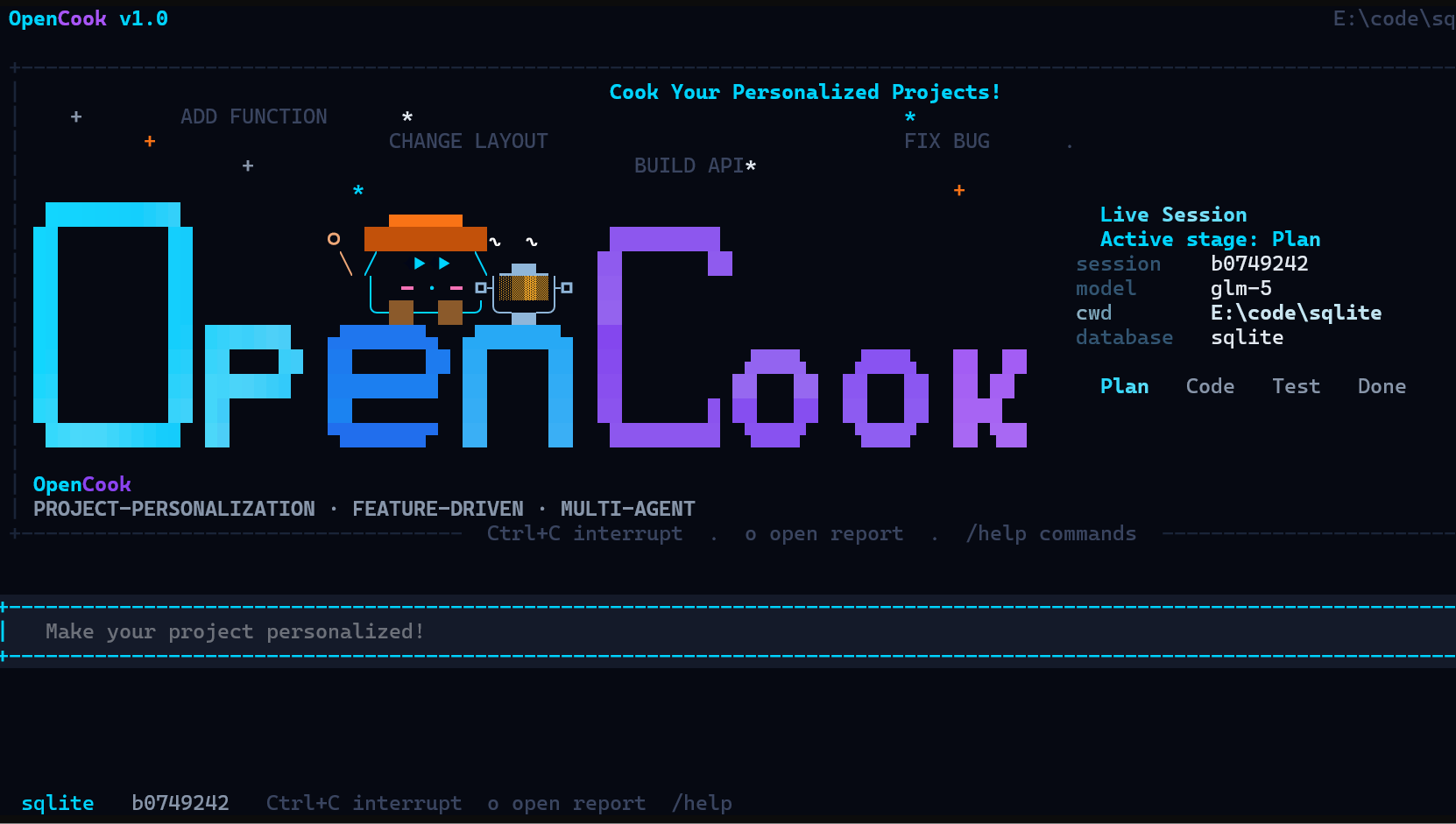
🎬 Demo
<br/>
🕹 Quick Start
Prerequisites: Python 3.10+, an LLM API key, and the source tree of your target project.
Step 1: Install
git clone https://github.com/weAIDB/OpenCook.git && cd OpenCook
uv venv --python 3.10 && source .venv/bin/activate
uv pip install -e .
Windows: use
.venv\Scripts\activateinstead ofsource .venv/bin/activate.
This installs OpenCook and its runtime dependencies, then exposes the
opencook command for all CLI workflows.
Step 2: Update After Local Changes
OpenCook is a pure Python CLI project. In most day-to-day development, you do not
need to rebuild or reinstall.
When you do NOT need to reinstall
- You changed Python source files under
code_agent/ - You edited prompts, markdown docs, or skill files under
open-cookbook/ - You changed YAML config files such as
opencook_config.yaml
In these cases, just run the command again:
opencook --help
opencook interactive --config-file opencook_config.yaml
When you SHOULD reinstall
- You changed
pyproject.toml - You changed package dependencies
- You changed the CLI entrypoint or script name
- You want to refresh the installed
opencooklauncher after packaging changes
Reinstall with:
uv pip install -e .To force a clean reinstall:
uv pip uninstall opencook
uv pip install -e .
If opencook is not found after reinstalling, use the module entrypoint as a fallback:
python -m code_agent --helpStep 3: Configure
Use the bundled opencook_config.yaml as your starting point, or copy it before editing:
cp opencook_config.yaml my_opencook_config.yamlThen update the database paths, model providers, and agent settings for your environment.
See opencook_config.yaml in the repository root for the full supported structure.
You can also point the CLI at a config file globally:
export OPENCOOK_CONFIG_FILE=my_opencook_config.yamlStep 4: Cook
# Interactive TUI (recommended)
opencook interactive --config-file my_opencook_config.yaml

# Headless single task
opencook run "Implement the BOOL_AND aggregate function for SQLite" --config-file my_opencook_config.yaml

# Start an interactive PostgreSQL session
opencook interactive --database postgresql --config-file my_opencook_config.yaml
🏗️ How It Works
OpenCook runs a deterministic Plan → Code → Test pipeline through three specialized agents:
| Agent | Role | Key Behavior |
|---|---|---|
| CodeAgent | Orchestrator | Writes code, coordinates subagents, self-corrects on failure |
| PlanAgent | Read-only Scoper | Decomposes the task; locates files, entry points, and conventions |
| TestAgent | Validator | Compiles, runs test suite, reports failures back to CodeAgent |
🗄️ Reference Case: Database Functions
Why database functions?
Implementing a C/C++ function inside a production database, subject to its memory model, type system, and build infrastructure, is one of the hardest personalization tasks imaginable. It is the strongest proof that the approach works.
The table below shows where each database's extension entry points live:
| Database | Language | Entry Point |
|---|---|---|
| SQLite | C | FuncDef aBuiltinFunc[] in func.c |
| PostgreSQL | C | builtins.h + .c implementation |
| DuckDB | C++ | ScalarFunctionSet / FunctionFactory |
| ClickHouse | C++ | FunctionFactory::instance().registerFunction<>() |
The same Plan → Code → Test loop applies to any codebase domain. Database engines are just the hardest kitchen to cook in.
🔌 Compatibility
Works alongside any coding agent
| Agent | Integration Path |
|---|---|
| Claude Code | Recipes via CLAUDE.md or recipe packages on the skills path |
| Codex | AGENTS.md context + MCP |
| OpenCode / OpenClaw | Plugin package path |
| TRAE | Project-local context |
| Any agent | Serialize recipes into the system prompt |
Supports any LLM provider
| Provider | Example Models |
|---|---|
| Anthropic | Claude Sonnet 4.6, Claude Opus 4.6 |
| OpenAI | GPT-4o, GPT-5 |
| Gemini 2.5 Pro | |
| DeepSeek | DeepSeek-V3, DeepSeek-Coder |
| Zhipu / Qwen / DouBao | GLM-5, Qwen3-Coder |
| Azure / OpenRouter | Any deployed endpoint |
| Ollama | Any local model (fully offline) |
Each agent role (Plan / Code / Test) can use a different model and provider independently.
🔪 Extend OpenCook
Write a Recipe
OpenCook ships a built-in recipe library at open-cookbook/ in the repository root. User-created recipes go in .opencook/skills/ inside your project directory and are auto-discovered at runtime. Both locations use SKILL.md as the entry file:
.opencook/skills/
└── my-feature-recipe/
    ├── SKILL.md        ← trigger · context · steps
    └── references/     ← optional supporting docs
---
name: my-feature-recipe
description: Teaches agents how to implement X in codebase Y
triggers: [implement X, add X feature]
---
## Context
[Conventions, pitfalls, and patterns the agent must know]
## Steps
1. Locate the entry point by searching for ...
2. Follow the registration pattern at ...
3. Verify with ...Add a new domain
| Step | What to implement |
|---|---|
| 1 | Template: code scaffolding for the target language/framework |
| 2 | Test harness: domain-specific build and execution runner |
| 3 | Extraction utils: symbol/schema extraction helpers |
| 4 | Recipes: domain knowledge in SKILL.md recipe packages |
Add an LLM provider
Implement BaseClient in code_agent/utils/llm_clients/ and register it in LLMClient. No other changes needed.
🤔 FAQ
<details>
<summary><b>Is OpenCook only for databases?</b></summary>
<br/>
No. Database function implementation is the reference benchmark because it demands deep C/C++ internals knowledge, making it the hardest test of our personalization thesis. The Plan → Code → Test loop and recipe system are fully domain-agnostic. We are actively expanding to other codebase domains.
</details>
<details>
<summary><b>How is this different from just prompting Claude Code or Codex?</b></summary>
<br/>
A generic prompt gives breadth, not depth. OpenCook's recipe system encodes the <em>exact</em> project conventions, registration patterns, pitfalls, and verification steps for your domain. Combined with a fixed delivery loop and multi-layer memory, the agent is far less likely to hallucinate conventions or leave the patch broken.
</details>
<details>
<summary><b>Which LLM gives the best results?</b></summary>
<br/>
For complex C/C++ internals: Claude Sonnet/Opus and GPT-4o class models. For cost-effective alternatives: DeepSeek-Coder and Qwen3-Coder. Models below ~32B may struggle with deep project conventions.
</details>
<details>
<summary><b>How does the self-correction loop work?</b></summary>
<br/>
TestAgent captures compiler output and test failures as structured tool results and feeds them back to CodeAgent. CodeAgent patches iteratively until all checks pass or the step budget is exhausted.
</details>
📋 Roadmap
- [ ] Open Benchmark: public leaderboard of personalization tasks across databases and domains
- [ ] Broader Domain Support: kernel modules, language runtimes, compiler backends
- [ ] Parallel Cooking: concurrent PlanAgent/TestAgent pairs for batch personalization
- [ ] Web UI: browser-based session dashboard
- [ ] Fine-Tuned Models: domain-specific models trained on successful trajectories
- [ ] MCP Server: expose the recipe + memory system as an MCP endpoint for any agent
👫 Community
We welcome contributions of all kinds: new recipes, domain backends, LLM clients, bug reports, and ideas.
📒 Citation
@article{zhou2026dbcooker,
  author       = {Wei Zhou and Xuanhe Zhou and Qikang He and Guoliang Li and Bingsheng He and Quanqing Xu and Fan Wu},
  title        = {Automating Database-Native Function Code Synthesis with LLMs},
  journal      = {Proc. {ACM} Manag. Data},
  volume       = {3},
  number       = {4},
  pages        = {141:1--141:26},
  year         = {2026}
}
📝 License
MIT License. See LICENSE for details.