

README
MathForm: Scaling Mathematical Autoformalization with Knowledge Retrieval and Verification-Guided Refinement



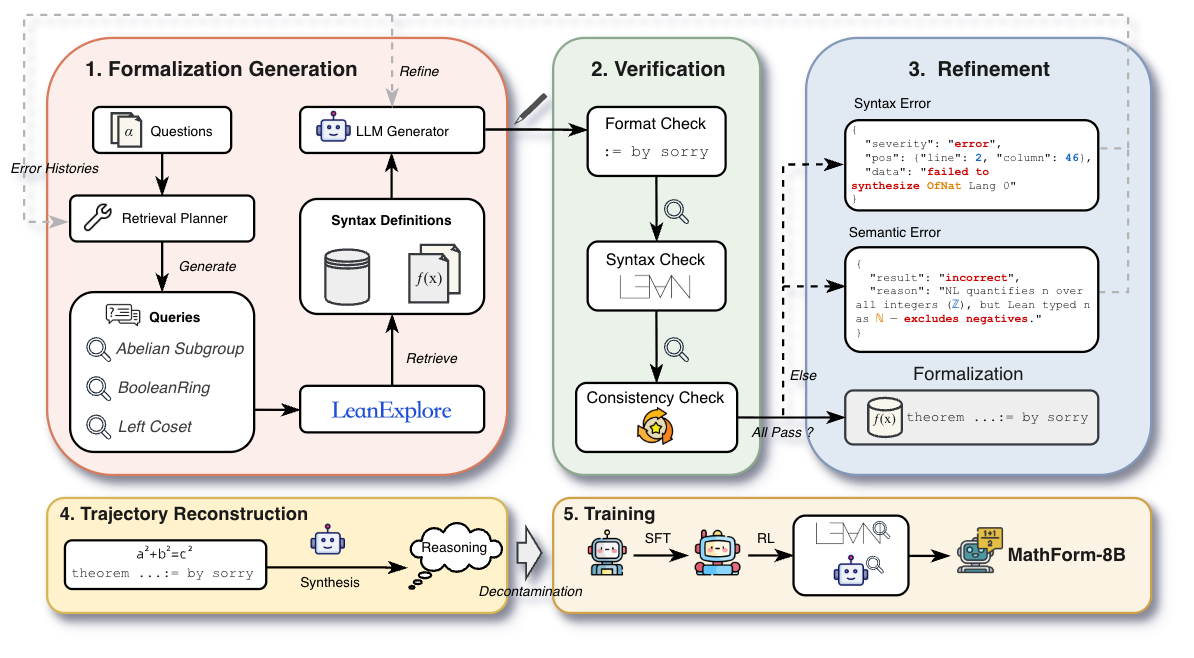 Figure 1: Overview of the MathForm data construction and training pipeline. The system combines Mathlib knowledge retrieval, compilation and semantic verification, and iterative refinement to generate reliable formal data, followed by trajectory reconstruction and training of MathForm-8B.
📖 Introduction
We introduce MathForm, an autoformalization framework that combines
knowledge retrieval from Mathlib with verification-guided iterative refinement.
MathForm retrieves relevant definitions and existing formalizations before
generation, then uses compiler diagnostics and semantic-consistency feedback to
refine generated Lean statements.
Using this framework, we construct
FormalVerse, a
verified Lean 4 dataset covering diverse mathematical domains and sources. We
also train MathForm-8B with
supervised fine-tuning followed by reinforcement learning using Lean compilation
and semantic-consistency feedback. The released code supports the data construction pipeline and
autoformalizer evaluation.
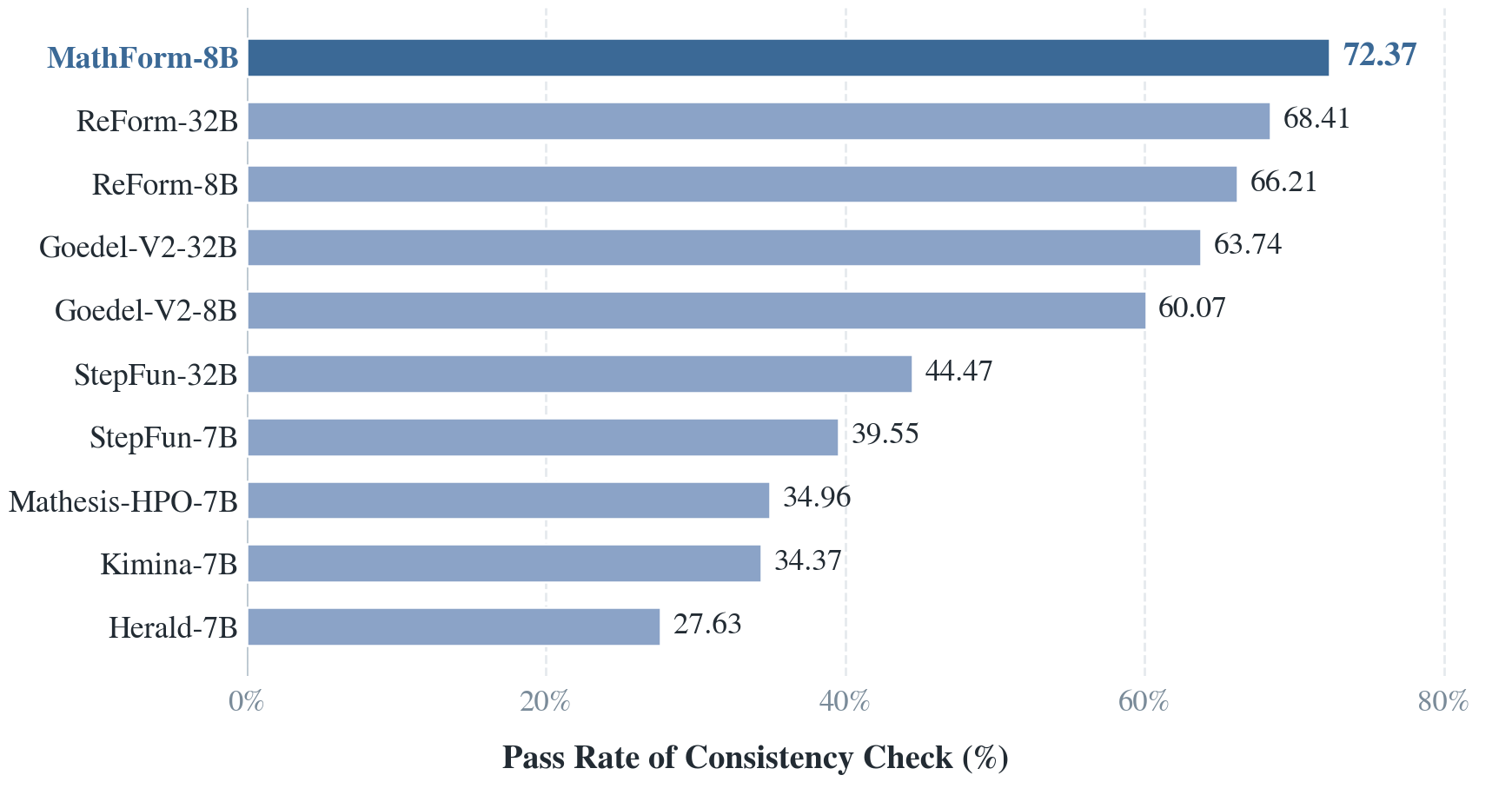 Figure 2: Macro-average Pass@8 (%) across FormalMATH-Lite, ProverBench, CombiBench, FATE-M, FATE-H, and FATE-X among specialized autoformalizers. MathForm-8B achieves the strongest overall performance within this category despite its smaller model size.
News
📁 Repository Structure
src/                         Data construction pipeline
evaluation/                  Evaluation pipeline and benchmark files
kimina-lean-server/          Lean compilation server source
assets/                      Figures used in this README
requirements.txt             Python dependencies
🛠️ Quick Start
Installation
- Clone the repository:
git clone https://github.com/OpenBMB/MathForm.git
cd MathForm- Install the Python dependencies:
pip install -r requirements.txtThe experiments use Lean 4.21.0.
Start Kimina Lean Server
The evaluation and data-construction pipelines require a running Kimina Lean
Server for compilation checks.
cd kimina-lean-server
cp .env.template .env
bash setup.sh
pip install -r requirements.txt
pip install .
prisma generate
python -m server
The default endpoint is http://localhost:8000.
Run Data Construction
The input is a JSONL file containing a natural-language statement in a field
such as statement or informal_statement.
cd src
API_URL=https://api.example.com/v1/chat/completions \
API_KEY="$API_KEY" \
BASE_MODEL_NAME=[GENERATION_MODEL] \
JUDGE_MODEL_NAME=[JUDGE_MODEL] \
LEAN_SERVER_URL=http://localhost:8000 \
bash run.sh path/to/input.jsonl output/run
Start Lean Explore with run_leanexp_server.sh and add:
LEAN_EXPLORE_URL=http://localhost:9000The generated files include success.jsonl, failed.jsonl, and
pipeline.log. Successful samples can be normalized and filtered with:
python postprocess.py normalize \
  --input output/run/success.jsonl \
  --output output/run/normalized.jsonl
python postprocess.py filter \
  --input output/run/normalized.jsonl \
  --output output/run/filtered.jsonl
Run Evaluation
The default evaluation uses the benchmark files under
evaluation/benchmarks/.
cd evaluation
EVAL_API_BASE_URL=https://api.example.com/v1 \
EVAL_API_MODEL=[EVALUATION_MODEL] \
JUDGE_API_BASE_URL=https://api.example.com/v1 \
JUDGE_API_MODEL=[JUDGE_MODEL] \
API_KEY="$API_KEY" \
bash run.sh
Results are written to evaluation/output/:
predictions.jsonl       Generated Lean candidates
results.jsonl           Compilation and judge results
results.compile.jsonl   Compilation cache
results.summary.json    Pass@k summary
To evaluate another benchmark or change the number of samples, set
DATASET_PATHS or NUM_SAMPLES before running run.sh.
🔎 Citation
If you find this repository useful, please cite our paper:
@misc{pu2026mathformscalingmathematicalautoformalization,
      title={MathForm: Scaling Mathematical Autoformalization with Knowledge Retrieval and Verification-Guided Refinement},
      author={Lushi Pu and Weiming Zhang and Xinheng Xie and Zixuan Fu and Bingxiang He and Hengyu Zhao and Hongya Lyu and Xin Li and Jie Zhou and Yudong Wang},
      year={2026},
      eprint={2608.14221},
      archivePrefix={arXiv},
      primaryClass={cs.AI},
      url={https://arxiv.org/abs/2608.14221},
}
🤝 Acknowledgement
This repository builds on the following open-source projects:
- Kimina Lean Server for Lean compilation checks.
- Lean Explore for retrieval.
The evaluation uses the following benchmarks:
Part of the informal problems used to build FormalVerse are drawn from the
following open collections:
We thank the authors and contributors of these projects.
📜 License
This project is licensed under the Apache License 2.0. The bundled third-party
components retain their original license and attribution notices.
📖 Introduction
3
-
We introduce MathForm , an autoformalization framework that combines knowledge retrieval from Mathlib with verification-guided iterative refinement. MathForm retrieves relevant definitions and existing formalizations before generation, then uses compiler diagnostics and semantic-consistency feedback to refine generated Lean statements.
News
4
📁 Repository Structure
1
-
src/ Data construction pipeline evaluation/ Evaluation pipeline and benchmark files kimina-lean-server/ Lean compilation server source assets/ Figures used in this README requirements.txt Python dependencies
Installation
1
-
Clone the repository:
Start Kimina Lean Server
1
-
The evaluation and data-construction pipelines require a running Kimina Lean Server for compilation checks.
Run Data Construction
1
-
The input is a JSONL file containing a natural-language statement in a field such as statement or informal_statement .
Run Evaluation
1
-
The default evaluation uses the benchmark files under evaluation/benchmarks/ .
🔎 Citation
1
-
If you find this repository useful, please cite our paper:
🤝 Acknowledgement
3
-
This repository builds on the following open-source projects:
📜 License
1
-
This project is licensed under the Apache License 2.0. The bundled third-party components retain their original license and attribution notices.