

README
StyleGAN2-ADA — Official PyTorch implementation
Training Generative Adversarial Networks with Limited Data
Tero Karras, Miika Aittala, Janne Hellsten, Samuli Laine, Jaakko Lehtinen, Timo Aila
https://arxiv.org/abs/2006.06676
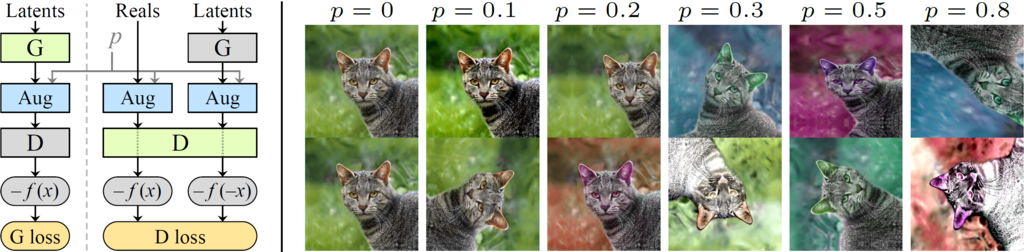
Abstract: Training generative adversarial networks (GAN) using too little data typically leads to discriminator overfitting, causing training to diverge. We propose an adaptive discriminator augmentation mechanism that significantly stabilizes training in limited data regimes. The approach does not require changes to loss functions or network architectures, and is applicable both when training from scratch and when fine-tuning an existing GAN on another dataset. We demonstrate, on several datasets, that good results are now possible using only a few thousand training images, often matching StyleGAN2 results with an order of magnitude fewer images. We expect this to open up new application domains for GANs. We also find that the widely used CIFAR-10 is, in fact, a limited data benchmark, and improve the record FID from 5.59 to 2.42.
For business inquiries, please visit our website and submit the form: NVIDIA Research Licensing
Release notes
This repository is a faithful reimplementation of StyleGAN2-ADA in PyTorch, focusing on correctness, performance, and compatibility.
Correctness
- Full support for all primary training configurations.
- Extensive verification of image quality, training curves, and quality metrics against the TensorFlow version.
- Results are expected to match in all cases, excluding the effects of pseudo-random numbers and floating-point arithmetic.
Performance
- Training is typically 5%–30% faster compared to the TensorFlow version on NVIDIA Tesla V100 GPUs.
- Inference is up to 35% faster in high resolutions, but it may be slightly slower in low resolutions.
- GPU memory usage is comparable to the TensorFlow version.
- Faster startup time when training new networks (