

Repository
MT-InfoSeek
Do LLMs Know What to Ask and When? Evaluating Multi-Turn Information Seeking
README
MT-InfoSeek




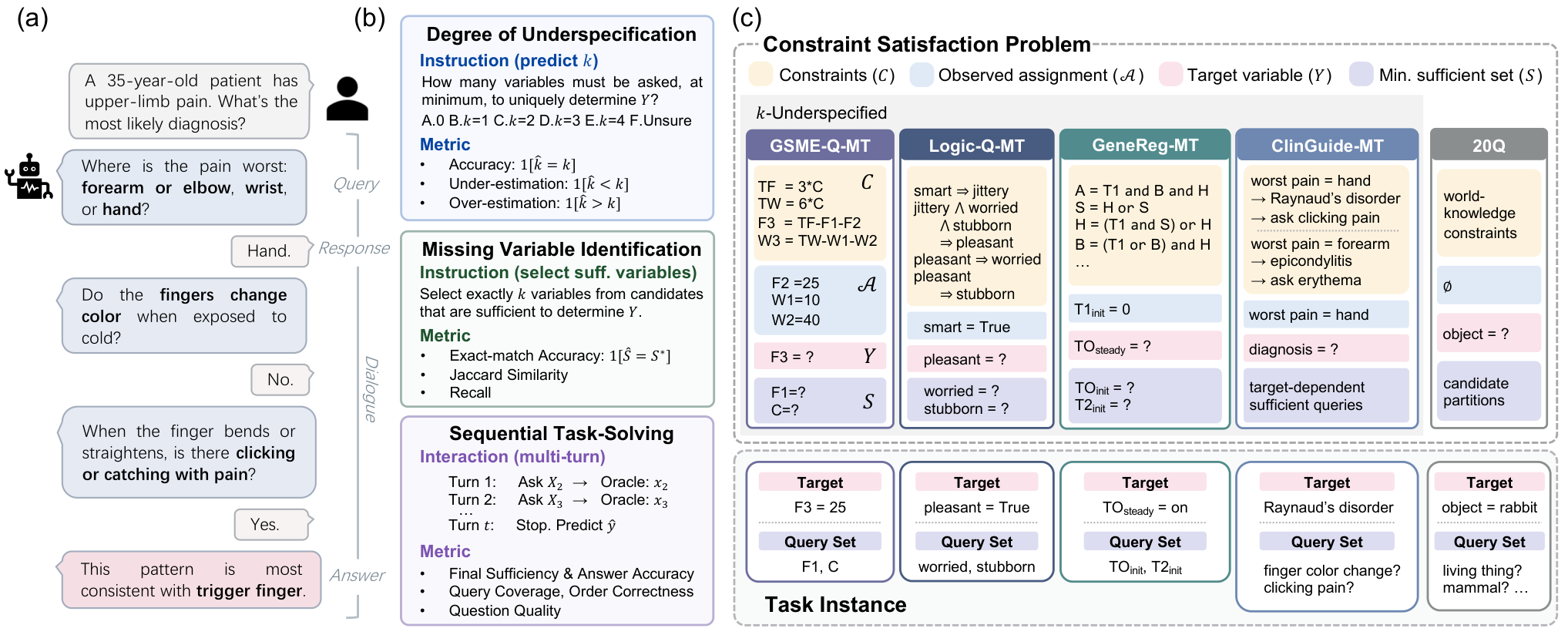
This repository contains code and data for Do LLMs Know What to Ask and When? Evaluating Multi-Turn Information Seeking.
Many reasoning benchmarks assume the input question is fully specified. In
practice, a model often has to identify what information is missing, ask for
it, and then solve the task. MT-InfoSeek measures multi-turn information seeking across logical, mathematical, biological, clinical, and common knowledge domains.
Website · Dataset · Setup guide
Dataset
The released benchmark files live in data/, with schemas and task descriptions provided. A machine-readable Croissant metadata file is provided in croissant.json.
Getting started
The smoke split is the default. Each path below sets up the suite and starts a smoke evaluation in two command lines. Full setup instructions are in SETUP.md.
Quick start
API model (example: gpt-5-mini)
bash setup.sh
OPENAI_API_KEY=... .venv/bin/python run_eval.py --datasets all --model gpt-5-mini
Use Azure OpenAI environment variables instead of OPENAI_API_KEY if needed.
For --datasets all, gpt-5-mini is also the default 20Q examiner and offline
judge.
The models we evaluated are OpenAI, Gemini, Qwen, and gpt-oss. Anthropic
(Claude) request paths exist in the code but were not used in the paper and are
untested; expect to adjust the token limits before using them.
Local models we evaluated (example: Qwen/Qwen3.5-4B)
Run the first line in a GPU/server terminal; it stays running. Run the second
line from the repo in another terminal after the server is ready.
bash setup.sh --with-vllm && REASONING_PARSER=qwen3 bash scripts/serve_vllm.sh Qwen/Qwen3.5-4B
VLLM_PORT=8011 .venv/bin/python run_eval.py --datasets all --model Qwen/Qwen3.5-4B --examiner-model Qwen/Qwen3.5-4B --no-20q-offline
The launcher also infers the parser for registered Qwen and gpt-oss models;
the example keeps it explicit so the server configuration is visible.
Omit the 20Q flags to keep the default gpt-5-mini examiner and offline judge;
that requires GPT credentials.
Custom local model
Run the first line in a GPU/server terminal; set REASONING_PARSER to the
parser your model needs, or none.
bash setup.sh --with-vllm && REASONING_PARSER=my_reasoning_parser bash scripts/serve_vllm.sh my-org/custom-7b
VLLM_PORT=8011 .venv/bin/python run_eval.py --datasets all --model my-org/custom-7b --examiner-model my-org/custom-7b --no-20q-offline
For a non-local OpenAI-compatible endpoint, set VLLM_BASE_URL or use
--model-config; see SETUP.md. To evaluate on the full
released data, add --full; the runner asks for confirmation before starting.
Defaults match the paper protocol. Results and a combined summary.md /
summary.json are written under logs/run_<model>_<...>/.
Rerunning resumes there by default; pass --fresh-run for a separate,
timestamped result directory.
Running a single dataset directly
Each dataset has an env-var-driven shell script. For example:
source .venv/bin/activate
MODEL=gpt-5-mini EVAL_MODE=mc DATA_FILE=data/smoke/logic_q_mt.csv bash logic_q_mt/scripts/run_singleturn.sh
These per-dataset scripts default to the full released split, so pass
DATA_FILE=data/smoke/<file> for a smoke run.
See each dataset's README for the full knob list and the regeneration
pipeline:
Coding-agent-assisted setup
Example prompt from the repository root:
Follow
SETUP.mdto set up this repository. Ask me for the model name,
API keys or local endpoint, GPU constraints, and whether to run smoke or full
evaluation. Do not invent credentials. If 20Q is selected, tell me that its
examiner and offline judge default togpt-5-mini, then confirm whether to
keep those defaults or use local models. Show me the exact command before
starting evaluation.
Repository layout
MT-InfoSeek/
├── run_eval.py                    # one-command driver for the whole suite
├── analyze_results.py             # combined summary (summary.md / summary.json)
├── setup.sh                       # evaluator environment, data assets, optional vLLM
├── scripts/serve_vllm.sh          # convenience vLLM launcher for the paper's models
├── data/                          # released benchmark files and dataset guide
├── model_registry.py              # shared model definitions (both model_utils read it)
├── model_utils.py                 # shared LLM client (Logic-Q-MT, GeneReg-MT, ClinGuide-MT)
├── chat_backends.py               # shared /v1/chat/completions request + parsing
├── logic_q_mt/                    # propositional-logic multi-turn benchmark
├── gsme_q_mt/                     # GSM math-CSP multi-turn benchmark (+ Ext)
├── genereg_mt/                    # GRN multi-turn benchmark (+ assets/ cache tarball)
├── 20q/                           # 20-Questions inference + offline evaluator
├── clinguide_mt/                  # ClinGuide-MT extraction pipeline + evaluator (data withheld)
├── build_croissant.py             # regenerates croissant.json from data/
├── croissant.json                 # machine-readable dataset metadata
├── validate_croissant.py          # checks croissant.json against data/
├── docs/                          # README assets (overview figure)
├── LICENSE                        # per-component licenses and upstream provenance
├── SETUP.md                       # setup instructions
├── .env.example                   # template for the env vars the scripts read
└── requirements.txt
Each released task folder (logic_q_mt/, gsme_q_mt/, genereg_mt/, 20q/)
is self-contained: a top-level README.md, a Python entry point, a scripts/
folder with env-var-driven shell templates, and, where applicable, a
data_generation/ folder with the regeneration pipeline. See
data/README.md for dataset contents, and each task README for
run-time knobs.
Citation
@misc{huang2026mtinfoseek,
  title         = {Do LLMs Know What to Ask and When? Evaluating Multi-Turn Information Seeking},
  author        = {Yepeng Huang and Jiawen Zhang and Michelle Dai and Xiaorui Su and Shanghua Gao and Zi Wang and Marinka Zitnik},
  year          = {2026},
  eprint        = {2608.14808},
  archivePrefix = {arXiv},
  primaryClass  = {cs.AI},
  url           = {https://arxiv.org/abs/2608.14808},
}
License
Code in this repository is released under the
Apache License 2.0. Released
dataset files under data/ are licensed
CC BY 4.0, inherited from
upstream sources where applicable. See LICENSE for per-component
provenance and upstream terms.