

Repository
jsonrepair-rs
Repair broken JSON in Rust — fix quotes, commas, comments, truncation, and 30+ issues from LLM outputs
- API
- Feature
- jsonrepair(input)
- default
- jsonrepair_with_options(input, options)
- default
- jsonrepair_to_writer(input, writer)
- default
Specs
- APIFeature
- jsonrepair(input)default
- jsonrepair_with_options(input, options)default
- jsonrepair_to_writer(input, writer)default
- jsonrepair_to_writer_with_options(input, writer, options)default
- jsonrepair_reader_to_writer(reader, writer)default
- jsonrepair_reader_to_writer_with_options(reader, writer, options)default
- jsonrepair_value(input)serde
- jsonrepair_value_with_options(input, options)serde
- jsonrepair_parse<T>(input)serde
- jsonrepair_parse_with_options<T>(input, options)serde
- Input styleExample repair
- Single, curly, and backtick quotes{'a': 'b'} -> {"a": "b"}
- Unquoted object keys{name: "Ada"} -> {"name": "Ada"}
- Missing commas[1 2 3] -> [1, 2, 3]
- Leading or trailing commas[1,2,] -> [1,2]
- Missing colons{"a" 1} -> {"a": 1}
- Missing object values{"a":} -> {"a":null}
- JavaScript, Python, and case variantsTrue , False , None , undefined , NaN , Infinity
- Signed non-finite values-Infinity , +NaN -> null
- Comments// , /* ... */ , and # comments are removed
- Markdown code fencesjson ... wrappers are stripped
- Truncated JSONmissing brackets, braces, strings, and exponents are completed
- Redundant closing brackets{"a":1}} -> {"a":1}
- Number fixes.5 , +.5 , 2. , 2e , 2e+
- Invalid numbers as strings0.0.1 -> "0.0.1"
- String fixesmissing quotes, invalid escapes, unescaped control chars
- String concatenation"a" + "b" -> "ab"
- JSONPcallback({"a":1}); -> {"a":1}
- MongoDB wrappersObjectId("...") , NumberLong("...") , NumberInt(...)
- NDJSON / root value listsnewline-delimited values become an array
- URLs and regex-like tokensunquoted URL and regex-like text become strings
- Ellipsis placeholders[1, 2, ...] -> [1, 2]
- BOM and special whitespacenormalized outside strings
- FeatureDefault
- serdeNo
README
jsonrepair-rs


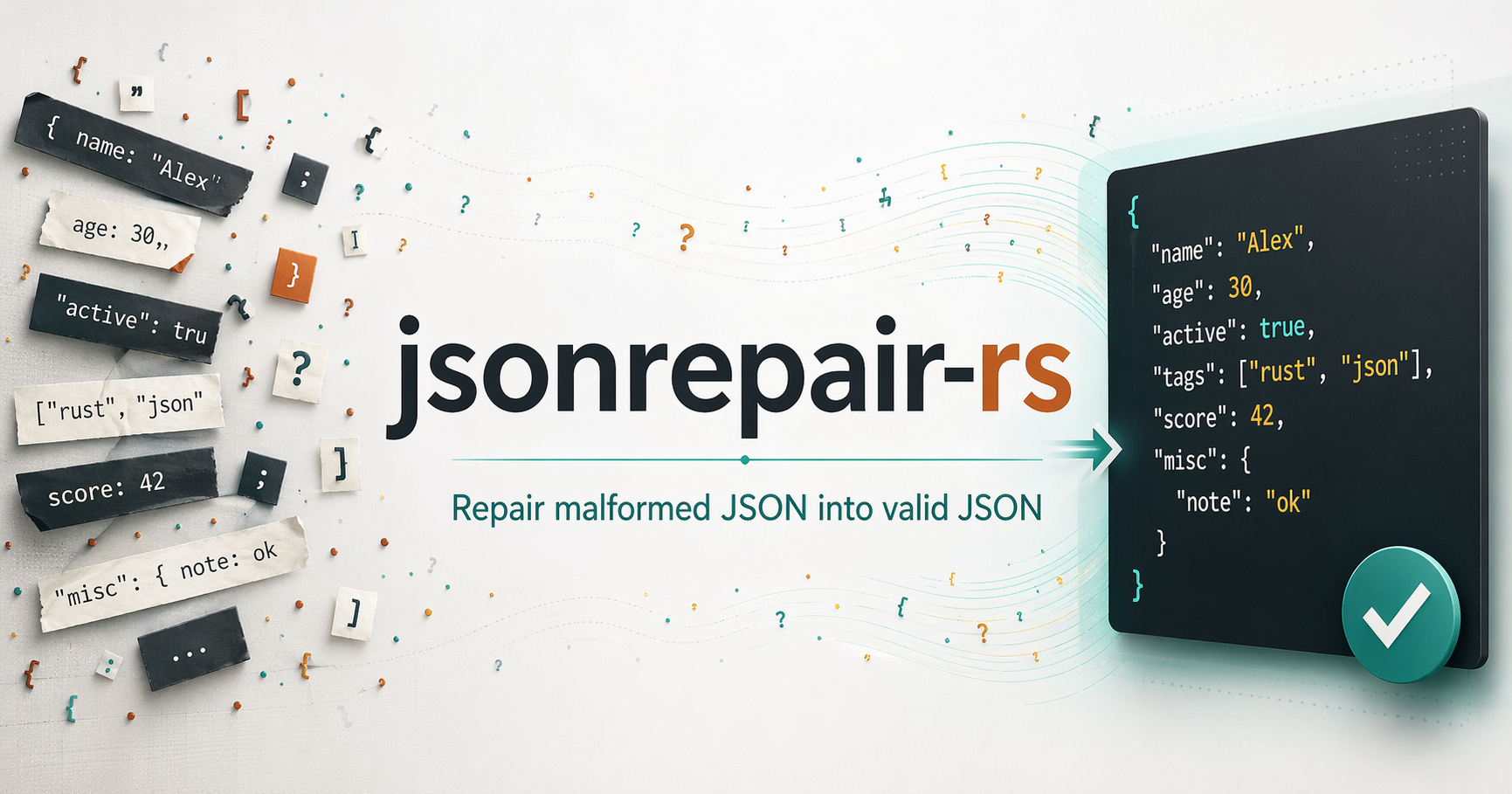
Repair malformed JSON-like text and return valid JSON text.
jsonrepair-rs is a Rust-native repair library for applications that receive
structured JSON from LLMs, copied JavaScript/Python/MongoDB snippets, markdown
code fences, logs, or truncated transport payloads. It is a Rust port inspired
by josdejong/jsonrepair, with broad
compatibility goals against the JavaScript jsonrepair and Python
json-repair ecosystems.
Why This Crate
- Rust library and CLI surfaces in one package.
- No default dependencies; optional
serdehelpers are behind a feature flag. - Repair behavior covers quotes, commas, comments, markdown fences, truncated
JSON, JSONP, MongoDB wrappers, NDJSON, non-standard keywords, and more. - Strict mode lets callers reject input that would require repair.
- Errors include kind, position, line, and column so callers can report failure
instead of silently dropping malformed data.
Trust And Limits
- Repair behavior is covered by unit tests, CLI tests, writer/reader tests,
strict-mode tests, serde tests, fuzz harnesses, and upstream-style parity
fixtures. - The output is valid JSON when an API returns
Ok(...); unrecoverable input
returns a typed error instead of a guessed repair. - The reader-to-writer API is streaming-oriented at the IO boundary, but the
current parser still buffers internally. Seedocs/streaming-api.md. - This crate does not do schema-guided repair or schema validation. Validate
repaired data against your application's schema before using it. - See
FEATURE_PARITY.mdfor a side-by-side comparison
with JS/Python repair libraries anddocs/competitor-comparison.md
for local comparison tooling.
Installation
cargo add jsonrepair-rsOr add it manually:
[dependencies]
jsonrepair-rs = "0.2.1"
Minimum supported Rust version: 1.70.
Command Line
Install the binary with Cargo:
cargo install jsonrepair-rsRepair stdin to stdout:
printf "{name: 'Ada', active: True}" | jsonrepairRepair a file and write the result to another file:
jsonrepair broken.json --output repaired.jsonQuick Start
use jsonrepair_rs::jsonrepair;

fn main() -> Result<(), Box<dyn std::error::Error>> {
    let broken = r#"{name: 'Alice', active: True, skills: ['Rust',],}"#;
    let repaired = jsonrepair(broken)?;

    assert_eq!(
        repaired,
        r#"{"name": "Alice", "active": true, "skills": ["Rust"]}"#
    );

    println!("{repaired}");
    Ok(())
}
jsonrepair returns a JSON string. If you need typed data, parse the repaired
string with serde_json in your application:
use jsonrepair_rs::jsonrepair;

fn main() -> Result<(), Box<dyn std::error::Error>> {
    let repaired = jsonrepair("{user: 'Ada', admin: False, attempts: [1,2,],}")?;
    let value: serde_json::Value = serde_json::from_str(&repaired)?;

    assert_eq!(value["user"], "Ada");
    assert_eq!(value["admin"], false);
    assert_eq!(value["attempts"][1], 2);

    Ok(())
}
API
pub fn jsonrepair(input: &str) -> Result<String, JsonRepairError>
pub fn jsonrepair_with_options(input: &str, options: RepairOptions) -> Result<String, JsonRepairError>
pub fn jsonrepair_to_writer<W>(input: &str, writer: &mut W) -> Result<(), JsonRepairWriteError>
pub fn jsonrepair_to_writer_with_options<W>(input: &str, writer: &mut W, options: RepairOptions) -> Result<(), JsonRepairWriteError>
pub fn jsonrepair_reader_to_writer<R, W>(reader: R, writer: &mut W) -> Result<(), JsonRepairStreamError>
pub fn jsonrepair_reader_to_writer_with_options<R, W>(reader: R, writer: &mut W, options: RepairOptions) -> Result<(), JsonRepairStreamError>
pub fn jsonrepair_value(input: &str) -> Result<serde_json::Value, JsonRepairParseError>
pub fn jsonrepair_value_with_options(input: &str, options: RepairOptions) -> Result<serde_json::Value, JsonRepairParseError>
pub fn jsonrepair_parse<T>(input: &str) -> Result<T, JsonRepairParseError>
pub fn jsonrepair_parse_with_options<T>(input: &str, options: RepairOptions) -> Result<T, JsonRepairParseError>| API | Feature | Returns | Failure modes |
|---|---|---|---|
jsonrepair(input) |
default | repaired JSON String |
JsonRepairError when input cannot be repaired safely |
jsonrepair_with_options(input, options) |
default | repaired JSON String with explicit policy |
JsonRepairError, including StrictModeViolation in strict mode |
jsonrepair_to_writer(input, writer) |
default | writes repaired JSON to std::io::Write |
JsonRepairWriteError::Repair or JsonRepairWriteError::Write |
jsonrepair_to_writer_with_options(input, writer, options) |
default | writes with explicit policy | JsonRepairWriteError::Repair or JsonRepairWriteError::Write |
jsonrepair_reader_to_writer(reader, writer) |
default | reads from std::io::Read, writes to std::io::Write |
JsonRepairStreamError::Read, Repair, or Write |
jsonrepair_reader_to_writer_with_options(reader, writer, options) |
default | streams with explicit policy | JsonRepairStreamError::Read, Repair, or Write |
jsonrepair_value(input) |
serde |
repaired serde_json::Value |
JsonRepairParseError::Repair or JsonRepairParseError::Parse |
jsonrepair_value_with_options(input, options) |
serde |
repaired serde_json::Value with explicit policy |
JsonRepairParseError::Repair or JsonRepairParseError::Parse |
jsonrepair_parse<T>(input) |
serde |
repaired and deserialized T |
JsonRepairParseError::Repair or JsonRepairParseError::Parse |
jsonrepair_parse_with_options<T>(input, options) |
serde |
repaired and deserialized T with explicit policy |
JsonRepairParseError::Repair or JsonRepairParseError::Parse |
Supporting types:
JsonRepairErrorcontainsmessage,position,kind,line, and
column.JsonRepairErrorKindis a non-exhaustive enum for programmatic repair-error
handling.JsonRepairWriteError,JsonRepairStreamError, andJsonRepairParseError
distinguish repair failures from IO orserde_jsonparse failures.
The output is valid JSON when the function returns Ok(...). When the input
cannot be repaired safely, the function returns an error instead of guessing.
Use RepairOptions::strict when callers want valid
JSON pass-through and an error for repairable non-standard input.
The reader-to-writer API is streaming-oriented at the IO boundary, but the
current parser still buffers complete input and repaired output internally. See
docs/streaming-api.md for the design and memory
tradeoffs.
Repair a file into another file:
use std::fs::File;
use jsonrepair_rs::jsonrepair_reader_to_writer;

fn main() -> Result<(), Box<dyn std::error::Error>> {
    let mut input = File::open("broken.json")?;
    let mut output = File::create("repaired.json")?;

    jsonrepair_reader_to_writer(&mut input, &mut output)?;
    Ok(())
}
What It Repairs
| Input style | Example repair |
|---|---|
| Single, curly, and backtick quotes | {'a': 'b'} -> {"a": "b"} |
| Unquoted object keys | {name: "Ada"} -> {"name": "Ada"} |
| Missing commas | [1 2 3] -> [1, 2, 3] |
| Leading or trailing commas | [1,2,] -> [1,2] |
| Missing colons | {"a" 1} -> {"a": 1} |
| Missing object values | {"a":} -> {"a":null} |
| JavaScript, Python, and case variants | True, False, None, undefined, NaN, Infinity |
| Signed non-finite values | -Infinity, +NaN -> null |
| Comments | //, /* ... */, and # comments are removed |
| Markdown code fences | json ... wrappers are stripped |
| Truncated JSON | missing brackets, braces, strings, and exponents are completed |
| Redundant closing brackets | {"a":1}} -> {"a":1} |
| Number fixes | .5, +.5, 2., 2e, 2e+ |
| Invalid numbers as strings | 0.0.1 -> "0.0.1" |
| String fixes | missing quotes, invalid escapes, unescaped control chars |
| String concatenation | "a" + "b" -> "ab" |
| JSONP | callback({"a":1}); -> {"a":1} |
| MongoDB wrappers | ObjectId("..."), NumberLong("..."), NumberInt(...) |
| NDJSON / root value lists | newline-delimited values become an array |
| URLs and regex-like tokens | unquoted URL and regex-like text become strings |
| Ellipsis placeholders | [1, 2, ...] -> [1, 2] |
| BOM and special whitespace | normalized outside strings |
The test suite contains many edge cases for these categories in
tests/repair_tests.rs.
Error Handling
use jsonrepair_rs::{jsonrepair, JsonRepairErrorKind};

match jsonrepair("") {
    Ok(json) => println!("repaired: {json}"),
    Err(err) => {
        eprintln!(
            "kind={:?}, line={}, column={}, position={}: {}",
            err.kind, err.line, err.column, err.position, err.message
        );

        if matches!(err.kind, JsonRepairErrorKind::UnexpectedEnd) {
            eprintln!("input ended before a repairable JSON value was found");
        }
    }
}
Error kinds are marked #[non_exhaustive]; include a fallback arm when matching
them outside this crate.
Limits And Behavior
- Maximum supported nesting depth is 512.
- The crate preserves much of the original whitespace where possible.
- It returns a repaired JSON string, not a
serde_json::Value. - The
jsonrepair_reader_to_writerAPI supports reader-to-writer workflows,
but the current parser still buffers internally instead of performing
constant-memory repair. - It is designed for practical repair, not for accepting arbitrary unsafe input
as if it were trustworthy. Validate the repaired data according to your
application's schema before using it.
Examples
Runnable examples live in examples/:
cargo run --example repair_basic
cargo run --example repair_and_parse
cargo run --example llm_output
cargo run --features serde --example llm_typed_parse
repair_basic repairs and prints a malformed JSON-like string.
repair_and_parse repairs a string and then parses it with serde_json.
llm_output repairs an LLM-style response that has prose around a JSON-like
object. The prose is preserved as strings in a valid JSON array, so callers can
inspect or extract the object they need.
llm_typed_parse repairs a markdown-fenced JSON object and deserializes it into
a typed struct with the serde feature enabled.
For production-style fallback patterns, see
docs/llm-fallback-parsing.md.
For a shell pipeline, pass fenced JSON through the CLI:
printf '```json
{name: "Ada", active: True, skills: ["rust",],}
```' | jsonrepair
This prints valid JSON for the fenced object:
{"name": "Ada", "active": true, "skills": ["rust"]}Feature Flags
| Feature | Default | Notes |
|---|---|---|
serde |
No | Enables optional serde and serde_json dependencies plus repair-and-parse helpers. |
For most applications, add serde_json directly to your own Cargo.toml if you
want to parse the repaired string into typed data.
With the serde feature enabled, the crate also provides convenience helpers
for repair-and-parse workflows:
use jsonrepair_rs::jsonrepair_value;

fn main() -> Result<(), Box<dyn std::error::Error>> {
    let value = jsonrepair_value("{name: 'Ada', active: True}")?;

    assert_eq!(value["name"], "Ada");
    assert_eq!(value["active"], true);
    Ok(())
}
Development
cargo build
cargo test --all-targets
CI-equivalent local checks:
RUSTFLAGS="-Dwarnings" cargo check --all-targets
cargo fmt --all -- --check
cargo test --all-targets
cargo doc --no-deps
The GitHub Actions workflow runs check, formatting, tests, and docs on main
pushes and pull requests.
Pre-commit Hooks
uv tool install pre-commit

pre-commit install
pre-commit install --hook-type pre-push

pre-commit run --all-files
pre-commit run --all-files --hook-stage pre-push
Benchmarks
Run Criterion benchmarks:
cargo benchSee docs/benchmarking.md for CLI throughput reports,
optional Rust competitor benchmarks, and allocation profiling commands.
Current benchmark groups cover:
- valid small JSON
- broken small JSON
- valid 1k-item JSON
- broken 1k-item JSON
- 100-level nesting
- 100 comments
- 200 string escapes
For optimization work, use the benchmark gate script with an existing Criterion
baseline:
scripts/opt_round.sh --baseline current_bec2481The script runs:
cargo fmtcargo check --all-targetscargo clippy --all-targets --all-features -- -D warningscargo test --all-targets- Criterion benchmarks against the selected baseline
- Stable regression detection with optional reruns and a control self-check
Useful options:
scripts/opt_round.sh --baseline current_bec2481 --eps 0.01
scripts/opt_round.sh --baseline current_bec2481 --require-all-improved
scripts/opt_round.sh --baseline current_bec2481 --reruns-on-regression 4
scripts/opt_round.sh --baseline current_bec2481 --skip-checks
Reports are written to .omx/reports/opt-round-<timestamp>.md by default. If
the benchmark environment is too noisy to trust, the script exits inconclusive
instead of reporting a false regression.
Release Status
The latest crate published on crates.io is 0.2.1.
To publish a new release, first bump the version in Cargo.toml and update any
version references in this README. Then follow
docs/release-checklist.md. The minimum local
gate is:
RUSTFLAGS="-Dwarnings" cargo check --all-targets
cargo fmt --all -- --check
cargo clippy --all-targets --all-features -- -D warnings
cargo test --all-targets
cargo doc --no-deps
cargo package
cargo publish --dry-run
If the dry run succeeds, publish with cargo publish and create a matching git
tag/release.
See docs/ecosystem-evaluations.md for the
planned order of binary distribution, WASM/npm bindings, and Python bindings.
License
MIT. See LICENSE.