

Repository
OPDVR
Official repository for OPDVR: On-policy Distillation with Verifiable Reward.
- Piece
- File
- OPDVR reward gate
- verl/verl/trainer/ppo/ray_trainer.py (search correctness_gated )
- GRPD scaling
- verl/verl/trainer/ppo/ray_trainer.py (search grpo_scaled )
- config knobs
- verl/verl/workers/config/rollout.py
Specs
- PieceFile
- OPDVR reward gateverl/verl/trainer/ppo/ray_trainer.py (search correctness_gated )
- GRPD scalingverl/verl/trainer/ppo/ray_trainer.py (search grpo_scaled )
- config knobsverl/verl/workers/config/rollout.py
- SwitchMeaning
- LOG_PROB_TOP_K0 = sampled-token OPD (paper main); >0 = top-k OPD
- CORRECTNESS_GATEDTrue = OPDVR; False = vanilla OPD
- CORRECTNESS_GATED_MODEdefault (paper) / inverse (ablation)
- CORRECTNESS_THRESHOLDverifier threshold, default 0 (score > 0 = correct)
- GRPO_SCALEDTrue = GRPD
- GRPO_NORM_BY_STDFalse = Dr.GRPO-style advantage (paper); True = /std
- N_RESPONSESgroup size G for GRPD (paper uses 8)
README
📖 Overview
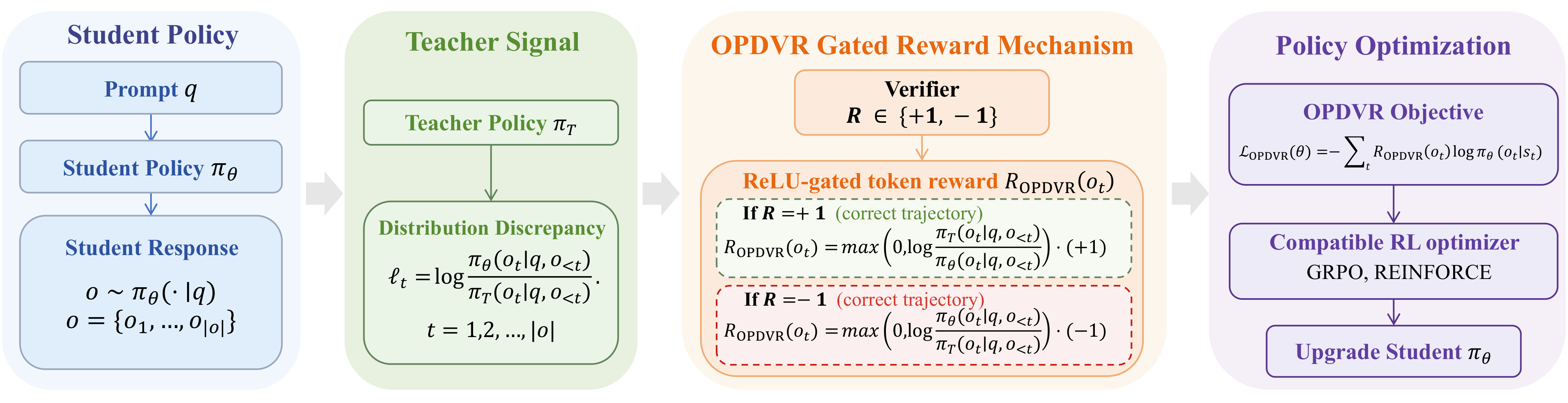
Reinforcement Learning with Verifiable Rewards (RLVR) provides sparse task-level feedback, while
on-policy distillation (OPD) provides dense token-level guidance but ignores trajectory correctness.
OPDVR combines the two with an extremely simple mechanism and zero extra hyperparameters.
Vanilla OPD rewards each token by the teacher–student log-ratio,
$$
R_{\text{OPD}}(o_t) = \log \frac{\pi_T(ot \mid q, o{\lt t})}{\pi_\theta(ot \mid q, o{\lt t})},
$$
equivalently, decomposed by trajectory correctness,
$$
R_{\text{OPD}}(o_t)=
\begin{cases}
\log \dfrac{\pi_T(ot \mid q, o{\lt t})}{\pi_\theta(ot \mid q, o{\lt t})} \cdot (+1), & \text{trajectory correct},\
\log \dfrac{\pi_\theta(ot \mid q, o{\lt t})}{\pi_T(ot \mid q, o{\lt t})} \cdot (-1), & \text{trajectory incorrect},
\end{cases}
$$
a dense signal that is completely blind to trajectory correctness — the log-ratio is applied
verbatim regardless of whether the trajectory is valid. OPDVR instead passes it through a
ReLU gate keyed by the verifier:
$$
R_{\text{OPDVR}}(o_t) =
\begin{cases}
\max(0, \log \dfrac{\pi_T(ot \mid q, o{\lt t})}{\pi_\theta(ot \mid q, o{\lt t})}) \cdot (+1), & \text{trajectory correct},\
\max(0, \log \dfrac{\pi_\theta(ot \mid q, o{\lt t})}{\pi_T(ot \mid q, o{\lt t})}) \cdot (-1), & \text{trajectory incorrect}.
\end{cases}
$$
- correct trajectories → non-negative rewards
- incorrect trajectories → non-positive rewards
The verifier (task reward) determines the direction of every token update; the teacher controls
its magnitude. Tokens whose learning direction conflicts with the verifier are simply masked out.
GRPD (Group Relative Policy Distillation): because OPDVR is now a proper RLVR reward,
the binary signal can be replaced by any policy-gradient advantage — we instantiate it
with GRPO-style group-relative advantages.
Experiments on six reasoning benchmarks (AIME24/25, AMC, MATH500, Minerva, OlympiadBench) show
OPDVR consistently outperforms standard OPD.
📊 Main Results (avg@16)
Same-architecture distillation (Qwen3-4B ← Qwen3-4B-RL):
| Method | AIME24 | AIME25 | AMC | MATH500 | Minerva | OlympiadBench |
|---|---|---|---|---|---|---|
| Student (Qwen3-4B) | 24.0 | 15.8 | 60.8 | 80.9 | 27.6 | 42.9 |
| Teacher (Qwen3-4B-RL) | 36.0 | 29.0 | 65.9 | 87.0 | 35.4 | 49.3 |
| Sampled-Token OPD | 34.2 | 26.0 | 63.1 | 85.5 | 31.6 | 46.5 |
| Top-64 OPD | 34.6 | 23.5 | 62.0 | 85.0 | 32.2 | 46.8 |
| OPDVR (Ours) | 36.9 | 28.1 | 64.8 | 84.7 | 33.2 | 47.0 |
Cross-architecture distillation (Qwen3-1.7B-Base ← Qwen3-4B-Base-RL):
| Method | AIME24 | AIME25 | AMC | MATH500 | Minerva | OlympiadBench |
|---|---|---|---|---|---|---|
| Student (Qwen3-1.7B-Base) | 4.1 | 1.7 | 23.2 | 48.9 | 8.9 | 17.1 |
| Teacher (Qwen3-4B-Base-RL) | 10.6 | 13.1 | 40.3 | 74.2 | 17.2 | 30.0 |
| Sampled-Token OPD | 6.5 | 2.1 | 24.8 | 59.1 | 11.5 | 21.6 |
| Top-64 OPD | 8.5 | 3.3 | 26.4 | 60.1 | 10.7 | 21.4 |
| OPDVR (Ours) | 8.5 | 3.3 | 30.3 | 60.8 | 11.6 | 22.0 |
✨ Repo Structure
OPDVR/
├── opdvr.sh                    # OPDVR training (the paper's main method)
├── grpd.sh                     # GRPD variant (group-relative advantage, G=8)
├── opd_baseline.sh             # vanilla sampled-token OPD baseline
├── ablation_inverse_gated.sh   # inverse-gate ablation (Table: ablation study)
├── verl/                       # fork of verl v0.7.0 containing the OPDVR implementation
└── datasets/                   # training + eval data (parquet)
🔧 Where the Method Lives
| Piece | File | What it does |
|---|---|---|
| OPDVR reward gate | verl/verl/trainer/ppo/ray_trainer.py (search correctness_gated) |
ReLU-clamps the OPD reward by per-response correctness |
| GRPD scaling | verl/verl/trainer/ppo/ray_trainer.py (search grpo_scaled) |
multiplies gated reward by group advantage |
| config knobs | verl/verl/workers/config/rollout.py |
all OPDVR/GRPD switches |
Key config switches (all env-overridable in the run scripts):
| Switch | Meaning |
|---|---|
LOG_PROB_TOP_K |
0 = sampled-token OPD (paper main); >0 = top-k OPD |
CORRECTNESS_GATED |
True = OPDVR; False = vanilla OPD |
CORRECTNESS_GATED_MODE |
default (paper) / inverse (ablation) |
CORRECTNESS_THRESHOLD |
verifier threshold, default 0 (score > 0 = correct) |
GRPO_SCALED |
True = GRPD |
GRPO_NORM_BY_STD |
False = Dr.GRPO-style advantage (paper); True = /std |
N_RESPONSES |
group size G for GRPD (paper uses 8) |
🚀 Getting Started
Environment
conda create -n verl python==3.12
conda activate verl
cd verl/
USE_MEGATRON=0 bash scripts/install_vllm_sglang_mcore.sh
pip install --no-deps e .
Train
Everything is launched from the scripts in the repo root:
bash opdvr.sh                    # OPDVR
bash grpd.sh                     # GRPD (group-relative advantage variant)
bash opd_baseline.sh             # OPD baseline
bash ablation_inverse_gated.sh   # inverse-gate ablation
All knobs (models, data, method switches) are environment variables set at the top of each
script — edit them or override on the command line, e.g. ACTOR_MODEL_PATH=... REWARD_MODEL_PATH=... bash opdvr.sh.
Training data and the val set are under datasets/.
Evaluate
Evaluation runs inside the training loop (verl's built-in validation):
val_kwargs.n=16 gives the paper's avg@16 protocol on datasets/valid_final_unique.parquet,
reported as val-core/... in wandb / console every TEST_FREQ (default 22) steps.
No separate eval repo is needed — checkpoints saved under checkpoints/<experiment> can also
be evaluated offline with any vLLM harness against the same parquet.
valid_final_unique.parquet (1,590 problems) combines the paper's six benchmarks:
AIME24 (30), AIME25 (30), AMC (83), MATH-500 (500), Minerva (272),
OlympiadBench (675).