

Repository
edge-llm-bench
Neutral, reproducible benchmark harness for local LLM engines on real devices — macOS / iOS / Android; LiteRT-LM, llama.cpp, MLX, Core AI, Cactus
README
edge-llm-bench
A neutral, reproducible benchmark harness for local LLM engines on real
devices — built to run continuously, not as one-off campaigns.
- Engines: LiteRT-LM, llama.cpp, MLX, Apple Core AI, Cactus — every pin
lives inenvironment.lock.json - Devices: Mac Studio (M4 Max), iPhone 17 Pro, Pixel 8a, Galaxy S26 —
one schema (schema/result.v1.json), one accumulation layer, one
leaderboard
This repo is shared as a harness. The pipeline, every raw capture record,
and the machine-readable regression verdicts ship here — but the repo does
not publish cross-runtime standings. Render your own locally any time from
the shipped raw:
python3 scripts/build_summary.py && python3 scripts/render_leaderboard.py
# -> LEADERBOARD.md (local, gitignored)
The loop
./bench release-watch        # upstream releases vs environment.lock.json pins
./bench matrix  matrices/apple-warm-matrix.cells
./bench regress matrices/release-regression-litert.cells \
    --engine litert-lm --version v0.16.0 --baseline engine:v0.15.0
Adding a model is one line in a cells file. This exact line is behind the
Pixel 8a LFM2.5 gpu rows:
android litert-lm litert-community/LFM2.5-1.2B-Instruct short-chat backend=gpu file=LFM2.5-1.2B-Instruct_int4_gpu.litertlmEvery run emits schema-v1 JSON per record plus its raw console log
(results/raw/<campaign>/) — a number without a stored report is not a
measurement. results/summary/*.csv is the derived accumulation layer; a
local LEADERBOARD.md renders from it (scripts/render_leaderboard.py);
regression verdicts persist as machine-readable JSON under
results/regression-reports/. CI keeps all of it consistent.
Operating manual — release regressions, adding a model / arm / device,
what stays manual and why: docs/OPERATIONS.md.
Setup
Reading needs none: every raw record (results/raw/) and the regression
verdicts ship in the repo, and the standings render locally from them (one
command, above). To measure, start with
./bench doctor # says exactly what is missing, with the fix commandMac lane — the shortest path to a first number (~45 min first time,
measured 2026-08-26: 37 min bootstrap on a contended machine — expect
~20–30 min solo — plus a 4-min build, then seconds to measure;
docs/first-run-rehearsal-2026-08-26.md):
brew install xcodegen coreutils
ios/BenchmarkApp/scripts/bootstrap.sh      # vendored engines — the long step
scripts/build_yardstick_mac.sh             # full-flavor CLI build
./bench matrix matrices/deepseek-r1-1.5b-crossarm.cells --platform mac
Android lane — prebuilt engine binaries are on the
releases page, so no
bazel/NDK build is needed: android/README.md (~15 min with an authorized
device).
iPhone lane — the heavy one: building and installing BenchmarkApp needs
Xcode signing plus two increased-memory entitlements that are GUI-only. Plan
half a day the first time; docs/OPERATIONS.md has the runbook.
Mac and iPhone captures self-police: a run that starts hot, lands with wide
trial spread, or records no decode at all is quarantined and retried once
automatically (scripts/cell_gate.py); what stays flagged is marked ⚠ in the
locally rendered leaderboard and charts, never silently kept. The Android driver's guards are
a thermal-nominal wait and a per-device campaign lock (two interleaved
drivers corrupt both campaigns — measured; methodology/android.md); its
post-capture gate is a disclosed phase-2 gap.
What keeps the numbers honest
- The recipe is part of every row. Arms run their own best available
build; quantization and engine pin sit in the row because a faster number
under a different recipe is a different deployment profile, not a win.
"int4" is not a spec — Gemma-4.litertlmis the wNa8o8 mobile schema and
is labeled as such. - Wide trial spread throws the cell out. Trials that disagree come back
UNRELIABLE instead of scored. - Failed runs stay in the table. Crashes, OOMs, and unsupported configs
keep their row; the reason is the datum. - Cross-session deltas only count through session anchors. Devices drift
between sittings, so every session runs an anchor cell first and deltas
are normalized through it. - Mismatched budgets or modes refuse to score.
Full rules, cited by slug from the code: methodology/fairness-rules.md.
Coverage
measured = stored capture sessions in results/raw/ today. wired =
the arm builds at its pinned version but has no stored captures yet. n/a
always carries its reason — that is part of the method, not an apology.
| engine | Mac Studio (M4 Max) | iPhone 17 Pro | Pixel 8a | Galaxy S26 |
|---|---|---|---|---|
| LiteRT-LM | measured | measured | measured (cpu, gpu) | measured (cpu, gpu) |
| llama.cpp | wired | wired | measured (cpu) | measured (cpu) |
| MLX | measured | measured | n/a — Apple-only | n/a — Apple-only |
| Core AI | wired (external runner) | measured | n/a — Apple-only | n/a — Apple-only |
| Cactus | n/a — no Mac arm | wired | planned | planned |
- Android LiteRT NPU is n/a on both devices — the NPU path is Early Access
only (methodology/android.md). - Android llama.cpp is the official CPU release binary at the same tag as
the Apple arm; GPU would need a custom NDK build and is a disclosed gap. - Android v1 has no warm regime and no TTFT on llama-cli; every disclosed
deviation is inmethodology/android.md. - Mac Core AI has no rows because the pinned 0.2.0 release does not run on
the bench Mac's macOS 27 beta (environment.lock.json). - The Core AI arm is best-effort: Gemma-4-class PLE models need an
unpublished engine patch (COREAI_STATIC_INPUTS); a clean clone reports
unsupported. Missing exports stay visible as reasoned rows (DeepSeek-R1
1.5B: bundle pending export). - Cactus Android is a phase-2 slot at the pinned commit; until then the
driver reports the row with its reason. - Energy cells are manual by design (battery-delta needs the cable out).
Seed baseline
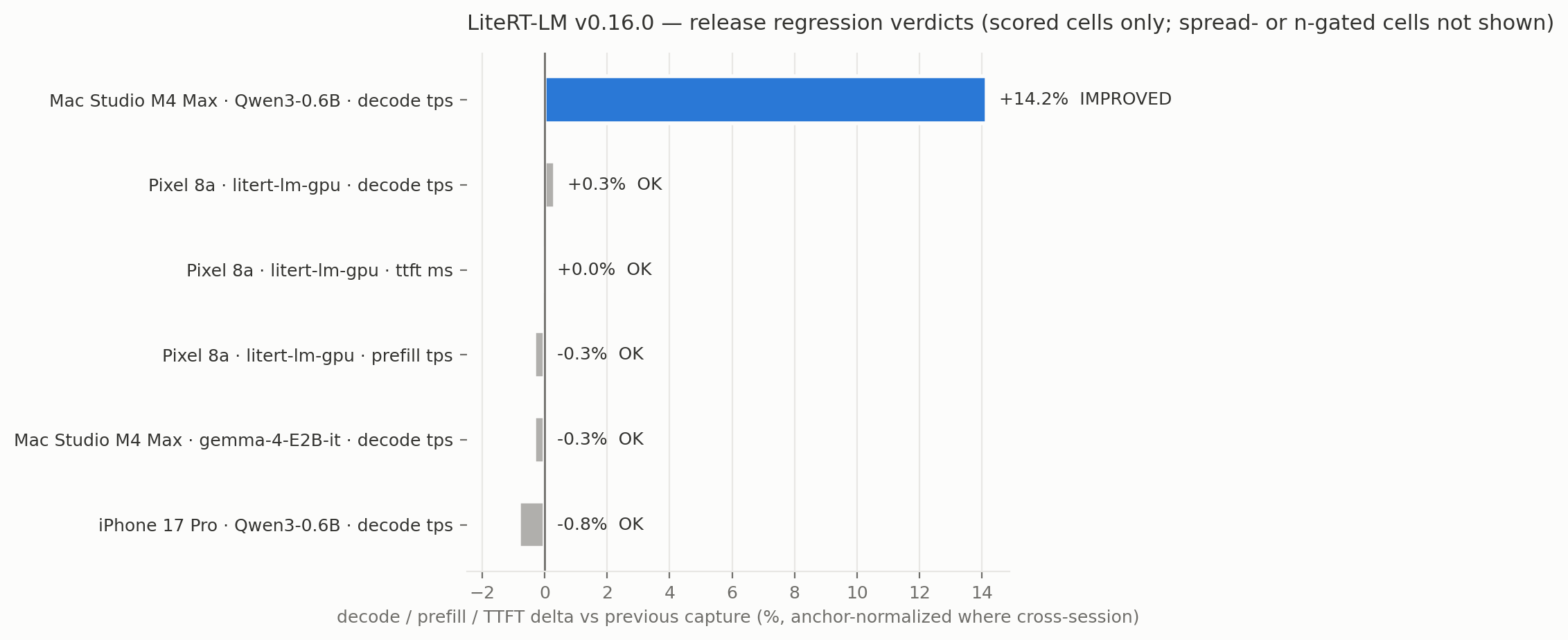
This repo starts with the 2026-08-17 LiteRT-LM v0.15.0 → v0.16.0 regression
run as its founding baseline: Pixel 8a (Android lane) and Mac Studio M4 Max,
verdicts in results/regression-reports/. On the Pixel GPU the release is a
clean pass (decode +0.3%); on the Mac, Qwen3-0.6B decode improved ~14% over
the July v0.13.1 rows (anchor-normalized) and Gemma-4-E2B stayed flat.
Provenance
The harness was carved out of
apple-silicon-llm-bench,
which remains the measurement archive (published campaign tables, full raw
history back to 2026-05, and the ./reproduce registry mapping each
published table to its pinned command). Numbers in that archive were
measured with the same harness code; this repo is canonical for the harness
going forward.
License: MIT.