

Repository
TeD-Q
TeD-Q (Tensor-network enhanced Distributed Quantum) is a tensor network enhanced distributed hybrid quantum machine learning framework.
README
TeD-Q
(Tensor-network enhanced Distributed Quantum)
TeD-Q is an open-source software framework for quantum machine learning, variational quantum algorithm and simulation of quantum computing.
Main Features
- Tensor-network enhanced. With tensor contraction, simulation of quantum circuts with large number of qubits is possible.
- Hybrid. TeD-Q seamlessly integrates classical machine learning libraries with quantum simulators, giving users the ability to laverage the power of classical machine learning while train quantum machine learning models.
- Distributed. TeD-Q is empowered with the capability of training quantum machine learning models in a distributed manner.
- Easy-to-use. Quantum circuit is seen as a python function.
- Device independent. The circuits can be run on different backends include software simulators (JAX and PyTorch) and quantum hardwares.
- Automatic differentiation. Provides back propagation, parameters shift, finite difference methods to obtain gradient.
- Flexible interfacing. Bridging quantum circuit to powerful machine learning libraries (like PyTorch).
- Good compatibility. Backend's optimizer can be directly applied.
- User friendly visualization. Quantum circuit and training progress can be visualized in real time.
Installation
Prerequisite
pip install numpy torch jax jaxlib matplotlib panel jupyterlab ipywidgets toolz rayIt is strongly recommended to install and use JDtensorPath for tensor network contraction mode.
Install
pip install -e .Test
Run the Run_all_tests.ipynb file under test document
Getting started
Simple example
Define the circuit with TeD-Q framework
import tedq as qai
def circuitDef(params):
    qai.RX(params[0], qubits=[0])
    qai.RY(params[1], qubits=[0])
    return qai.expval(qai.PauliZ(qubits=[0]))
Quantum circuit constuction
number_of_qubits = 1
parameter_shapes = [(2,)]
my_circuit = qai.Circuit(circuitDef, number_of_qubits, parameter_shapes = parameter_shapes)
Draw the quantum circuit
drawer = qai.matplotlib_drawer(my_circuit)
drawer.draw_circuit()
Compile quantum circuit with "pytorch" backend
my_compilecircuit = my_circuit.compilecircuit(backend="pytorch")Run the circuit
import torch
a = torch.tensor([0.54], requires_grad= True)
b = torch.tensor([0.12], requires_grad= True)
my_params = (a, b)
c = my_compilecircuit(*my_params)
>>> c = tensor([0.8515], grad_fn=<TorchExecuteBackward>)
Obtain the gradient
c.backward()Getting start with the graphic circuit composer
Init the circuit composer in TeD-Q framework
%matplotlib ipympl
import tedq as qai

composer = qai.circuit_composer(4, figsize=(10,4))
Add a quantum gate
Drag the template quantum gate on the bar on the top.
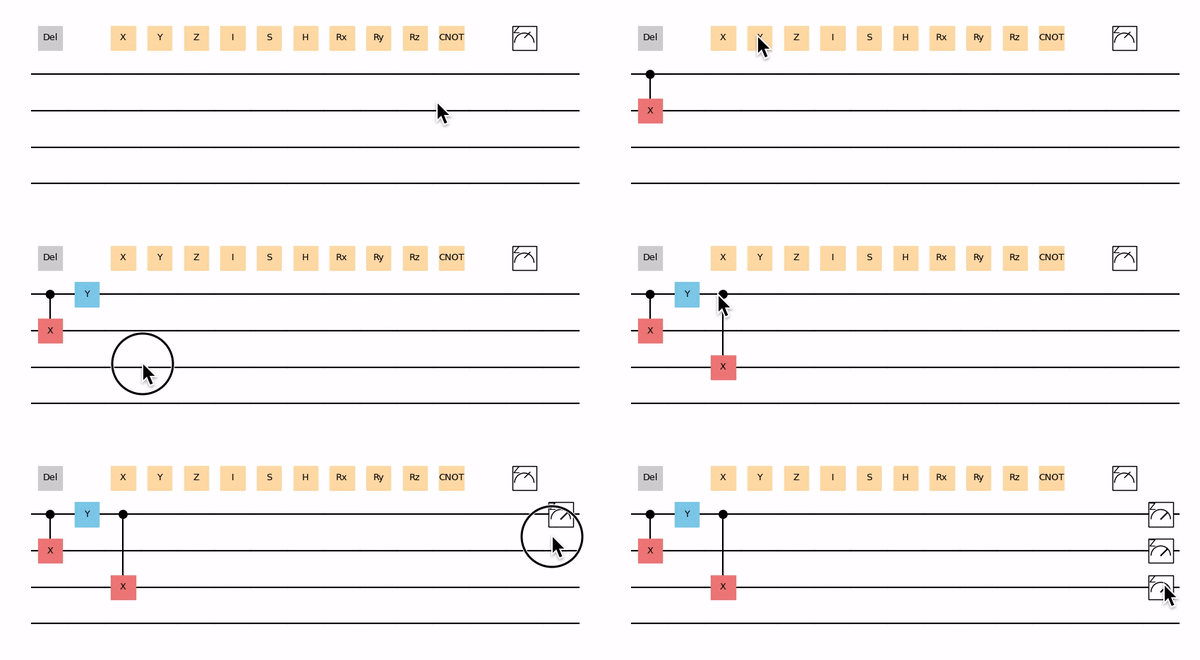
Remove a quantum gate
Click the gate on the quantum wire and drag to the trash box.
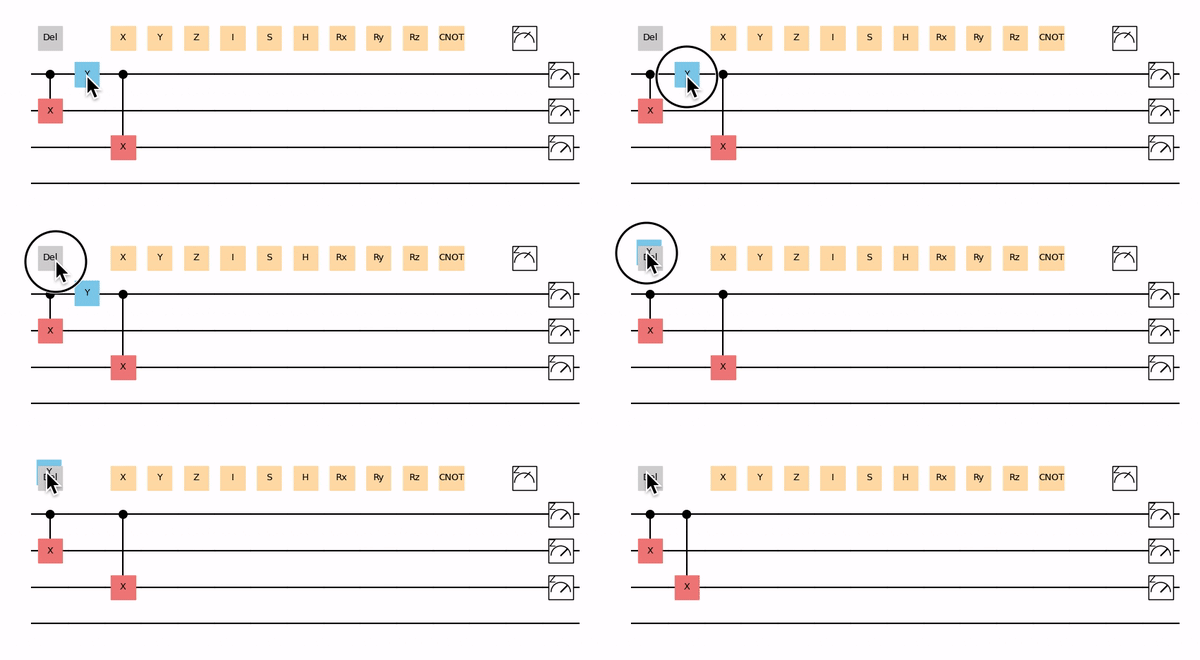
Convert to a circuit object
The composer can be converted to circuit object and compiled for evaluating the circuit.
circuit = composer.toCircuit()
compiledcircuit = circuit.compilecircuit(backend="pytorch")
Show the definition of circuit
User can also show the circuit definition by printing the circuit object.
print(circuit)
Learn more
Follow the tutorial and the examples below to learn more usage of the TeD-Q framework.
Tutorial and examples
For more diverse examples of using TeD-Q to solve quantum machine learning problem and variational quantum algorithm, please refer to the following tutorials or our official documentation website.
Qubit rotation
QNN circuit example
Quanvolution neural network
Quantum transfer learning
Expected value and the gradient of parameters
Simple variational quantum eigensolver
1D Many Body Localization
2D Many Body Localization
Authors
TeD-Q is released by JD Explore Academy and currently maintained by Xingyao Wu. The project is not possible without the efforts made by our contributors.
License
TeD-Q is free and open source, released under the Apache License, Version 2.0.