

Repository
barunlm-35m
BarunLM-35M: a parameter-efficient 35M base language model trained on 5.7B tokens
- Model
- Parameters
- LFM2.5-230M-Base
- 229.7M
- GPT-2 125M
- 125.0M
- Pythia-160M
- 162.3M
Specs
- ModelParameters
- LFM2.5-230M-Base229.7M
- GPT-2 125M125.0M
- Pythia-160M162.3M
- Stentor-30M30.4M
- TinyStories-33M¹68.5M
- Pythia-70M70.4M
- ComponentConfiguration
- Parameters35,072,768
- Layers12
- Hidden size448
- Attention7 query heads, 1 key/value head
- Attention schedule3 local layers + 1 global layer
- Local attention window256 tokens
- Position encoding50% Partial RoPE
- Feed-forward width1,228
- Residual selectorEvery 4 layers
- Vocabulary16,384 byte-level BPE
- Context length2,048 tokens
- EmbeddingsTied input/output
README
BarunLM-35M
The world's best language model under 100 million parameters
BarunLM-35M achieves 41.01% on a fixed, decontaminated nine-task zero-shot benchmark at 35,072,768 parameters. It outperforms LFM2.5-230M-Base by 1.81 percentage points while using 6.55× fewer parameters, leading every evaluated sub-100M base model under the same protocol.
Overview
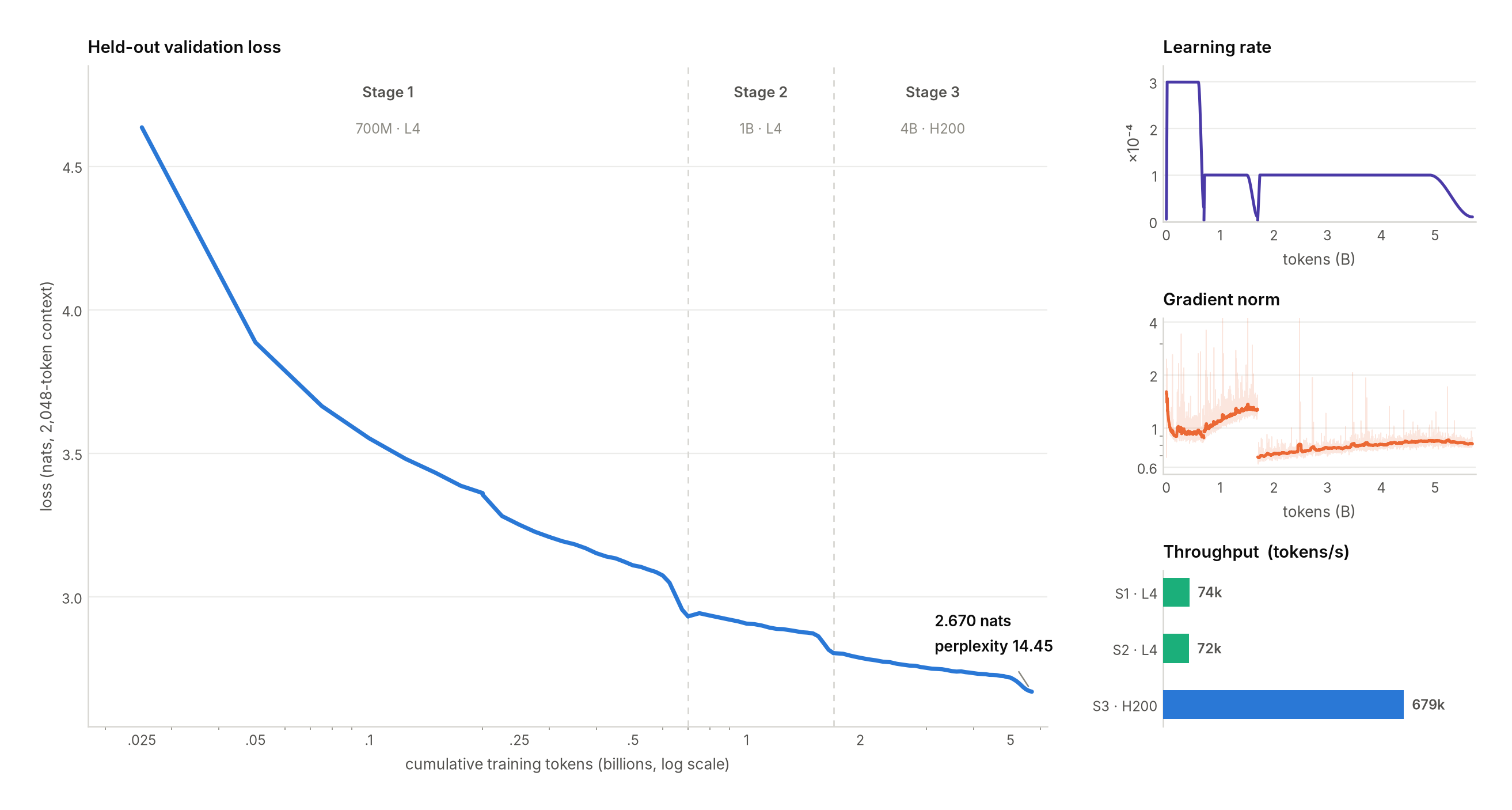
BarunLM-35M demonstrates that carefully designed architectures can significantly improve parameter efficiency. Trained on 5.70 billion tokens, the model surpasses substantially larger language models on a standardized evaluation suite.
The improvement is driven by three core architectural innovations:
- A 3:1 local-to-global attention schedule
- A learned residual selector applied every four layers
- A capacity-aligned training budget of 162.5 tokens per parameter
Key Highlights
- Hybrid attention architecture: Three local-attention layers are followed by one global-attention layer, combining efficient local computation with periodic long-range communication.
- Selective residual routing: A lightweight learned residual selector preserves useful representations while improving optimization.
- Optimized small-model design: Integrates grouped-query attention, partial RoPE, QK normalization, gated attention outputs, and bounded SwiGLU into a single 35M-parameter architecture.
- Capacity-aligned pretraining: Trained on 5.70B tokens from a curated mixture of educational text, synthetic content, mathematics, general web data, and code.
- Contamination-aware evaluation: Benchmark results exclude 1,854 contaminated samples detected using a correctness-blind 13-token exact-match scan across the complete training corpus.
Benchmark Results
All models were evaluated zero-shot using LM Evaluation Harness 0.4.12 on:
- ARC-Challenge
- ARC-Easy
- BoolQ
- HellaSwag
- LAMBADA OpenAI
- OpenBookQA
- PIQA
- SciQ
- WinoGrande
| Model | Parameters | Macro Accuracy | BarunLM Lead |
|---|---|---|---|
| BarunLM-35M | 35.1M | 41.01% | — |
| LFM2.5-230M-Base | 229.7M | 39.20% | +1.81 pp |
| GPT-2 125M | 125.0M | 39.10% | +1.91 pp |
| Pythia-160M | 162.3M | 37.35% | +3.66 pp |
| Stentor-30M | 30.4M | 36.46% | +4.55 pp |
| TinyStories-33M¹ | 68.5M | 33.16% | +7.85 pp |
| Pythia-70M | 70.4M | 31.71% | +9.30 pp |
The paired 10,000-resample bootstrap confidence interval for the BarunLM minus LFM2.5 difference is [+0.92, +2.71] percentage points.
Complete benchmark details, confidence intervals, and task-level scores are available in benchmark_results.json.
¹ TinyStories is included as a narrow-domain diagnostic baseline.
Model Architecture
| Component | Configuration |
|---|---|
| Parameters | 35,072,768 |
| Layers | 12 |
| Hidden size | 448 |
| Attention | 7 query heads, 1 key/value head |
| Attention schedule | 3 local layers + 1 global layer |
| Local attention window | 256 tokens |
| Position encoding | 50% Partial RoPE |
| Feed-forward width | 1,228 |
| Residual selector | Every 4 layers |
| Vocabulary | 16,384 byte-level BPE |
| Context length | 2,048 tokens |
| Embeddings | Tied input/output |
The architecture performs global attention periodically while relying primarily on computationally efficient local attention. This design reduces compute without sacrificing long-range information flow.
Quick Start
git clone https://github.com/harrrshall/barunlm-35m.git
cd barunlm-35m

python -m venv .venv
source .venv/bin/activate

pip install -e .

python examples/generate.py \
  --prompt "The future of efficient language models is" \
  --max-new-tokens 48 \
  --temperature 0.8
The example automatically downloads the required model artifacts from Hugging Face, verifies SHA-256 hashes, and uses CUDA when available.
For deterministic decoding:
--temperature 0To download the release manually:
hf download harrrshall/BarunLM-35M --local-dir BarunLM-35M

sha256sum -c BarunLM-35M/SHA256SUMS
Training
BarunLM-35M was pretrained on 5,699,985,408 tokens using a sequence length of 2,048.
The final 4B-token training stage used:
- Optimizer: Muon
- Peak learning rate: 1e-4
- Weight decay: 0.1
- Batch size: 48
- Training steps: 40,690
- Hardware: 1× NVIDIA H200
Training Data
The training corpus consists of:
- FineWeb-Edu
- Cosmopedia v2
- FineMath-4+
- DCLM-Baseline
- CodeSearchNet Python
- CodeParrot Clean
Documents were deduplicated before training. Training data itself is not redistributed.
Intended Use
BarunLM-35M is designed for:
- Research on compact language models
- Educational purposes
- Text-generation experiments
- Local prototyping
- Parameter-efficient modeling research
Limitations
- Base model without instruction tuning
- 2,048-token context window
- Limited factual recall compared to larger models
- English-centric training
- May generate inaccurate, biased, repetitive, or fabricated outputs
- Not intended for medical, legal, financial, or other high-stakes applications without additional safeguards
Acknowledgements
This project builds upon advances from the open language-model ecosystem, including grouped-query attention, rotary position embeddings, SwiGLU, PyTorch, Hugging Face, LM Evaluation Harness, FineWeb-Edu, Cosmopedia, FineMath, DCLM, CodeSearchNet, and CodeParrot.
License
The source code and released model weights are licensed under Apache License 2.0. Upstream datasets remain subject to their respective licenses and terms.