

Repository
CardioState-Jepa
CardioState-JEPA — a single shared Transformer encoder for ECG, PPG, and PCG, pretrained with delay-aware cross-modal joint-embedding prediction.
- Type
- Tasks
- Classification (macro-AUROC ↑)
- wesad , dalia_activity , ppgarrhythmia , mimicperform_af , sdb , bidmc_rr , uqvitalsigns_rr
- Regression (MAE ↓)
- dalia_hr , earset_hr , wildppg_hr , wildppg_rmssd , bcg_sbp , bcg_dbp , ppgbp_sbp , ppgbp_dbp , sensors_sbp , sensors_dbp , uci_sbp , uci_dbp , uqvitalsigns_spo2
Specs
- TypeTasks
- Classification (macro-AUROC ↑)wesad , dalia_activity , ppgarrhythmia , mimicperform_af , sdb , bidmc_rr , uqvitalsigns_rr
- Regression (MAE ↓)dalia_hr , earset_hr , wildppg_hr , wildppg_rmssd , bcg_sbp , bcg_dbp , ppgbp_sbp , ppgbp_dbp , sensors_sbp , sensors_dbp , uci_sbp , uci_dbp , uqvitalsigns_spo2
README




<br>
:rocket: Introduction
What if one cardiac foundation model could read ECG, PPG, and PCG?
Electrocardiography (ECG), photoplethysmography (PPG), and phonocardiography (PCG) are
three different observations of the same cardiac cycle — electrical activation,
peripheral pulse, and heart sounds — yet cardiac foundation models are almost always
trained for a single sensor, leaving the shared physiology across sensors unexploited.
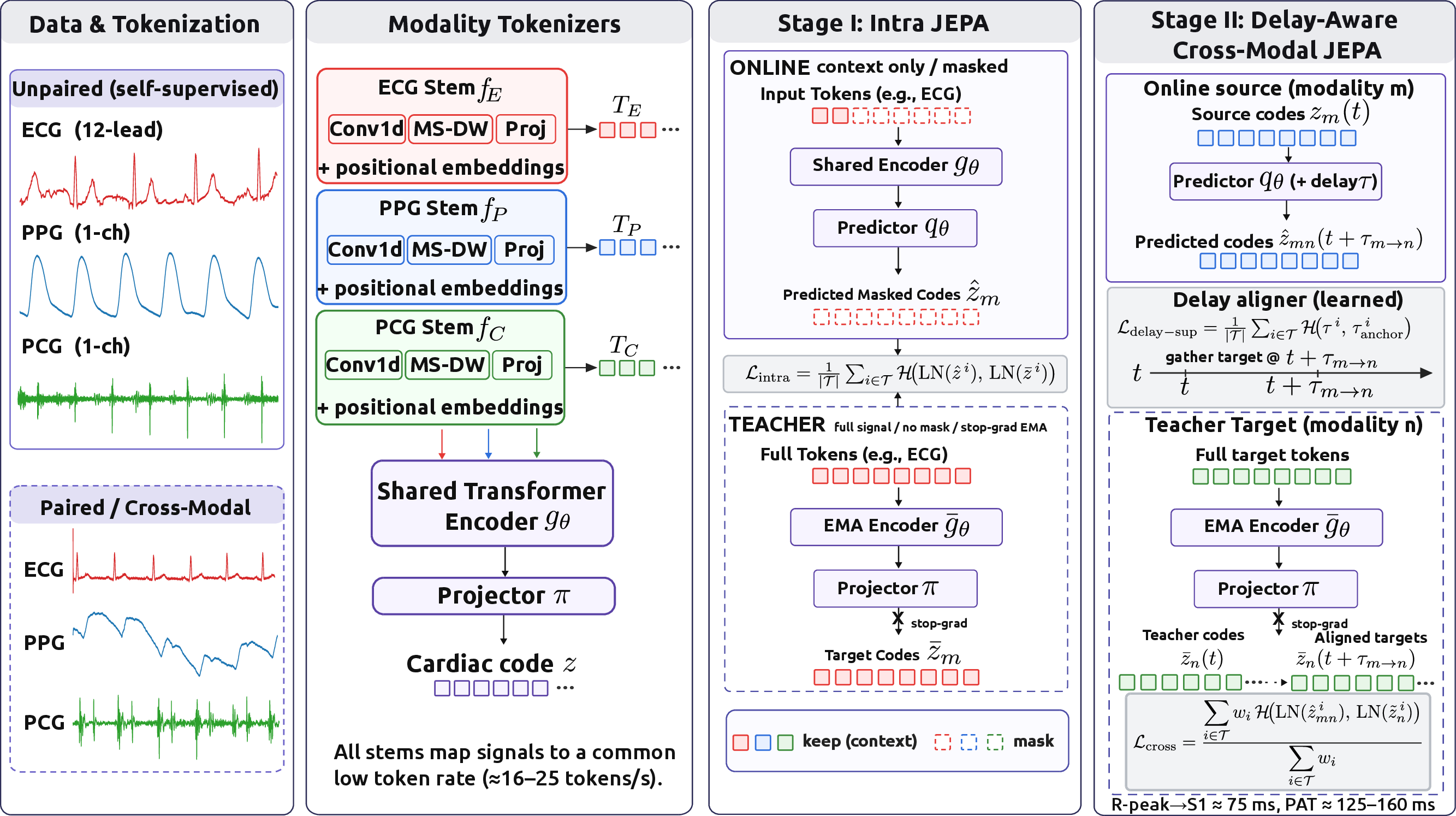
CardioState-JEPA is a cardiac foundation model that learns one shared representation
jointly across ECG, PPG, and PCG, built on a physiology-aware joint-embedding predictive
architecture (JEPA). It maps heterogeneous waveforms into a common token space, processes
them with a single shared Transformer encoder, and learns by predicting masked latent
cardiac states rather than reconstructing raw waveforms — placing the pretraining target
on shared physiology instead of sensor-specific appearance.
Because the three modalities observe the same beat at different physiological times (PCG
follows electromechanical coupling, PPG arrives later via pulse transit), cross-modal
prediction uses a learned delay aligner that matches signals at the corresponding
cardiac time. And because synchronized multi-sensor recordings are scarce, training follows
a two-stage curriculum: Stage I learns within-modality structure from abundant
unimodal data, then Stage II uses paired data to align modalities in latent cardiac
time.
Evaluated as a frozen encoder across 25 downstream tasks spanning ECG, PPG, and PCG,
a single shared encoder improves average PPG classification by +8.2 AUROC, PCG
murmur detection by +18.8 AUROC, and ECG classification by +15.5 AUROC over the
best self-supervised signal baseline, and matches or exceeds cardiac models trained with
privileged clinical text or supervised labels on several ECG benchmarks.
This repository releases the pretrained shared encoder and a linear-probe evaluation
harness, so you can extract cardiac codes from any of the three modalities and reproduce
the frozen-encoder downstream results.
:bar_chart: Key Results (frozen encoder, linear probe)
| Modality | Metric | Best signal baseline | CardioState-JEPA |
|---|---|---|---|
| PPG (6 classification tasks) | macro-AUROC ↑ | 72.2 | 80.4 |
| PPG (11 regression tasks) | MAE ↓ | 10.9 | 9.1 |
| ECG (6 datasets × 3 label fractions) | macro-AUROC ↑ | 68.5 | 84.1 |
| PCG — CirCor murmur | macro-AUROC ↑ | 79.1 | 97.9 |
| PCG — CinC2016 abnormal | macro-AUROC ↑ | 62.4 | 66.8 |
All downstream evaluations use patient-disjoint splits and a frozen encoder → trainable
nn.Linear head. See the paper for full per-task tables and ablations.
:file_folder: Repository Structure
.
├── cardiostate_jepa
│   ├── models          # shared encoder, tokenizers/stems, JEPA model
│   ├── losses          # intra/cross JEPA, delay supervision, VICReg state, phase
│   ├── data            # modality datasets + paired loaders (VitalDB, EPHNOGRAM, ...)
│   ├── evaluation      # linear-probe evaluation harness (ECG / PPG / PCG runners)
│   ├── scripts         # feature extraction, linear probe, figures
│   └── configs/model   # encoder architecture configs
├── cardio_state_weights
│   └── cardiostate_encoder.pt      # released shared encoder (or download from HF)
├── requirements.txt
└── README.md
:hammer_and_wrench: Installation
git clone https://github.com/hamzashafiq28/CardioState-JEPA.git && cd CardioState-JEPA
conda create -n cstate python=3.10 && conda activate cstate
pip install -r requirements.txt
pip install -e .          # installs the `cardiostate_jepa` package
:floppy_disk: Model Weights (Hugging Face)
The released model is a single encoder checkpoint (cardiostate_encoder.pt, ~360 MB) —
the frozen ViT-B shared encoder used for all downstream results. It is a pure weights file
(a state_dict with no optimizer state, no config, and no data/paths embedded), so you load
it together with the matching architecture config shipped in this repo:
cardiostate_jepa/configs/model/cardiostate.yaml.
Download from the Hub:
huggingface-cli download hamzashafiq/CardioState-JEPA \
    cardiostate_encoder.pt --local-dir cardio_state_weights/
or in Python:
from huggingface_hub import hf_hub_download
ckpt = hf_hub_download("hamzashafiq/CardioState-JEPA", "cardiostate_encoder.pt")
Load the encoder and extract cardiac codes:
import torch
from cardiostate_jepa.evaluation.checkpoint_model import load_model_for_eval

model = load_model_for_eval(
    "cardio_state_weights/cardiostate_encoder.pt",
    "cardiostate_jepa/configs/model/cardiostate.yaml",
).eval()

# tokenize -> shared encoder -> projector; pooled mean gives the cardiac code
ppg = torch.randn(2, 1, 1250)        # [batch, 1 channel, 10 s @ 125 Hz]
with torch.no_grad():
    tokens, _ = model.core.tokenize(ppg, "ppg", 125.0)
    code = model.core.encode(tokens).mean(1)   # [2, 768] cardiac code
print(code.shape)
The same encoder accepts "ecg" (12-lead, 500 Hz) and "pcg" (1-channel, 4000 Hz) — pass
the modality name and its sampling rate to tokenize.
Load with transformers (AutoModel.from_pretrained)
The encoder is also published as a transformers-compatible model, so it loads with the
standard AutoModel.from_pretrained(..., trust_remote_code=True) interface:
from transformers import AutoModel
import torch

model = AutoModel.from_pretrained("hamzashafiq/CardioState-JEPA",
                                  trust_remote_code=True).eval()

ppg = torch.randn(2, 1, 1250)            # [batch, 1 ch, 10 s @ 125 Hz]
with torch.no_grad():
    out = model(ppg, modality="ppg", fs=125.0)
print(out.pooler_output.shape)           # (2, 768) cardiac code
modality is "ecg" (12 leads @ 500 Hz), "ppg" (1 ch @ 125 Hz), or "pcg" (1 ch @ 4000 Hz);
pass the matching fs. This path requires the package to be installed (pip install -e .),
since the encoder architecture lives here. The transformers wrapper (CardioStateConfig /
CardioStateModel) and the script that assembles the Hugging Face repo are in hf/.
:book: Usage — PPG Evaluation with Hugging Face Weights
The PPG downstream data is the public PulseLM
benchmark and is auto-downloaded from Hugging Face on first run. To evaluate the released
encoder, point the runner at the checkpoint via CSTATE_CKPT and select --model cardiostate:
# 1) get the weights (once)
huggingface-cli download hamzashafiq/CardioState-JEPA \
    cardiostate_encoder.pt --local-dir cardio_state_weights/

# 2) point the runner at the weights + the matching architecture config
export CSTATE_CKPT=cardio_state_weights/cardiostate_encoder.pt
export CSTATE_CONFIG=cardiostate_jepa/configs/model/cardiostate.yaml

# 3) run a PPG task — PulseLM is fetched from the Hub automatically
python -m cardiostate_jepa.evaluation.baselines.ppg.run \
    --model cardiostate --dataset pulselm --task wesad \
    --epochs 100 --lr 1e-3 --batch-size 16 --device cuda
This freezes the encoder, extracts features, trains a linear head under the MERL protocol
(Adam, lr=1e-3, 100 epochs, MultiStepLR milestone 40), and reports
macro-AUROC (classification) or MAE (regression) with a 95% subject-level bootstrap CI to
runs/ppg/cardiostate_pulselm_<task>/metrics.json.
Available PPG task keys (--task):
| Type | Tasks |
|---|---|
| Classification (macro-AUROC ↑) | wesad, dalia_activity, ppgarrhythmia, mimicperform_af, sdb, bidmc_rr, uqvitalsigns_rr |
| Regression (MAE ↓) | dalia_hr, earset_hr, wildppg_hr, wildppg_rmssd, bcg_sbp, bcg_dbp, ppgbp_sbp, ppgbp_dbp, sensors_sbp, sensors_dbp, uci_sbp, uci_dbp, uqvitalsigns_spo2 |
Sweep every task with three seeds:
for task in wesad dalia_activity ppgarrhythmia mimicperform_af sdb bidmc_rr uqvitalsigns_rr \
            dalia_hr earset_hr wildppg_hr wildppg_rmssd bcg_sbp bcg_dbp ppgbp_sbp ppgbp_dbp \
            sensors_sbp sensors_dbp uci_sbp uci_dbp uqvitalsigns_spo2; do
  for seed in 0 1 2; do
    python -m cardiostate_jepa.evaluation.baselines.ppg.run \
        --model cardiostate --dataset pulselm --task "$task" \
        --seed "$seed" --epochs 100 --lr 1e-3 --batch-size 16 --device cuda
  done
done
Env vars:
CSTATE_CKPT(required, path to the weights) andCSTATE_CONFIG(the
architecture config above). Optional:CSTATE_FEATURE(encoder, default),
CSTATE_POOLING(mean, default),CSTATE_PPG_FS(125, default).
The ECG and PCG probes work the same way — cardiostate_jepa.evaluation.baselines.ecg.run
(--dataset ptbxl --task super, etc.) and cardiostate_jepa.scripts.probe_pcg_baselines
(--dataset circor --task murmur) — all with --model cardiostate and the same CSTATE_*
environment variables.
:page_facing_up: Citation
@misc{shafiq2026cardiostatejepadelayawarecrossmodallearning,
      title={CardioState-JEPA: Delay-Aware Cross-Modal Learning of a Shared Cardiac Representation},
      author={Hamza Shafiq and Hung Manh Pham and Bin Zhu and Pan Zhou and Jun Hu and Aaqib Saeed},
      year={2026},
      eprint={2608.12944},
      archivePrefix={arXiv},
      primaryClass={cs.LG},
      url={https://arxiv.org/abs/2608.12944},
}
Load with transformers ( AutoModel.from_pretrained )
2
-
The encoder is also published as a transformers -compatible model, so it loads with the standard AutoModel.from_pretrained(..., trust_remote_code=True) interface: