

- Agent
- Objective
- file
- Python
- requirements-eval-genbench.txt
- 3.10
- requirements-eval-arena.txt
- 3.12
Specs
- AgentObjective
- filePython
- requirements-eval-genbench.txt3.10
- requirements-eval-arena.txt3.12
- environmenthow TRTLLM attention is disabled
- vLLM 0.23 judge/eval env ( requirements-eval.txt )0.23
- J-Zero ( launch/ )R-Zero ( baselines/r-zero/launchers/ )
- Output rootPROJECT_ROOT (required) → outputs/ ; OUT_ROOT overrides
- CheckpointsCKPT_ROOT (optional, defaults under VERL_REPO )
- verl checkoutVERL_REPO (required), recipe at $VERL_REPO/recipe_J-Zero ( RECIPE_DIR overrides)
- Val parquets$PROJECT_ROOT/data
- Smoke runSMOKE=1 (+ RZERO_SMOKE_* )
- Round countRZERO_NITER
README
J-Zero: Unified Challenger--Solver--Judge Co-Evolution from Zero Data


🔔 Updates
- [✔] (26.08.28) The code implementation of J-Zero is out.
- [✔] (26.08.27) Paper is out! Link
🔎 Overview
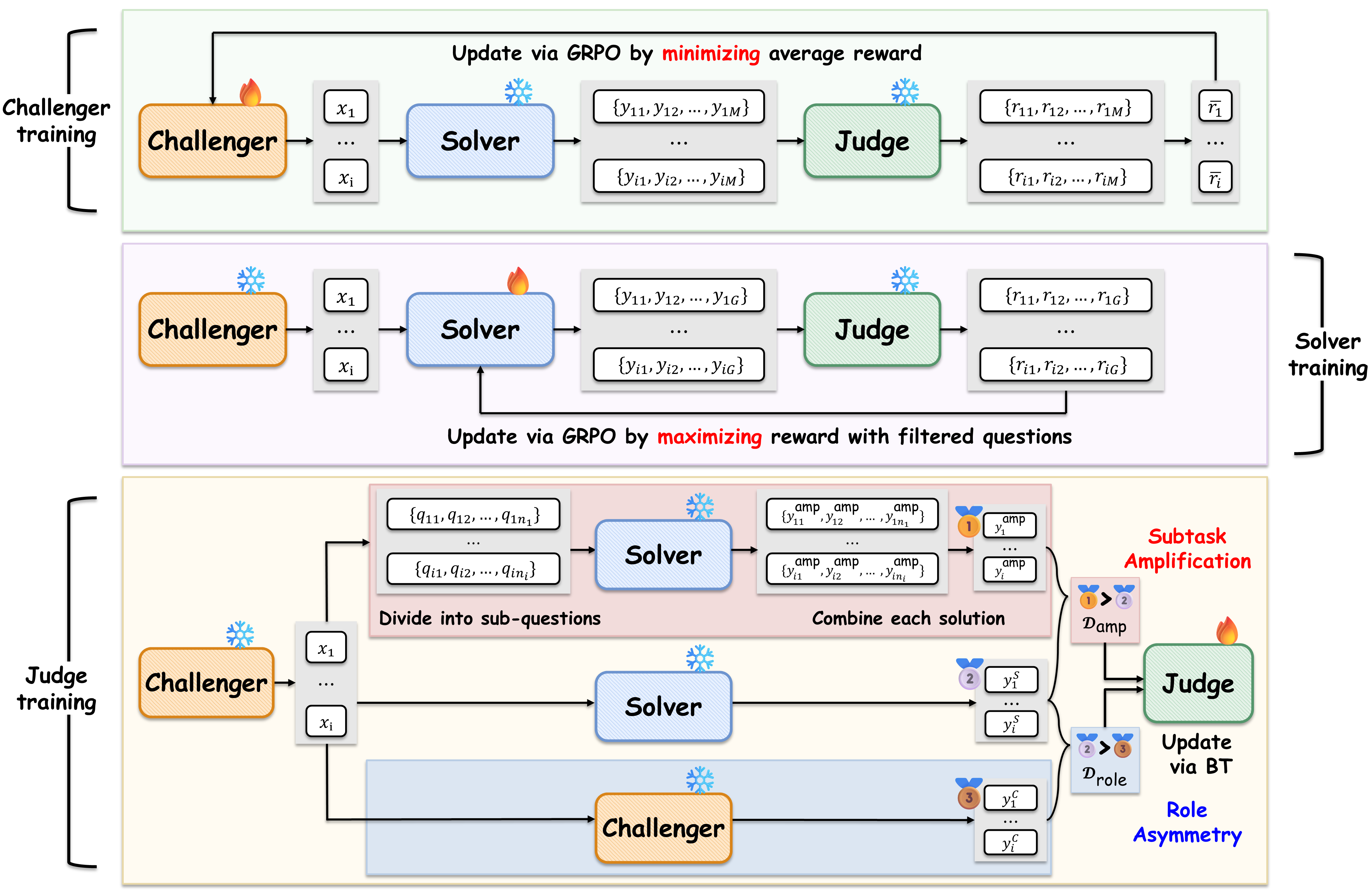
A unified LLM Zero-data Self-play framework that enables self-evolving in both verifiable and unverifiable domain, where Judge co-adapts alongside the Challenger and Solver.
In unverifiable domains, reward models provide preference-based supervision for improving model capabilities; however, the extent of self-improvement may ultimately be constrained by the judge model’s own evaluation capability.
To resolve this, J-Zero co-evolves the Judge under two constraints:
- Preference pairs must be constructed entirely within the closed loop, without external supervision.
- Their labels must not depend on signals produced by the Judge itself, both to avoid self-bias and to allow correction of any miscalibration in the current Judge.
To satisfy these two, we construct preference pairs from the outputs of Challenger and Solver, namely role-asymmetry and subtask-amplification. Check out our paper for the details.
J-Zero Self-Play Loop
Each iteration trains all three agents, each initialized from the previous round:
| Agent | Objective | Trainer | |
|---|---|---|---|
| Stage 1 | Challenger | generate well-formed questions the current Solver scores low on | GRPO (verl) |
| Stage 2 | Solver | answer Challenger's questions | GRPO (verl) |
| Stage 3 | RM | provide accurate rewards | FSDP BT (pipeline/rm_train_loop.py) |
Solver and Challenger start from BASE_MODEL — the shipped runs use
Qwen3-4B-Base, Qwen3-8B-Base and Llama-3.2-3B-Instruct (one launcher each, see
Usage); the Judge starts from
Skywork/Skywork-Reward-V2-Llama-3.1-8B and is continued round-over-round.
🔧 Environments and Setup
Hardware: one node with 4 GPUs per experiment (validated on 4xB200; the 8B config fits via CPU offload — see launch/run_jzero_8b.sh).
We provide several mutually-incompatible environments (e.g. vLLM 0.11 vs 0.23) that we have used in requirements/. Install cleanly from scratch with uv pip install -r <file>.
| file | Python | key pins | used for |
|---|---|---|---|
requirements-train-vllm011.txt |
3.12 | torch 2.8, vLLM 0.11, transformers 4.56 | Default training env: all J-Zero / R-Zero / G-Zero runs on Qwen3-4B/8B-Base and Llama-3.2-3B-Instruct |
install_train_env_vllm023.sh |
3.12 | torch 2.11, vLLM 0.23, transformers 5.6.0 or 5.12.1 | Same pipelines, but for base models vLLM 0.11 cannot load (Qwen3.5, Gemma4, …), plus generation from checkpoints those runs produce — vLLM 0.11 mis-detokenizes transformers-5-saved checkpoints |
requirements-eval.txt |
3.12 | vLLM 0.23 (cu130 index) | all benchmark judge/test serving |
requirements-eval-genbench.txt |
3.10 | alpaca_eval deps | AlpacaEval / EQ-Bench orchestration |
requirements-eval-arena.txt |
3.12 | torch +cpu index | Arena-Hard-Auto harness |
IFEval needs NLTK tokenizer data that pip does not ship.
install_train_env_vllm023.sh downloads it; after installing
requirements-train-vllm011.txt do it yourself, once, while you have network:
(Note that training does not need it — see benchmarks/README.md ("One-time setup"))
python -m nltk.downloader punkt_tabTraining additionally requires verl installed editable at the revision the
released runs used — clone
volcengine/verl and pin
accb1a07d22b516a2a4e607a7891b8dea0897b91 (the patch below is
generated against this revision):
git clone https://github.com/volcengine/verl && cd verl
git checkout accb1a07d22b516a2a4e607a7891b8dea0897b91
uv pip install --python /path/to/venv/bin/python -e . --no-deps(uv venv does not put a pip inside the venv, so pip install -e . fails
there — use the uv pip form above, or create the venv with uv venv --seed.)
Place this repo's pipeline/ directly inside the verl checkout as
<verl>/recipe_J-Zero (the launch/ wrappers expect that name; override with
RECIPE_DIR), and baselines/r-zero/ likewise as <verl>/recipe_R-Zero. The
benchmark suite's math phase takes the baseline install location via its own
RECIPE_DIR env var (any path works — it just needs evaluate/ from
baselines/r-zero/).
Required verl patch — the released runs were trained on a locally patched
verl core, not stock upstream:
cd /path/to/verl && git apply /path/to/repo/patches/verl-core-rzero-fixes.patch<details>
<summary>patch information</summary>
It covers master-port selection, reward-fn registration, distributed init, the
async vLLM rollout server, and stage teardown.
The teardown hunk matters for reading logs: unpatched, every verl stage ends a
successful, checkpoint-saved run with a wandb Tracking.__del__ traceback
(ValueError: Cannot use run() inside async loop, then a closed-transport
follow-up), and often a torch DataLoader one (RuntimeError: DataLoader worker (pid …) is killed by signal: Killed — this one is intermittent, it needs a
worker to be killed while torch's SIGCHLD handler is still armed). Both are
teardown noise that says nothing about the run, but they make a 15-round launcher
impossible to judge from its log. Patched, trainer tracebacks on a successful
stage are largely gone, and a stage that raised is also filed as failed in wandb
rather than green. Not all of them: the solver stage can still emit one wandb
Tracking.__del__ traceback, because that object is collected while fit() is
still running and the patch's teardown runs after it returns.
What the patch does not silence is vLLM's own shutdown: the rollout-server
actors can still emit multiprocessing/resource_tracker.py … KeyError: '/psm_…'
or '/loky-…' while releasing shared-memory segments. That is a stock
CPython/vLLM teardown race in a different process, its count varies run to run,
and it is unrelated to whether the stage succeeded.
TRTLLM attention on SM100 (B200-class). A colocated rollout EngineCore can
futex-deadlock on idle/resume while TRTLLM-gen attention is active, so all three
training pipelines keep it off. How that is achieved differs per environment:
| environment | how TRTLLM attention is disabled |
|---|---|
vLLM 0.11 training env (requirements-train-vllm011.txt) |
VLLM_ATTENTION_BACKEND=FLASH_ATTN (+ the VLLM_USE_FLASHINFER* knobs) pinned in pipeline/env_prelude.sh, baselines/r-zero/env_prelude.sh and g_zero/local_backend.py. FlashInfer is never selected, so TRTLLM attention never engages. No patch needed. |
vLLM 0.23 judge/eval env (requirements-eval.txt) |
apply patches/vllm023-disable-trtllm-attn.patch and export VLLM_DISABLE_TRTLLM_ATTN=1 (benchmarks/scripts/eval_gen/serve_judge_vllm.sh does this). |
VLLM_DISABLE_TRTLLM_ATTN is introduced by that patch — stock vLLM of any
version ignores it, so it does nothing in the 0.11 env. vLLM 0.11's own switch,
if you ever want FlashInfer there, is upstream VLLM_USE_TRTLLM_ATTENTION=0.
</details>
🚀 Usage
J-Zero
One-time setup: cp .env.example $PROJECT_ROOT/.env and fill HF_TOKEN
(+ WANDB_API_KEY, or set WANDB_MODE=offline); copy the three val parquets
cp benchmarks/data/{math500,minervamath,olympiadbench}.parquet $PROJECT_ROOT/data/
(loaded by the solver trainer at init); pre-download the base model and
Skywork/Skywork-Reward-V2-Llama-3.1-8B into your HF cache — the pipeline
defaults to HF_HUB_OFFLINE=1 (export HF_HUB_OFFLINE=0 to allow first-run
downloads).
Then run:
PROJECT_ROOT=/abs/path/project \    # holds .env, data/ (val parquets), outputs/
VERL_REPO=/abs/path/verl \    # verl checkout with pipeline/ installed inside
RZERO_VENV_ACTIVATE=/abs/path/venv/bin/activate \
bash launch/run_jzero_4b.sh    # Qwen3-4B-Base, rounds 1-15
# same contract:
bash launch/run_jzero_8b.sh    # Qwen3-8B-Base, rounds 1-10 (adds the 8B CPU-offload)
bash launch/run_jzero_llama3b.sh   # Llama-3.2-3B-Instruct, rounds 1-15 (note that Llama-3.2-3B is a gated hug repo)
Custom runs go through the core launcher directly:
PROJECT_ROOT=... VERL_REPO=... RZERO_VENV_ACTIVATE=... \
RZERO_NITER=10 RZERO_TAG=my_run BASE_MODEL=Qwen/Qwen3-4B-Base \
bash launch/launch_jzero_4gpu.shSMOKE=1runs a tiny end-to-end pre-flight (100 questions, 1 round).- Resume: completed challenger/solver/RM checkpoints are detected and skipped;
rerun the same wrapper (or setRZERO_START_ITER) to continue. - Stage 3 uses the challenger-negative + IDA subtask pair builders (the paper method).
- The wrappers take
${VAR:-default}forBASE_MODEL,RZERO_NITER,
CKPT_ROOTandOUT_ROOT, so a released run can be shortened in place:
RZERO_NITER=3 bash launch/run_jzero_4b.sh.RZERO_TAGis fixed per wrapper
because it names the released checkpoint directories — use
launch/launch_jzero_4gpu.shdirectly to change it. The G-Zero launchers take
G_ZERO_NROUNDSfor the same purpose (see the contract table below). - Per-iteration eval is off by default (the paper numbers come from the
post-hoc 14-benchmark sweep). SetRZERO_SKIP_PER_ITER_EVAL=0— or its alias
RZERO_SKIP_ITER_EVAL=0— plusRZERO_EVAL_SCRIPTto enable it. The same
contract applies tobaselines/r-zero/run_rzero.sh.
Baselines
- R-Zero —
baselines/r-zero/: the verl recipe, the
launchers of the paper runs (Qwen3-4B/8B, Llama-3.2-3B). See
baselines/r-zero/RUNS.md. - G-Zero —
baselines/g-zero/: the fully-local
(vLLM + peft LoRA DPO) fork used for the paper runs, with its own README
and one launch script per released run.
Entrypoint env-var contract
The three entrypoints grew independently and do not take the same variables.
Export the "required" ones for whichever one you are running:
J-Zero (launch/) |
R-Zero (baselines/r-zero/launchers/) |
G-Zero (baselines/g-zero/scripts/) |
|
|---|---|---|---|
| Python env | RZERO_VENV_ACTIVATE — path to the activate file (required) |
RZERO_VENV — the venv directory (required; the script appends /bin/activate) |
G_ZERO_PY — a python executable (optional, defaults to python) |
| Secrets | $PROJECT_ROOT/.env (required; hard-fails on a missing HF_TOKEN, and on WANDB_API_KEY unless WANDB_MODE=offline) |
RZERO_ENV_FILE — path to the env file (required; no key validation) |
not needed |
| Output root | PROJECT_ROOT (required) → outputs/; OUT_ROOT overrides |
OUT_ROOT (required) |
G_ZERO_STORAGE (optional, defaults to baselines/g-zero/runs) |
| Checkpoints | CKPT_ROOT (optional, defaults under VERL_REPO) |
CKPT_ROOT (required) |
inside G_ZERO_STORAGE |
| verl checkout | VERL_REPO (required), recipe at $VERL_REPO/recipe_J-Zero (RECIPE_DIR overrides) |
recipe dir is the launcher's parent — no variable | not used (no verl) |
| Val parquets | $PROJECT_ROOT/data |
DATA_DIR (see RUNS.md) |
not used |
| Smoke run | SMOKE=1 (+ RZERO_SMOKE_*) |
SMOKE=1 (+ RZERO_SMOKE_*) |
SMOKE=1 (+ G_ZERO_SMOKE_*) |
| Round count | RZERO_NITER |
RZERO_NITER |
G_ZERO_NROUNDS |
Note on where files land: the verl trainer runs from the recipe directory and
uses hydra, so inside your verl checkout each stage writes
<verl>/recipe_J-Zero/outputs/<date>/<time>/{main_ppo.log,.hydra} and wandb
writes <verl>/recipe_J-Zero/wandb/ (same for recipe_R-Zero). These are
independent of OUT_ROOT/PROJECT_ROOT, they accumulate one directory per run,
and this repo's .gitignore does not reach them once the recipe has been copied
into verl — so git status in the verl checkout gets dirty. Set WANDB_DIR to
move the wandb half elsewhere (the offline-sync step follows it; the RM stage
always writes and syncs <recipe>/wandb).
Evaluation
One command evaluates one checkpoint on all 14 benchmarks (math×7, EM×3
[MMLU-Pro/SuperGPQA/BBH], IFEval, AlpacaEval 2.0, Arena-Hard-v2.0, EQ-Bench
Creative v3) on 4 GPUs, using local judges only — zero API calls:
cd benchmarks
GPU_SET=0,1,2,3 bash scripts/eval_standard/run_eval.sh <ckpt> <slug>
Setup (one-time clones, env vars, judge models) is documented in
benchmarks/README.md and
benchmarks/THIRD_PARTY.md.
📚 BibTeX
If you find this repo useful for your research, please consider citing us:
@article{chu2026jzero,
  title   = {J-Zero: Unified Challenger--Solver--Judge Co-Evolution from Zero Data},
  author  = {Chu, Gyouk and Jeon, Myeongho and Yang, Eunho},
  journal = {arXiv preprint arXiv:2608.26582},
  year    = {2026}
}
✉️ Contact
If you have any questions or feedback, feel free to reach out:
- Gyouk Chu: [email protected]