

- Role
- Model
- Discovery, Monitoring
- Gemini 3.1 Pro
- Analyst B
- GPT-5.4 (xHigh)
- Synthesis, Analyst A, Evaluator, Exit
- Claude Opus 4.6 (max effort)
Specs
- RoleModel
- Discovery, MonitoringGemini 3.1 Pro
- Analyst BGPT-5.4 (xHigh)
- Synthesis, Analyst A, Evaluator, ExitClaude Opus 4.6 (max effort)
- CategoryTools
- Market DatarefreshXYZAssets, getFundingRates, getMacroIndicators
- Prediction MarketssearchPolymarket, getEventEquityMapping (LLM-powered)
- Researchweb_search (Claude native), fetchWebPage, getEarningsCalendar
- PortfoliogetPortfolioState, getTradeHistory
- ComputationrunSimulation (Python sandbox: numpy, pandas, scipy)
- ExecutionplaceOrder (with riskReasoning), closePosition, setStopLoss
- Built-inreadFile, listFiles, grepFiles, bash (read-only, sandboxed)
- FileWhat
- workspace/state/discovery-candidates.jsonLatest discovery scan
- workspace/state/cycle-summaries.jsonlFull pipeline per candidate
- workspace/state/thesis-registry.jsonAll theses
- workspace/state/positions.jsonAll positions
- workspace/state/decisions-log.jsonlEvery trade decision
- workspace/state/paper-equity.jsonPersisted equity
- workspace/state/signal-cache/*.jsonLayer 1 agent outputs
- workspace/progress.mdHuman-readable session log
- logs/discovery-*.jsonlEvent log
- logs/llm-detail-*.jsonlFull prompts, responses, tool calls
README
AI Trading Agent
A fully autonomous multi-model trading harness that discovers, evaluates, and executes trades across Hyperliquid perpetual futures and Public.com US equities/options by finding divergences between prediction market odds and asset pricing.
Architecture
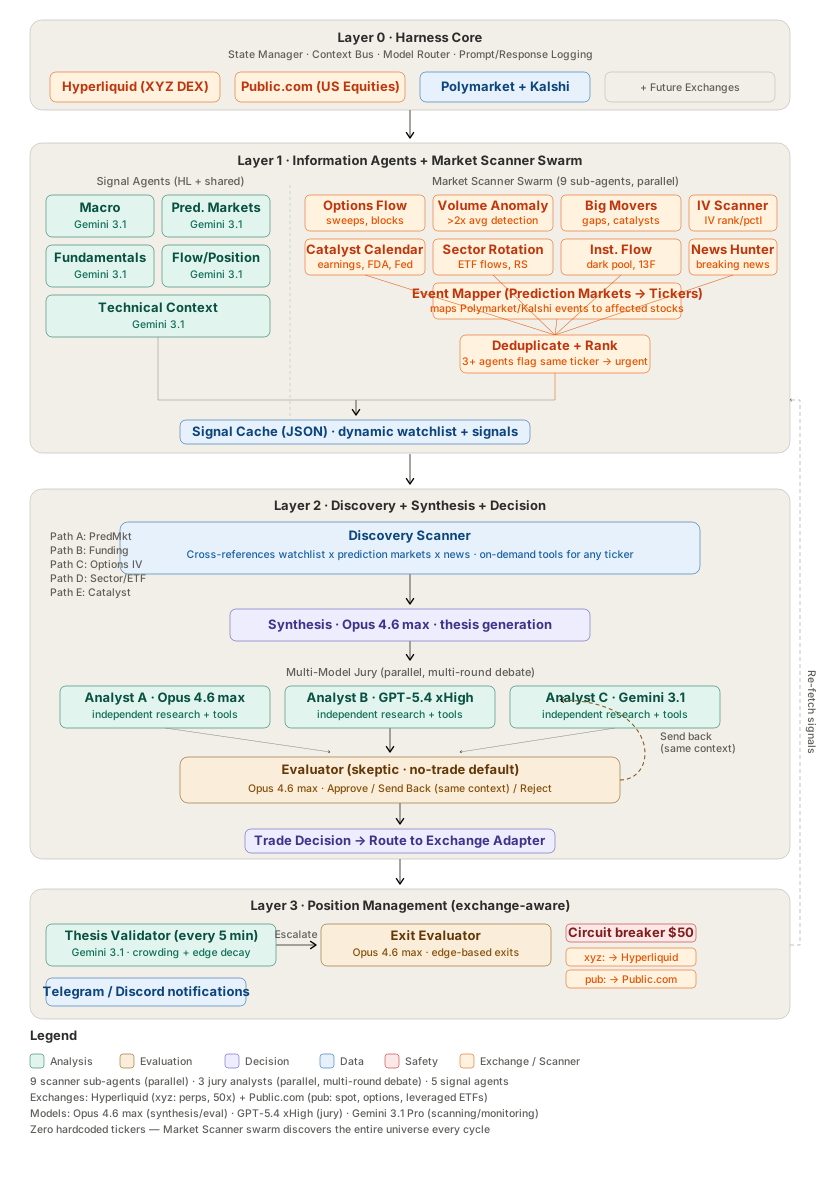
How It Works
The system runs 7 concurrent loops:
Layer 1: Information Agents (5 agents → signal cache)
    ↓
Layer 2: Discovery → Synthesis → Multi-Model Jury → Evaluator
    ↓
Layer 3: Execution → Position Monitoring → Exit Management
    ↓
Circuit Breaker (continuous) + Meta-Analysis (weekly)
The Edge
Prediction markets (Kalshi, Polymarket) price discrete events — tariff decisions, rate cuts, regulatory actions — that continuous equity/asset models handle poorly. When Kalshi says 70% chance of event X but the corresponding asset hasn't moved, that's the signal.
Three-Layer Architecture
Layer 0 — Harness Core: File-backed state (atomic JSON writes), per-role context assembly, multi-provider model router, full prompt/response logging.
Layer 1 — Information Agents: Five cheap-model agents run every 15 minutes, pre-processing raw data into structured signals:
- Macro Regime — classifies risk-on / risk-off / transitional / crisis
- Prediction Markets — extracts actionable signals, flags anomalies (>15% odds shift)
- Earnings & Fundamentals — upcoming earnings, analyst revisions
- Flow & Positioning — funding rate anomalies, crowding detection
- Technical Context — price momentum, volume classification
Layer 2 — Synthesis & Decision:
- Discovery scanner reads cached Layer 1 signals + live data
- Synthesis agent generates a thesis with concrete falsification conditions
- Multi-model jury (3 analysts in parallel) produces independent analyses
- GAN-inspired evaluator grades on 5 criteria (thesis quality, falsification specificity, information completeness, risk/reward, edge decay)
- Evaluator can APPROVE, SEND_BACK (for re-analysis), or REJECT
Layer 3 — Position Management:
- Continuous thesis validation (cheap model, every 5 min)
- Escalation to frontier model on anomaly detection
- Exit based on edge decay, not price movement
- Circuit breaker at configurable equity floor
Multi-Model Routing
| Role | Model | Why |
|---|---|---|
| Discovery, Monitoring | Gemini 3.1 Pro | Cheap — runs every 5-15 min |
| Analyst B | GPT-5.4 (xHigh) | Epistemic diversity |
| Synthesis, Analyst A, Evaluator, Exit | Claude Opus 4.6 (max effort) | Frontier reasoning |
All models are swappable via environment variables. The harness is model-agnostic.
No-Trade as Default
Being flat is the correct default state. Every agent prompt enforces this:
- Discovery returns empty candidates when nothing qualifies
- Synthesis defaults to no-trade unless specific, measurable edge exists
- Evaluator rejects >60% of proposals by design
- No mechanism penalizes inaction
Autonomous Operation
The LLM has full discretion over sizing, leverage, and position count. The only hard constraint is the circuit breaker — protects the experiment, not the LLM's judgment. The placeOrder tool requires a riskReasoning parameter that gets logged for meta-analysis.
Tool Registry
The harness provides 15+ tools scoped per agent role:
| Category | Tools |
|---|---|
| Market Data | refreshXYZAssets, getFundingRates, getMacroIndicators |
| Prediction Markets | searchPolymarket, getEventEquityMapping (LLM-powered) |
| Research | web_search (Claude native), fetchWebPage, getEarningsCalendar |
| Portfolio | getPortfolioState, getTradeHistory |
| Computation | runSimulation (Python sandbox: numpy, pandas, scipy) |
| Execution | placeOrder (with riskReasoning), closePosition, setStopLoss |
| Built-in | readFile, listFiles, grepFiles, bash (read-only, sandboxed) |
Agents only see tools relevant to their role. Discovery can't execute. The executor can't analyze.
Data Sources
All public APIs — no auth required for market data:
- Hyperliquid XYZ DEX — 59 assets: 34 stocks (NVDA, TSLA, AAPL...), 9 commodities, 5 indices, 3 FX
- Kalshi — 88+ economic/political prediction markets (Fed decisions, tariffs, elections)
- Polymarket — 97+ events via gamma API (crypto, finance, geopolitics)
Setup
git clone https://github.com/Gajesh2007/ai-trading-agent-v2.git
cd ai-trading-agent-v2
npm install
cp .env.example .env
# Add your API keys to .env
npm start
Required
Only one thing:
ANTHROPIC_API_KEY=your-keyOptional (enhances the system)
OPENAI_API_KEY=       # GPT-5.4 for jury diversity
OPENROUTER_API_KEY=   # Gemini for cheap agents

TELEGRAM_BOT_TOKEN=   # Trade notifications
TELEGRAM_CHAT_ID=
DISCORD_WEBHOOK_URL=

KALSHI_API_KEY=       # Additional prediction market data (works without it)

HL_PRIVATE_KEY=       # Only for live trading
HL_WALLET_ADDRESS=
Paper Trading (Default)
The system starts in paper trading mode. All data is real — prices, prediction markets, web searches, LLM reasoning. Only execution is simulated.
PAPER_TRADING=true          # Default
PAPER_STARTING_EQUITY=200   # Virtual starting capital
Paper equity persists across restarts. To go live: PAPER_TRADING=false + add Hyperliquid keys.
State & Logging
Everything is written to disk:
| File | What |
|---|---|
workspace/state/discovery-candidates.json |
Latest discovery scan |
workspace/state/cycle-summaries.jsonl |
Full pipeline per candidate |
workspace/state/thesis-registry.json |
All theses |
workspace/state/positions.json |
All positions |
workspace/state/decisions-log.jsonl |
Every trade decision |
workspace/state/paper-equity.json |
Persisted equity |
workspace/state/signal-cache/*.json |
Layer 1 agent outputs |
workspace/progress.md |
Human-readable session log |
logs/discovery-*.jsonl |
Event log |
logs/llm-detail-*.jsonl |
Full prompts, responses, tool calls |
Deploy to Railway
# Push to GitHub, then in Railway:
# 1. New Project → Deploy from GitHub
# 2. Add Volume at /app/workspace
# 3. Add Volume at /app/logs
# 4. Set environment variables
# 5. Deploy
The Dockerfile includes Python + numpy/pandas/scipy for the simulation tool. restart: always policy recovers from crashes.
Architecture Principles
Drawn from Anthropic's harness design research, OpenAI's harness engineering, and the TradingAgents framework:
- The harness determines the outcome, not the model — models are replaceable components
- Generator-evaluator separation — self-evaluation is broken; use a separate skeptical evaluator
- Quick-think / deep-think split — cheap models for data processing, frontier models for decisions
- Externalized file-backed state — survives crashes and context resets
- Exit based on edge, not price — "does the information edge still exist?" not "has the price moved?"
- Tool availability scoped per role — agents only see what they need
Tech Stack
- TypeScript + Vercel AI SDK v6 (multi-provider: Anthropic, OpenAI, OpenRouter)
- @nktkas/hyperliquid (exchange integration)
- Kalshi public API + Polymarket gamma API (prediction markets)
- Claude native web search (zero-config for Anthropic models)
- File-backed JSON state with atomic writes + mutex locking
- No frameworks (LangChain, etc.) — custom orchestration for full control
License
Proprietary. All rights reserved.