

README
ReasonMaxxer
Rethinking RL for LLM Reasoning: It's Sparse Policy Selection, Not Capability Learning


ReasonMaxxer is an offline post-training method for reasoning models.
Instead of running online reinforcement learning, it identifies a small set of high-entropy decision tokens in model rollouts and applies contrastive updates only where the policy appears genuinely uncertain.
Our central claim is simple: for mathematical reasoning, much of the useful effect of RL is sparse and localized. Once those decision points are identified, a lightweight offline procedure can recover much of the benefit of RL at a tiny fraction of the cost.
Why ReasonMaxxer?
ReasonMaxxer is designed to answer a practical question:
Can we recover the reasoning benefits of RL without online rollouts, reward optimization, or large-scale training runs?
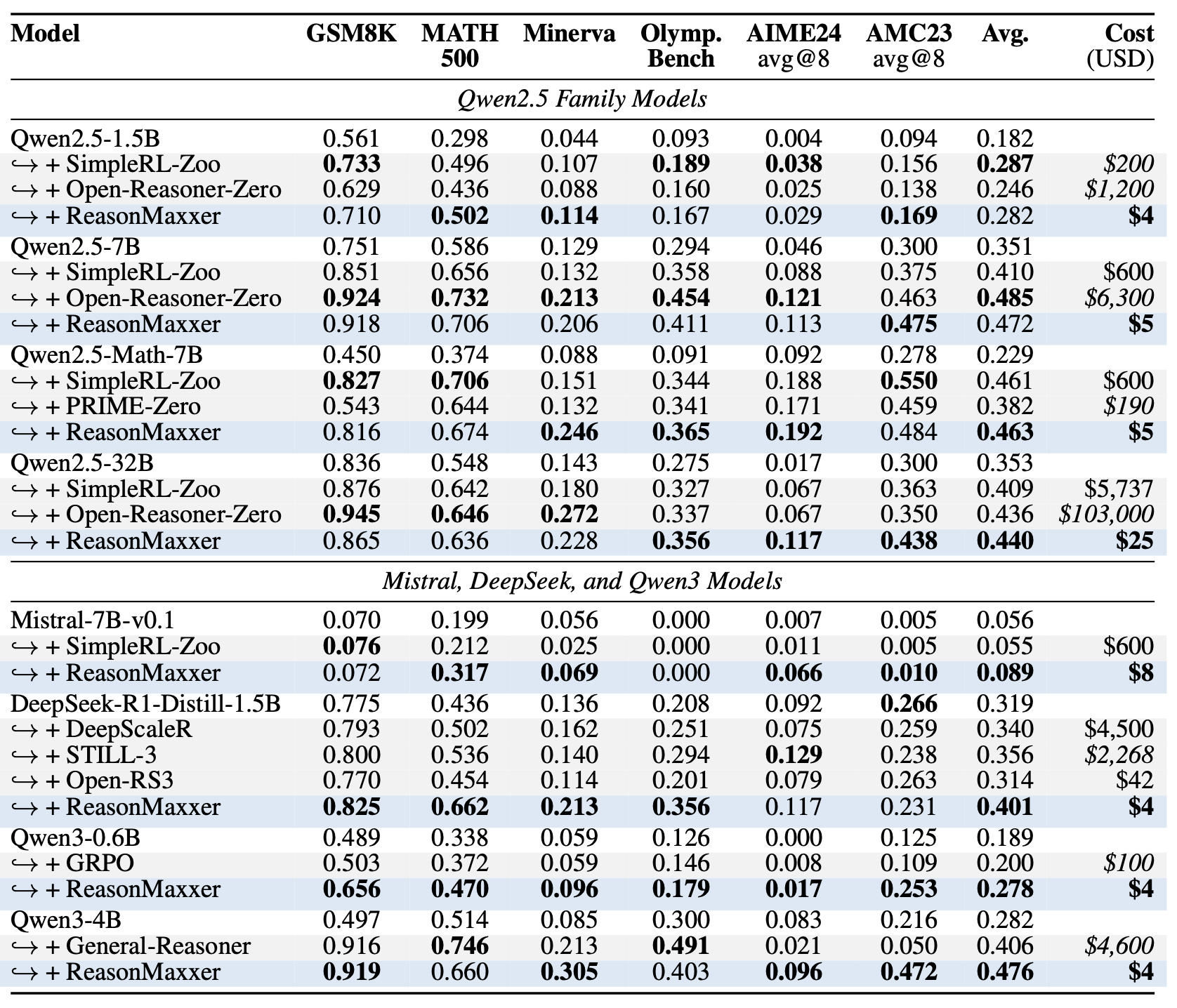
In the paper, we show that the answer is often yes. Across multiple model families, ReasonMaxxer is competitive with or better than public RL baselines while remaining dramatically cheaper to reproduce.
At a high level, ReasonMaxxer:
- uses offline base-model rollouts,
- detects uncertain decision points via token entropy,
- applies contrastive learning only at those sparse positions,
- preserves the rest of the model distribution with a KL anchor,
- and trains a small LoRA adapter rather than full model weights.
Main contributions
- RL-free reasoning post-training. No online RL loop is required.
- Sparse policy learning. Updates are concentrated on entropy-gated decision tokens rather than all generated tokens.
- Cheap reproduction. The method is designed to be lightweight enough for commodity multi-GPU setups.
- Cross-family applicability. The same pipeline can be used across Qwen, Qwen3, DeepSeek-Distill, Mistral, and related causal LMs with model-specific prompting defaults.
What this repository contains
This repository provides the core pipeline used for ReasonMaxxer experiments:
- rollout generation,
- entropy scoring,
- mid-difficulty pool selection,
- ReasonMaxxer LoRA training,
- checkpoint evaluation on held-out and benchmark sets.
The repo is intentionally focused on the ReasonMaxxer pipeline itself. It does not include unrelated research code, RL baselines, or internal experiment management tooling.
Repository structure
ReasonMaxxer/
├── assets/
├── examples/
│   └── qwen25_1p5b/
├── reasonmaxxer/
│   ├── answer_extraction.py
│   ├── answer_verification.py
│   ├── config.py
│   ├── eval_lib.py
│   └── generation.py
├── scripts/
│   ├── eval_checkpoints.py
│   ├── generate_rollouts.py
│   ├── prepare_training_data.py
│   ├── sample_simplerl_records.py
│   ├── score_rollouts.py
│   ├── select_mid_pool.py
│   └── train_reasonmaxxer.py
└── requirements.txt
Installation
conda create -n reasonmaxxer python=3.10 -y
conda activate reasonmaxxer
pip install -r requirements.txt
The example scripts expect the SimpleRL-Zoo training parquet. The first sampling script will download the public simplelr_abel_level3to5 training split automatically when it is missing.
Supported benchmarks and data format
Built-in dataset loading is provided for:
math500vianlile/hendrycks-MATH-benchmarkgsm8kviaopenai/gsm8k
For local benchmarks such as aime24, amc23, minerva_math, and olympiadbench, pass a records file in the following format:
{
  "records": [
    {
      "problem_id": "example-1",
      "problem_text": "...",
      "ground_truth": "...",
      "category": "math"
    }
  ]
}
Prompting defaults
Prompt style is resolved automatically from the model name unless you override it.
- Qwen2.5 base models:
qwen_boxed - Qwen3 reasoning/instruct models:
qwen3_chatorchat_template - DeepSeek-R1-Distill / ORZ / related chat reasoning models:
chat_template - LLaMA / Mistral:
llama_abel - OLMo math checkpoints:
qwen_boxed,olmo3_math, orolmo3_rlzero_math
The common evaluation defaults used in this repo are:
temperature=0.6top_p=0.95seed=42
Example run
The scripts in examples/qwen25_1p5b/ provide a concrete example pipeline for Qwen2.5-1.5B:
- sample candidate training problems,
- generate multi-rollout responses,
- score rollouts with teacher-forced entropy,
- select a mid-difficulty pool and trim long tails,
- train a ReasonMaxxer LoRA adapter,
- select checkpoints on a held-out split,
- evaluate the chosen checkpoint on benchmark suites.
Run the example pipeline step by step:
bash examples/qwen25_1p5b/01_sample_300.sh
bash examples/qwen25_1p5b/02_generate_score_3x100x20.sh
bash examples/qwen25_1p5b/03_select_mid50_trim80.sh
bash examples/qwen25_1p5b/04_train_tau1p4.sh
bash examples/qwen25_1p5b/05_eval_holdout60.sh
bash examples/qwen25_1p5b/06_eval_fullsuite.sh
Optional tau sweep:
bash examples/qwen25_1p5b/04_train_tau_sweep.shThese scripts are intended as reference recipes for using the codebase. They are not meant to encode every exact model-specific setting used in every paper table.
Core scripts
scripts/generate_rollouts.py: generate base-model or LoRA-adapted rolloutsscripts/score_rollouts.py: compute teacher-forced token entropies for generated rolloutsscripts/select_mid_pool.py: merge scored rollouts, select mid-difficulty problems, and optionally trim long tailsscripts/prepare_training_data.py: convert scored rollouts into ReasonMaxxer training examplesscripts/train_reasonmaxxer.py: train the LoRA adapter with sparse contrastive updates and KL anchoringscripts/eval_checkpoints.py: evaluate saved checkpoints on a fixed held-out split and summarize pass@1scripts/download_simplerl_data.py: download the public SimpleRL-Zoo parquet files used by the example pipeline
Citation
@misc{akgül2026rethinkingrlllmreasoning,
      title={Rethinking RL for LLM Reasoning: It's Sparse Policy Selection, Not Capability Learning},
      author={Ömer Faruk Akgül and Rajgopal Kannan and Willie Neiswanger and Viktor Prasanna},
      year={2026},
      eprint={2605.06241},
      archivePrefix={arXiv},
      primaryClass={cs.CL},
      url={https://arxiv.org/abs/2605.06241},
}